Bay Bridge Bicycle Takeover Shut Down: SFPD and CHP Intercept 85 Cyclists in Coordinated Law Enforcement Operation
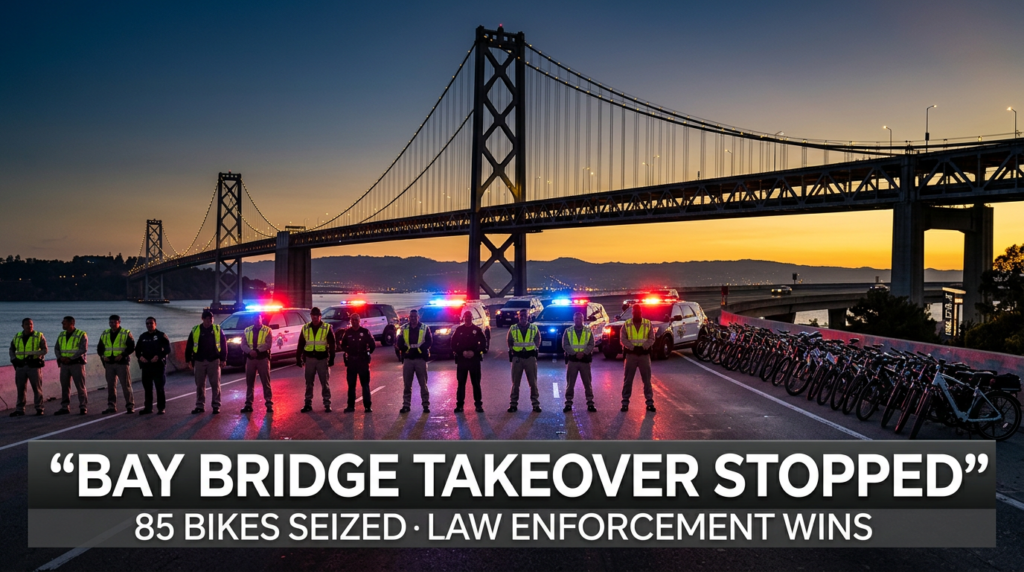
When 85 cyclists rode the wrong way up a freeway ramp to seize control of one of California’s most critical transportation arteries, law enforcement was ready. Here’s why their swift response matters — and what it says about accountability in public spaces.
There was nothing spontaneous about what unfolded on the streets of San Francisco on Saturday, March 28. A large, coordinated group of cyclists tore through city streets — swerving directly at moving cars, weaving dangerously through traffic, and cutting within inches of pedestrians — not on a sanctioned ride, but on a planned mission to take over the San Francisco–Oakland Bay Bridge.
They didn’t make it. And that’s exactly the point.
Support Independent Local Journalism
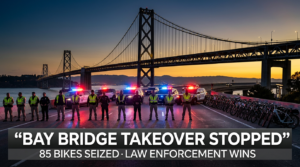
TheTownHall.News is a non-profit reader-supported journalism. Just $5 helps us hire local reporters, investigate important issues, and hold public officials accountable across Alameda County. If you believe our community deserves strong, independent journalism, please consider donating $5 today to support our work.Thanks to a seamlessly coordinated operation between the California Highway Patrol (CHP) and the San Francisco Police Department (SFPD), the group was intercepted before they could turn a critical public artery into a reckless spectacle. Eighty-five cyclists were detained and cited. Eighty-five bikes were seized. And for once, the city held the line.
What Happened on the Bay Bridge
The operation began when CHP officers observed a large gathering of cyclists and witnessed them riding recklessly through San Francisco’s streets — heading, authorities believed, toward the Bay Bridge with a clear intent to take it over.
SFPD’s Real Time Investigations Center immediately swung into action, conducting aerial surveillance on the group and relaying live position updates to officers on the ground. The coordination was precise and professional.
The cyclists eventually attempted their bridge entry by riding the wrong way up the Harrison Street off-ramp — directly against oncoming freeway traffic. What they found waiting for them was a large contingent of CHP and SFPD personnel who blocked their path, detained all participants without incident, issued 85 citations for riding a bicycle on a freeway, and seized every bike on the scene.

No injuries. No property destruction. No chaos. Just law enforcement doing its job — and doing it well.
“Not Harmless Fun” — The Safety Reality Behind the Stunt
Some may be tempted to dismiss the incident as a quirky San Francisco moment — cyclists being cyclists in a progressive city known for its bike culture. CHP San Francisco Area Captain Tim McCollister made clear that framing is dangerously wrong.
“What we saw was not harmless fun,” McCollister said in a statement following the operation. “Riding the wrong way on the freeway poses a serious danger not only to cyclists but also to the motoring public traveling at freeway speeds. Our priority is safety, and actions like this put lives at risk and disrupt critical transportation corridors.”
He’s right. The Bay Bridge carries tens of thousands of vehicles daily. A takeover — even a brief one — doesn’t just inconvenience commuters. It creates conditions for catastrophic, potentially fatal collisions. Cyclists riding against freeway-speed traffic are not protesters exercising a right. They are participants in a dangerous stunt that puts innocent people at serious risk.
The law is clear on this point: riding a bicycle on a California freeway is a citable offense, and for good reason.
Support Independent Local Journalism
TheTownHall.News is a non-profit reader-supported journalism. Just $5 helps us hire local reporters, investigate important issues, and hold public officials accountable across Alameda County. If you believe our community deserves strong, independent journalism, please consider donating $5 today to support our work.Intelligence-Led Policing: A Model That Works
What sets this incident apart from the chaotic “takeover” scenes that have plagued other American cities is not just the outcome — it’s how law enforcement got there.
This was not a reactive scramble. It was a proactive, intelligence-driven intercept. SFPD’s Real Time Investigations Center tracked the group from the air, feeding live data to officers who were already in position before the cyclists reached their target. By the time the group rode up the Harrison Street off-ramp the wrong way, they were outnumbered and outmaneuvered.
This is what smart, well-resourced policing looks like — and it saved lives.
The operation stands as a compelling argument against the anti-police narratives that have dominated Bay Area civic conversation for years. Defunding, demoralizing, and handcuffing law enforcement doesn’t make cities safer. Equipping officers with real-time intelligence tools and the authority to act decisively does.
Why This Trend Is Spreading — and Why It Must Be Stopped
Bridge and highway takeovers are not isolated incidents. Across the country — from Los Angeles freeways to Southern California intersections — organized “takeover” stunts have grown in frequency, scale, and boldness. They follow a predictable pattern: a group organizes covertly, descends on a public roadway, and counts on law enforcement being too slow, too understaffed, or too politically constrained to respond effectively.
In many cities, that calculation has paid off. Takeover participants have repeatedly escaped with minimal or no consequences, emboldening future attempts.
San Francisco’s response on March 28 sent a different message: show up to take over a public roadway, and you will be met with officers who are already waiting. Your bike will be impounded. You will be cited. And the stunt will fail.
That kind of accountability is not punitive for its own sake. It is essential to maintaining the social contract that makes a functional city possible. Public infrastructure exists for everyone — the commuter crossing the Bay Bridge for work, the family in the car, the emergency vehicle that needs a clear route. When organized groups seize public spaces for private spectacles, they don’t just break the law. They break trust.
What Critics Get Wrong
Defenders of these events often frame them as harmless counter-cultural expression — a form of protest against car-centric infrastructure or a reclamation of public space for cyclists. This argument deserves a serious response, not dismissal.
San Francisco is, in fact, one of the most bicycle-friendly cities in America. It has invested significantly in dedicated bike lanes, shared paths, and cycling infrastructure. Cyclists have legitimate venues for advocacy — city hall, public comment periods, ballot initiatives, organized lobbying. California law protects peaceful protest. None of that protection, however, extends to riding the wrong way on a freeway at speed.
The issue is not bikes versus cars. The issue is whether any group — regardless of cause or ideology — has the right to seize control of shared public infrastructure and endanger others in the process. The answer, legally and morally, is no.
Civic freedoms depend on civic responsibility. One does not exist without the other.
The Takeaway: Accountability Still Wins
Saturday’s operation on the Bay Bridge was a small but meaningful victory for law and order, civic responsibility, and the idea that public spaces belong to everyone — not just to those willing to break the rules to claim them.
SFPD and CHP deserve credit not just for the outcome, but for the approach: disciplined, coordinated, and proportionate. No one was harmed. No excessive force was used. Eighty-five people were cited and released. Eighty-five bikes were impounded. And a dangerous stunt that could have paralyzed traffic or caused fatal accidents was stopped before it started.
When law enforcement is properly equipped, properly coordinated, and given the authority to act, it works. March 28 proved it.
The question for San Francisco — and for California — is whether this level of preparedness becomes the standard, or whether it remains the exception.
Stay Informed. Stay Engaged.
Stories like this one rarely get the sustained attention they deserve. If you believe in accountable government, public safety, and honest local journalism, share this article with your community. Subscribe to The Town Hall News for independent coverage that doesn’t flinch from the facts. And if you value civic accountability, show up — at the ballot box, at city council meetings, and in the conversations that shape your community.
Democracy doesn’t run itself. Neither does public safety.