California $10 Gallon Gas: What the Viral Big Sur Pump Reveals About a State in Crisis
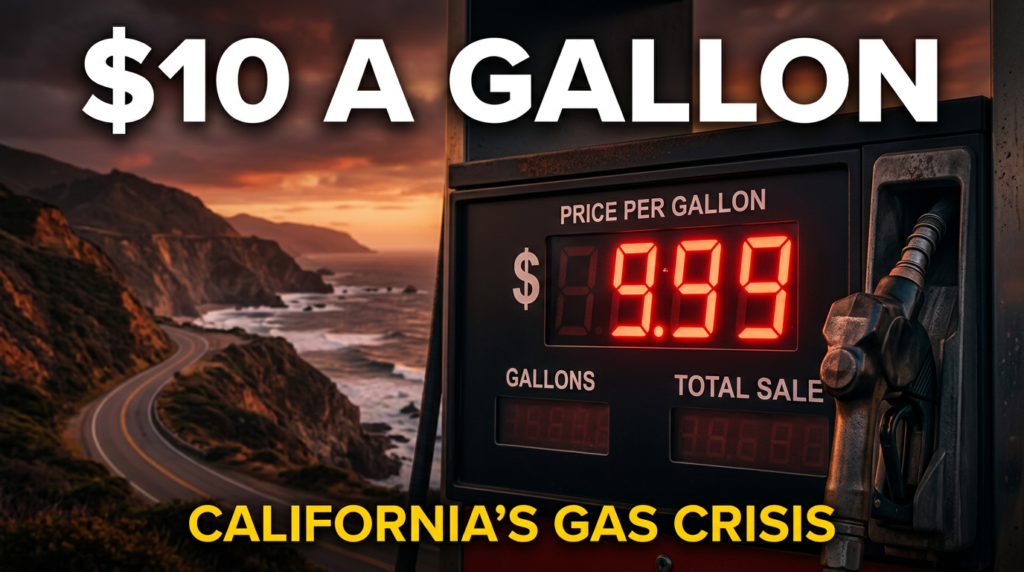
A remote Big Sur gas station charging $9.99 a gallon has gone viral — but the real scandal isn’t one isolated pump. It’s the decades of policy decisions that made $10 gas not just possible, but inevitable.
Pull up to the pump at Gorda by the Sea on California’s Highway 1 and you’ll see a number that looks like a typo: $9.99 per gallon. It’s not a typo. It’s not a glitch. The pump simply can’t display a price higher than that — so that’s where the owner, Leo Flores, stops.
For millions of Californians, the image of that pump has gone viral this week not because it’s shocking, but because it’s familiar. Gas already tops $5.89 statewide on average. In Los Angeles County, drivers are routinely paying $6 or more. The Gorda station isn’t an outlier — it’s a preview.
Support Independent Local Journalism
TheTownHall.News is a non-profit reader-supported journalism. Just $5 helps us hire local reporters, investigate important issues, and hold public officials accountable across Alameda County. If you believe our community deserves strong, independent journalism, please consider donating $5 today to support our work.Why a Remote Big Sur Gas Station Is Telling a Much Bigger Story
Leo Flores has a legitimate explanation for his prices. His station operates without grid electricity — it runs on generators. Fuel is trucked in over miles of rugged, winding coastline. Every logistical layer adds cost, and he’s transparent about it. He isn’t gouging anyone. He’s running a business in one of the most logistically punishing environments in the United States, and he’s keeping a critical lifeline open for travelers on a stretch of Highway 1 with almost no alternatives.
“They probably could charge $20,” one driver told ABC 7. “If you have to get gas, you have to get gas.”
That driver’s resignation captures something important: Californians have stopped being surprised by pain at the pump. They’ve been conditioned to accept it. And that acceptance — that slow normalization of the extraordinary — is exactly what Sacramento is counting on.
The Real Price Tag: What Government Policy Costs Every Driver
California doesn’t have the highest gas prices in America by accident. It has them by design — the cumulative result of taxes, mandates, and regulations that have been piling up for decades, each one justified by its own bureaucratic logic, each one adding another cent or dime to the gallon.

Start with the gas tax. As of July 1, 2025, California’s gasoline excise tax rose to 61.2 cents per gallon — one of the highest in the nation, and a figure that has climbed 20 cents since lawmakers hiked it in 2017. That tax alone generates nearly $8 billion a year. Drivers pay it every single time they fill up, whether they’re commuting to work or hauling their kids to school.
Then add the state’s aggressive climate regulations. California’s Low Carbon Fuel Standard, cap-and-trade program, and refinery emissions rules collectively add an estimated 50 cents per gallon, according to the U.S. Energy Information Administration. These are real costs passed directly to consumers at the pump, justified in Sacramento as the price of environmental progress.
Finally, there’s what California’s own petroleum market watchdog has documented as an unexplained “mystery surcharge” — an additional markup averaging approximately 41 cents per gallon between 2015 and 2024, costing drivers an estimated $59 billion over that period. Even state analysts can’t fully account for it.
Add it all up, and California drivers are paying well over $1.50 more per gallon than the national average — before a single global supply disruption enters the picture.
When Policy Meets Reality: Refinery Closures and the Iran Factor
The current price spike has been amplified by geopolitical instability tied to the U.S. conflict with Iran, which has rattled global oil markets. But experts are careful to point out that the crisis is landing harder in California precisely because the state’s starting point is so much higher than the rest of the nation.
Support Independent Local Journalism
TheTownHall.News is a non-profit reader-supported journalism. Just $5 helps us hire local reporters, investigate important issues, and hold public officials accountable across Alameda County. If you believe our community deserves strong, independent journalism, please consider donating $5 today to support our work.“The current increase is almost entirely due to global oil markets,” said Paasha Mahdavi, a UC Santa Barbara energy policy professor. “The problem, though, is that our starting point is so much higher than nationally.”
That higher starting point is, in large part, a consequence of California’s own regulatory decisions. State climate policies have contributed to refinery closures across California, shrinking domestic production capacity and making the state increasingly dependent on fuel imports. When global supply chains tighten, California feels it first and hardest.
Chevron — one of the few major refiners still operating in California — has warned that continued tightening of state regulations could force the company to reconsider its California operations entirely. The California Air Resources Board (CARB) is currently weighing updates to cap-and-trade rules that critics, including some Democratic lawmakers, warn could accelerate further refinery closures.
When government regulation eliminates domestic production, it doesn’t eliminate the need for fuel — it just makes drivers pay more to import it.
What Critics Get Wrong About “Price Gouging”
California’s Division of Petroleum Market Oversight (DPMO) launched a formal enforcement probe in March 2026, characterizing recent retail price spikes as “disproportionate.” Politicians across the spectrum have reached for the word “gouging” — it’s an easy villain and a reliable headline.
But price gouging, as a concept, requires a predatory actor charging prices that bear no relationship to market conditions. That doesn’t describe Leo Flores in Big Sur. It doesn’t fully describe the broader California market either, where prices are high for documented, structural reasons.
Blaming gas stations for charging what the market will bear is a convenient way to avoid the harder conversation — the one about who built this market in the first place. Gas stations operate on thin margins. The heavy cost layers — taxes, compliance costs, import premiums — are set in Sacramento, not at the pump.
Calling it gouging lets politicians escape accountability for the predictable consequences of their own policy choices.
The Political Reckoning at the Pump
The viral $10 gas station has landed in the middle of a heated California governor’s race, and it’s forcing candidates to get specific. Former Los Angeles Mayor Antonio Villaraigosa has called for a moratorium on several greenhouse-gas regulations he blames for refinery closures and higher prices. San Jose Mayor Matt Mahan has proposed temporarily suspending the state’s 61-cent gas tax. Republican candidates have gone further — Steve Hilton has pledged to cut the gas tax in half and eliminate emissions mandates, while Chad Bianco supports eliminating the gas tax entirely.
Notably, the top-polling Democratic candidates — including Tom Steyer and Eric Swalwell — have largely dismissed these proposals as unserious, with Steyer’s camp preferring to focus on oil company “excess profits.”
That response tells voters something important about priorities. When fuel costs are crushing working-class families — people who can’t work from home, who drive long commutes, who have no EV option — pointing the finger at oil company profits while defending the very policies that shrink domestic supply is not a solution. It’s a deflection.
Fiscal accountability means acknowledging that $8 billion in annual gas tax revenue has to come from somewhere — and it comes from ordinary Californians filling up on their way to work.
How This Hits Families and Working Californians Hardest
The $10 gas story is easy to dismiss as an extreme edge case — a remote outpost on a dramatic stretch of coastline, picturesque and exceptional. But the families feeling this aren’t at Gorda by the Sea. They’re in Bakersfield, Fresno, Riverside, and East Los Angeles, paying $5.89 on average every time they fill up to get to jobs that don’t offer remote work flexibility.
For a family with two working parents commuting daily, California’s gas premium — conservatively $1.50 above the national average — can add up to $1,500 or more per year in excess fuel costs alone. That’s money not going to groceries, school supplies, or savings. It’s a regressive tax, one that hits lower-income households proportionally harder than wealthy ones who have already made the switch to electric vehicles.
The people least able to absorb these costs are the ones being asked to carry the most weight.
The Bottom Line: California Built This, and Californians Are Paying for It
Leo Flores didn’t create California’s energy crisis. He’s just the most visible symptom of it. A state that has spent years regulating and taxing its way out of domestic fuel production, while failing to build the infrastructure that would make alternatives viable at scale, has arrived at exactly the destination that critics predicted: gas at $6, $7, $8, $9 — and a pump in Big Sur that simply can’t go higher.
The fix isn’t a price gouging investigation. It’s a reckoning with the real drivers of cost: a 61-cent gas tax that keeps climbing, climate mandates that have closed refineries, and an energy policy built for a future California hasn’t arrived at yet, funded by the working Californians living in the present.
When policy ignores the cost it imposes on real people, the pump doesn’t lie.
Key Takeaway
California’s $10-a-gallon gas station is a symbol, not an anomaly. Behind it lies a system of taxes, mandates, and regulatory decisions that have made California the most expensive place to buy gas in America. Until state leaders hold themselves accountable for that system, no investigation will lower the price — and drivers will keep paying whatever the pump demands.
Stay informed. Share this story. Independent journalism depends on readers who care enough to pass the truth along. If you believe Californians deserve honest answers about what’s driving the cost of living, share this article and make your voice heard at the ballot box.