California Gun Control Law Struck Down: NRA Wins $481K in Fees as State Pays the Price for Trampling the Constitution
When Government Overreaches, Someone Has to Fight Back
There is a principle as old as the Republic itself: government power, left unchecked, tends to grow. It creeps into living rooms, commerce, speech, and eventually into the very freedoms that define what it means to be an American. California has, for years, served as the most vivid laboratory for that creep — passing law after law that tests the outer limits of what citizens will tolerate from their government.
On March 23, 2026, that experiment hit a wall.
A federal court ruled that California’s firearm advertising restriction — a law signed in 2022 that banned the gun industry from marketing products in ways deemed “attractive to minors” — was unconstitutional. Not merely flawed. Not in need of revision. Unconstitutional in its entirety. And in a fitting turn of accountability, the state of California was ordered to pay the National Rifle Association $481,749.72 in attorney fees. That is nearly half a million dollars of taxpayer money — the consequence of Sacramento betting on a law it had no legal right to enforce.
Support Independent Local Journalism
TheTownHall.News is a non-profit reader-supported journalism. Just $5 helps us hire local reporters, investigate important issues, and hold public officials accountable across Alameda County. If you believe our community deserves strong, independent journalism, please consider donating $5 today to support our work.This is not just a legal footnote. It is a teachable moment about the cost of government overreach, the resilience of constitutional rights, and what happens when citizens refuse to back down.
What the Law Actually Said — and Why It Was Always Unconstitutional
California’s AB 2571, enacted in June 2022, prohibited firearm industry members from advertising or marketing gun-related products in any manner that could be considered “attractive to minors.” That sounds reasonable on the surface — few people, conservative or otherwise, want irresponsible marketing targeting children. But the devil, as always, was in the details.
The law’s language was sweeping and vague. It targeted the use of bright colors, cartoon-style imagery, and product placement in media with youth audiences. Violators faced fines of $25,000 per infraction. The practical effect was not child protection — it was the government dictating what a legal industry could and could not say about legal products to the general public.
That is a First Amendment problem. Full stop.

The U.S. Court of Appeals for the Ninth Circuit — hardly a court known for its conservative leanings — agreed. The court found that California’s law violated the constitutional right to free speech. Following that decision, the state attempted to argue that at least some portion of the law could be salvaged. Those arguments failed. California eventually conceded the law was unconstitutional in its entirety, a remarkable admission from a government that spent years and hundreds of thousands of dollars defending it.
The case, Safari Club International v. Bonta, was brought by the NRA alongside Safari Club International, Sportsmen’s Alliance Foundation, and the Congressional Sportsmen’s Foundation. Together, they did what citizens in a free society are supposed to do when government oversteps: they fought back through the courts, and they won.
Free Speech Doesn’t Have a Carve-Out for Industries You Dislike
One of the most important dimensions of this ruling is what it reaffirms about the First Amendment: free speech protections do not disappear simply because a product or industry is politically unpopular.
California’s approach to the firearms industry has long operated on an unspoken premise — that gun manufacturers and retailers deserve fewer rights than other businesses. That their advertising can be restricted, their operations burdened, and their customers stigmatized, all in the name of “public safety.” This ruling is a direct rebuke of that premise.
The court did not ask whether it agreed with the NRA’s politics. It asked whether the law was constitutional. It was not. And that should matter to every American — gun owner or not — who values the principle that government cannot pick and choose which legal businesses get to speak freely.
Support Independent Local Journalism
TheTownHall.News is a non-profit reader-supported journalism. Just $5 helps us hire local reporters, investigate important issues, and hold public officials accountable across Alameda County. If you believe our community deserves strong, independent journalism, please consider donating $5 today to support our work.Parents have every right to guide what their children consume and to make choices about their family’s relationship with firearms. That is parental responsibility. But it is not the government’s role to substitute its judgment for the judgment of parents by suppressing legal commercial speech. The solution to parenting concerns is not a government gag order on an entire industry.
Fiscal Accountability: Who Pays When Sacramento Gets It Wrong?
Here is the part of the story that deserves far more attention than it is likely to receive: California taxpayers are now on the hook for $481,749.72.
Let that number sink in. Sacramento’s legislators passed this law. The state’s attorneys defended it — all the way through the appeals process — even after the Ninth Circuit made the constitutional problems crystal clear. And at every stage, it was California’s citizens who were financing the state’s legal losing streak.
This is the hidden cost of performative legislation. When politicians craft laws designed more to signal their values than to survive judicial scrutiny, they are not spending their own money. They are spending yours. The NRA’s legal fees, now owed by the state, represent real dollars drawn from the public treasury — dollars that could have funded schools, roads, or public safety services.
Conservatives have long argued for fiscal accountability in government. That principle extends beyond tax rates and budget line items. It includes demanding that elected officials act responsibly when they draft legislation — and face real consequences when they don’t. Nearly half a million dollars is a tangible consequence. It should prompt voters to ask hard questions about who approved this law and why it was defended for so long after the legal writing was on the wall.
A Pattern, Not an Anomaly
This ruling does not exist in isolation. It is part of a broader pattern in which California’s aggressive gun control agenda has repeatedly collided with constitutional reality.
In recent years, federal courts have struck down the state’s ban on “assault weapons,” its restrictions on magazine capacity, its unique approach to background checks for ammunition purchases, and now its firearm advertising law. Each ruling represents the judiciary doing its job — serving as a check on legislative excess, regardless of how politically popular that excess may be in Sacramento.
The consistency of these defeats raises a serious question: at what point does persistent, unconstitutional lawmaking become something that voters demand accountability for? California’s leadership has demonstrated a willingness to spend liberally — both in policy ambition and in taxpayer funds — to advance a gun control agenda that the Constitution simply does not permit. Citizens deserve elected officials who respect the rule of law, not legislators who treat the Constitution as an obstacle to be repeatedly tested.
What This Means for the Rest of the Country
California’s laws don’t stay in California. The state has long styled itself as a policy trendsetter, and its model legislation frequently migrates to other left-leaning state legislatures. AB 2571’s firearm advertising restrictions were already being watched by advocates and lawmakers in other states. This ruling puts a firm legal stake in the ground.
Any state legislature considering similar advertising bans now has a direct legal precedent telling them how that story ends: with a permanent injunction, a concession of unconstitutionality, and a check written to the organization that beat them in court. That is a powerful deterrent.
More broadly, this case reinforces that the constitutional order still functions. That courts — including courts not ideologically aligned with conservative legal principles — will still apply the First Amendment and Second Amendment as written. That rights do not evaporate when they become politically inconvenient.
The Constitution Is Not Negotiable
The NRA’s victory in Safari Club International v. Bonta is more than a legal win for one organization. It is a reaffirmation of foundational American principles: that free speech protects lawful commerce, that the right to keep and bear arms is not subject to legislative erosion by hostile state governments, that parents — not bureaucrats — guide their families’ values, and that when government overreaches, it must be held accountable — including financially.
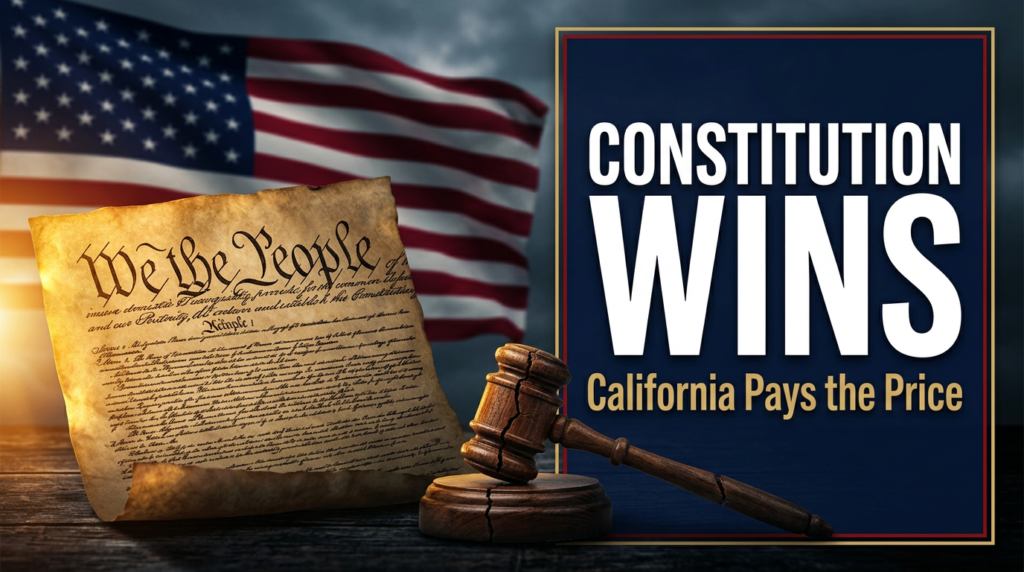
California chose to fight the Constitution. The Constitution won. And the bill has come due.
Stay Informed. Stay Engaged. Stay Free.
The battles over your constitutional rights are fought every day — in courtrooms, in state legislatures, and in the voting booth. Share this article to make sure your community understands what’s at stake. Follow the NRA-ILA for updates on active legal challenges across the country. And when election season arrives, ask every candidate where they stand on your First and Second Amendment rights — and whether they believe the government should be held accountable when it violates them.
Freedom is not self-defending. That’s our job.
Sources: NRA-ILA (March 23, 2026); U.S. District Court for the Eastern District of California, Safari Club International v. Bonta; U.S. Court of Appeals for the Ninth Circuit.