California Is Burning Again: The Irwin Fire, Sacramento’s New Spending Spree, and the Governance Failures That Keep the State on Fire
Another Fire. Same Failed Playbook.
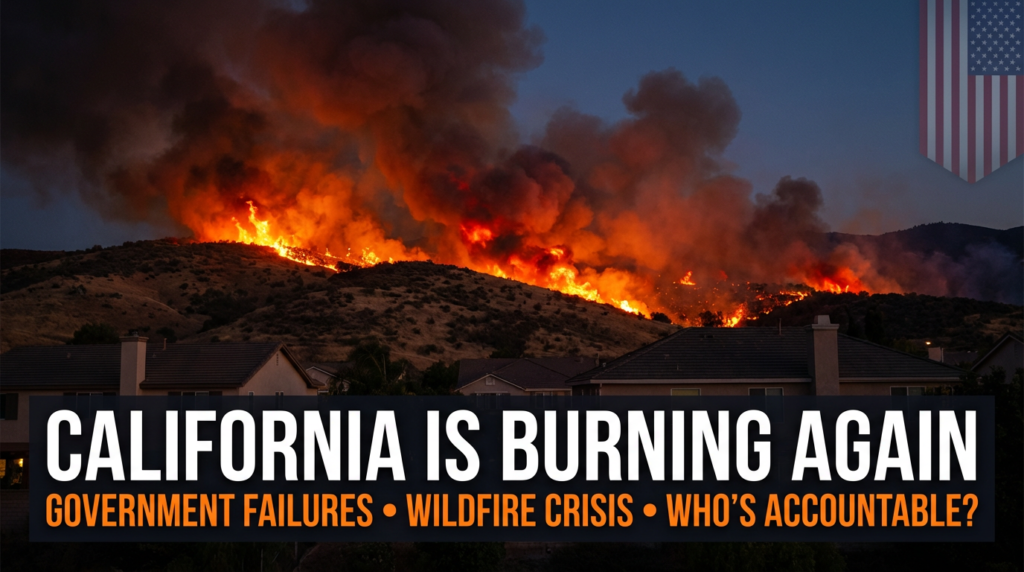
At 9:38 a.m. on Thursday, March 5, 2026, a new wildfire ignited in Los Angeles County. The Irwin Fire, burning on private land, has no containment status and no determined cause. Firefighters are on scene. Residents are watching the sky.
It is a scene that has become grimly routine in California — and it should not be.
The Irwin Fire broke out less than 14 months after the catastrophic Palisades and Eaton fires of January 2025 killed 31 people, destroyed thousands of homes and businesses, displaced tens of thousands of families, and inflicted an estimated $250 billion in economic damage on the state — one of the most destructive wildfire events in American history. And yet, here we are again. Another fire. Another press release. Another round of Sacramento lawmakers stepping to podiums with fresh legislation in hand.
The question Californians have every right to ask — and demand an answer to — is this: When does the cycle end?
The answer, if we are honest about it, requires confronting not just the fires themselves, but the government failures that have made California a tinderbox for decades.
Sacramento’s Response: More Government, More Spending
In the wake of last year’s devastation, California lawmakers have introduced what they are calling the most comprehensive wildfire prevention package in state history. The centerpiece is Senate Bill 894, authored by Senator Benjamin Allen (D-Santa Monica), which proposes establishing a California Wildfire Resilience Program to increase access to home hardening modifications — using fire-resistant materials to make homes less vulnerable to embers and flames.
Additional bills in the package include:
- SB 1079 (Sen. Henry Stern) — creating a Fire Innovation Unit within CAL FIRE for wildfire technology research
- AB 1934 (Assemblymember Steve Bennett) — requiring a home hardening certification program
- AB 1699 (Assemblymember Chris Rogers) — indefinitely extending the Prescribed Fire Liability Program
- AB 1891 (Assemblymember Damon Connolly) — establishing a Beneficial Fire Capacity Program for community-led controlled burns
On the surface, some of these proposals — particularly the controlled burn expansion and home hardening programs — reflect genuine, evidence-based thinking. Prescribed burns, when properly executed, reduce the dangerous fuel loads that turn ordinary fires into catastrophic infernos. Home hardening has been shown to save structures in fire-prone zones. These are not bad ideas.
But here is the problem: California has known about these solutions for decades. The state has passed legislation, created programs, issued mandates, and allocated billions of dollars — and yet the fires keep coming, bigger and more destructive than ever. Before Californians accept another massive government program at face value, they deserve a full accounting of why the last round of programs failed.
The Real Cause of California’s Wildfire Crisis: Government, Not Nature
Let’s be direct: California’s wildfire catastrophe is not simply an act of God. It is, in significant part, an act of government.
Decades of failed forest management. Researchers at the Property and Environment Research Center (PERC) have documented how California’s hands-off approach to forest management has allowed dangerous fuel loads — dead wood, overgrown brush, dry chaparral — to accumulate across millions of acres. In prehistoric California, an estimated 4.4 to 11.8 million acres burned naturally each year, cycling through vegetation and maintaining ecological balance. By the late 1990s and 2000s, California’s land managers were conducting controlled burns on just 13,000 acres per year. Scientists estimate the state would need to burn approximately 20 million acres to restabilize its fire ecology. We are not even close.
Regulatory paralysis. Proactive measures like forest thinning and prescribed burns can dramatically reduce wildfire risk — but in California, they are routinely buried under years of environmental reviews and legal challenges. The National Environmental Policy Act (NEPA) and California’s own Environmental Quality Act (CEQA) create layers of red tape that stall critical restoration projects for years, sometimes indefinitely, while communities burn. This is not a climate story. This is a governance story.
Water infrastructure left to rot. During the January 2025 fires, firefighters encountered dry hydrants across Pacific Palisades and Altadena. Three tanks, each holding a million gallons of water, ran dry within 12 hours. Firefighters had to drive to neighboring cities to fill their trucks. In Altadena, residents tried desperately to fight flames with pool water and garden hoses. Meanwhile, California has not built a significant new reservoir in over 40 years. In 2014, voters approved Proposition 1, a $2.7 billion water bond — and more than a decade later, most of those projects are still tied up in planning processes, with some not expected to be operational until 2033 or beyond.
Budget cuts to the fire department. Just weeks before the January 2025 disaster, Los Angeles Fire Department Chief Kristin Crowley warned in a memo that the department was facing “unprecedented operational challenges” due to budget cuts — including a $7 million reduction in overtime hours that hampered training, disaster preparation, and large-scale emergency response. The memo was forwarded to Mayor Karen Bass and the City Council on December 17, 2024. Weeks later, the city was on fire.
The pattern is clear: California’s political leadership has consistently prioritized ideology and bureaucracy over practical, results-oriented fire prevention. The cost has been measured in lives, homes, and hundreds of billions of taxpayer dollars.
Fiscal Accountability: Who Is Paying for This?
Every Californian — and every American — should understand the financial scale of what is happening here.
The January 2025 Palisades and Eaton fires alone generated an estimated $250 billion in economic losses. The federal government committed to covering 100% of initial disaster response costs, and California sought an additional $36 billion in federal disaster relief. Governor Newsom proposed a $2.5 billion state spending package on wildfire response and recovery. FEMA has allocated approximately $2.7 billion in direct aid to fire survivors — and many victims say it still hasn’t been enough.
Now, as the ink is barely dry on those recovery bills, Sacramento is proposing another sweeping legislative package. And the Irwin Fire has started burning.
Fiscal conservatism demands that we ask hard questions before writing more blank checks. How much of the previous wildfire funding was spent efficiently? Where did the $2.7 billion from Proposition 1’s water bond go? Why is California spending billions on wildfire recovery when decades of proactive prevention — controlled burns, reservoir construction, forest thinning — could have reduced the damage at a fraction of the cost?
The most fiscally responsible approach to wildfire is not a bigger government recovery apparatus. It is smaller, smarter, faster preventive action — cutting red tape, enabling private landowners to manage their property responsibly, expanding prescribed burn programs, and actually building the water infrastructure California’s voters have already paid for.
Real Reform, Not More Bureaucracy
The conservative case for wildfire reform is not anti-environment. It is pro-results.
Private property rights matter. Homeowners in fire-prone zones who want to clear brush, thin trees, and harden their properties should not face regulatory obstacles from the state. Personal responsibility starts with letting people protect what is theirs.
Streamline environmental reviews. When a prescribed burn or forest thinning project takes five years to clear regulatory hurdles, it is not a success of environmental law — it is a failure of governance. Common-sense reform should expedite restoration projects that have broad scientific support.
Build the water infrastructure. California’s voters already said yes to new reservoirs in 2014. Twelve years later, the state has little to show for it. This is fiscal negligence. Those projects should be on a fast track.
Hold leaders accountable. The fire department’s budget was cut. The hydrants ran dry. The mayor was abroad. These are not abstractions — they are failures of leadership with life-and-death consequences. Accountability is not partisan. It is fundamental.
Some elements of Senate Bill 894 — particularly the home hardening loan program — are promising and deserve support. But Californians should approach Sacramento’s sweeping legislative packages with clear eyes and a demand for measurable outcomes, not just good intentions.
Conclusion: California Deserves Better
The Irwin Fire is burning today. We do not yet know its cause or its ultimate scope. We do not know whether it will be contained quickly or whether it will grow into another chapter in California’s long, painful wildfire history.
What we do know is this: the conditions that make California vulnerable — overgrown forests, inadequate water storage, strained fire departments, regulatory paralysis — have not been solved by the legislation already on the books. They will not be solved by new programs alone. They will only be solved by honest governance, clear accountability, and a willingness to prioritize results over politics.
California’s families deserve to live without fear that the next fire is already smoldering on the hillside. They deserve leaders who protect them proactively, spend their tax dollars wisely, and are held responsible when they fall short.
The status quo is not acceptable. It is time to demand better.