California New Laws 2026: Sacramento’s 900+ Regulations Expand Government Overreach Into Your Daily Life
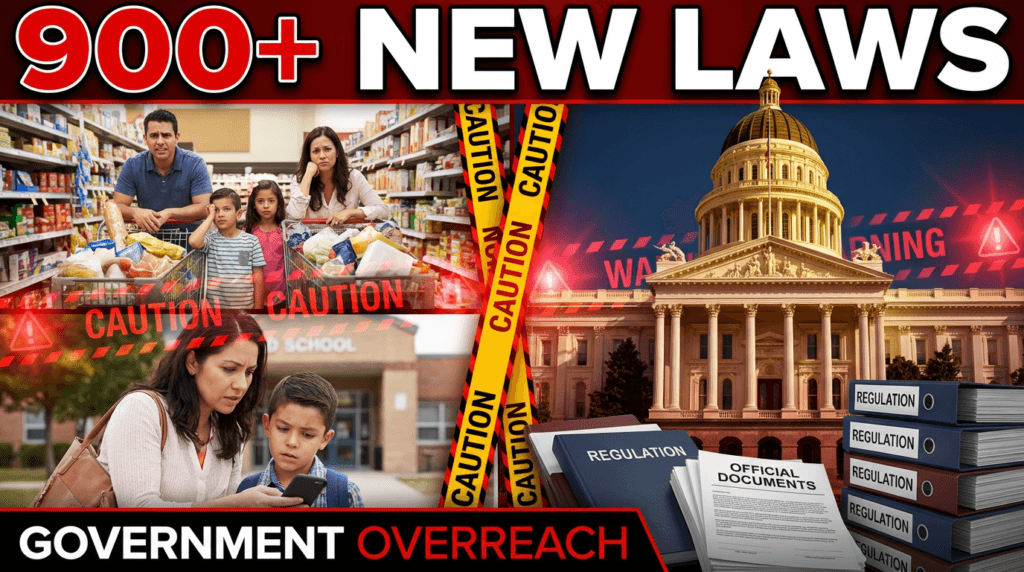
As the calendar turns to 2026, Californians will wake up to more than 900 new laws dictating everything from what bags they can use at the grocery store to whether their children can access cell phones during emergencies at school. Governor Gavin Newsom’s legislative blitz represents a masterclass in government overreach—lawmakers in Sacramento have once again decided they know better than parents, business owners, and individual citizens how to run their lives.
Among the most invasive new regulations: a complete ban on plastic shopping bags (SB 1053) and mandatory restrictions on student cell phone use in all K-12 public schools (AB 3216). These laws, sold as environmental protection and student welfare measures, actually represent something far more concerning—the steady erosion of personal choice, parental authority, and local control that conservatives have long warned about.
The message from California’s progressive supermajority is clear: trust the government, not yourself.
Support Independent Local Journalism
TheTownHall.News is a non-profit reader-supported journalism. Just $5 helps us hire local reporters, investigate important issues, and hold public officials accountable across Alameda County. If you believe our community deserves strong, independent journalism, please consider donating $5 today to support our work.The Plastic Bag Ban: Environmental Theater at Your Expense
Starting January 1, 2026, California retailers can no longer provide any plastic shopping bags—not even the thicker “reusable” ones that were supposed to be the solution when the state first banned single-use bags in 2014. Under SB 1053, stores may only offer recycled paper bags, charging a minimum of 10 cents per bag.
Proponents claim this represents environmental progress. The reality? It’s expensive virtue signaling that punishes working families while doing little to address actual environmental challenges.
The Cost to Consumers
Every trip to the grocery store now comes with a hidden tax. Forget your reusable bags at home? That’ll be an extra dollar or two at checkout—money that goes directly to retailers, not environmental programs. For families making multiple shopping trips weekly, these costs add up quickly.
Cal Recycle mandates that stores keep the bag revenue to cover “the cost of providing the bags, compliance with the bag ban, and educational materials.” Translation: retailers profit from a government mandate while consumers pay more for the privilege of carrying groceries home.
This regressive policy hits low-income families hardest. Affluent Californians can easily afford reusable bags and the occasional paper bag fee. Working families juggling multiple jobs and tight budgets face yet another cost increase in a state already notorious for its high cost of living.
The Environmental Hypocrisy
Here’s what Sacramento doesn’t want you to know: paper bags have their own environmental costs. They require significantly more energy to produce than plastic bags, generate more air and water pollution during manufacturing, and take up considerably more space in landfills. A comprehensive 2011 UK study found that paper bags must be reused at least three times to match the environmental profile of plastic bags—yet most paper bags tear after a single use.
Meanwhile, reusable bags—which consumers must now purchase separately—come with their own problems. Studies have found bacteria, including E. coli and salmonella, in reusable grocery bags that aren’t regularly washed. How many families actually launder their grocery bags weekly? The public health implications receive far less attention than the feel-good environmental messaging.
Support Independent Local Journalism
TheTownHall.News is a non-profit reader-supported journalism. Just $5 helps us hire local reporters, investigate important issues, and hold public officials accountable across Alameda County. If you believe our community deserves strong, independent journalism, please consider donating $5 today to support our work.The Real Solution: Personal Responsibility
Conservatives understand that environmental stewardship doesn’t require government mandates. Education, voluntary programs, and personal responsibility work better than top-down regulations that increase costs and reduce choice.
If plastic bag litter is the concern, enforce existing littering laws. If retailers want to encourage reusable bags, let them offer incentives voluntarily. But allowing Sacramento bureaucrats to dictate what type of bag you can use at checkout? That’s government overreach masquerading as environmental policy.
School Cell Phone Restrictions: Undermining Parental Authority
AB 3216 requires all California public K-12 schools to implement policies limiting or prohibiting student cell phone use by July 1, 2026. While the law gives school districts some flexibility in crafting specific policies, the mandate itself represents a troubling erosion of parental rights and local control.
The Parental Rights Problem
Many parents provide cell phones to their children for legitimate safety reasons: coordinating pickups, monitoring their whereabouts, and maintaining emergency contact during the school day. In an era of school threats, natural disasters, and family emergencies, parents reasonably want the ability to reach their children immediately.
AB 3216 overrides these parental decisions with a one-size-fits-all Sacramento mandate. Instead of trusting parents to determine what’s appropriate for their own children, state lawmakers have decided they know better.
Consider the parent working multiple jobs who needs to text their child about after-school arrangements. Or the family dealing with a medical emergency who needs to reach their student immediately. Under many of the policies being implemented, these communications become more difficult or impossible during school hours.
Local Control Matters
School governance should happen at the local level, where parents, teachers, and administrators who actually know the students and community can make informed decisions. A suburban school in Orange County faces different challenges than an urban school in Los Angeles or a rural school in the Central Valley.
AB 3216 eliminates this local flexibility by imposing a statewide mandate. While districts technically have some latitude in implementation, the state requirement removes their ability to decide whether such restrictions are necessary at all.
This represents exactly the kind of centralized control conservatives oppose: distant bureaucrats making decisions that should be left to local communities and individual families.
The Mental Health Misdirection
Supporters justify the cell phone restrictions by citing concerns about student mental health and classroom distraction. These are legitimate issues—but they don’t require state mandates.
Schools already have authority to set classroom rules. Teachers can prohibit phone use during instruction. Districts can implement policies tailored to their specific needs. None of this requires a state law.
Moreover, the mental health argument conveniently ignores that phones also provide students access to support resources, crisis hotlines, and communication with trusted adults during difficult moments. The relationship between technology and adolescent mental health is complex—too complex for a blanket state mandate.
The Right Approach
Conservatives believe in empowering parents and local communities, not Sacramento politicians. If a school district determines that cell phone restrictions would benefit their students, they should have the freedom to implement appropriate policies. But that decision should come from local school boards accountable to parents—not state legislators accountable to special interests.
Parents who believe their children need phones for safety or coordination should have the authority to make that choice. Parents who prefer their children not have phones at school should have that option too. Personal responsibility and parental authority—not government mandates—should guide these decisions.
The Broader Pattern: California’s Regulatory Addiction
The plastic bag ban and school phone restrictions are just two examples from a legislative session that produced over 900 new laws. This regulatory flood reveals California progressives’ fundamental worldview: every problem requires a government solution, every choice requires state oversight, and individual liberty must yield to collective mandates.
The Cost of Compliance
Each new law imposes costs—on businesses forced to comply, on local governments required to enforce, and on citizens navigating an increasingly complex regulatory maze. Small businesses, already struggling with California’s high costs and burdensome regulations, face additional compliance requirements and potential penalties.
The cumulative effect of hundreds of new laws each year creates an environment where success requires expensive lawyers and compliance officers rather than hard work and innovation. This regulatory burden drives businesses out of California and makes it harder for working families to get ahead.
The Accountability Gap
State legislators face little accountability for the laws they pass. They hold hearings, issue press releases, and move on to the next legislative session. Meanwhile, real people deal with the consequences: higher costs, reduced choices, and more government intrusion into daily life.
Local officials and parents who understand their communities’ actual needs get overridden by Sacramento politicians responding to activist pressure and special interest lobbying. This disconnect between lawmakers and the people affected by their laws represents a fundamental failure of democratic accountability.
The Alternative Vision
Conservatives offer a different approach: trust people to make their own decisions, empower local communities to address local challenges, and reserve government intervention for situations where individual action genuinely cannot solve the problem.
This doesn’t mean opposing all regulation—reasonable rules that protect public safety and prevent genuine harm have their place. But it means starting with a presumption of freedom rather than control, of personal responsibility rather than government mandates, and of local solutions rather than statewide edicts.
Additional Concerning Laws Taking Effect
While the plastic bag ban and school phone restrictions grab headlines, dozens of other new California laws expand government reach into various aspects of life:
Immigration Enforcement Restrictions (SB 98, AB 49, SB 81): Multiple new laws restrict cooperation with federal immigration enforcement, prohibit ICE agents from entering schools and hospitals without warrants, and require notifications when immigration officers are on campus. These laws prioritize political ideology over public safety and federal law enforcement cooperation.
Workplace Mandates (SB 294): The “Know Your Rights Act” requires employers to post extensive notices about worker rights and notify emergency contacts if employees are arrested at work—adding compliance burdens while treating employers as presumptive violators of worker rights.
Minimum Wage Increases (SB 3): The statewide minimum wage rises to $16.90 per hour, pricing entry-level workers out of jobs and forcing small businesses to cut hours or eliminate positions. Well-intentioned but economically illiterate policies that hurt the people they claim to help.
All-Gender Restrooms (SB 760): Schools must provide all-gender restrooms by July 2026, overriding local preferences and parental concerns about privacy and safety in favor of progressive gender ideology.
Transportation Network Driver Unionization (AB 1340): The law grants Uber and Lyft drivers the right to unionize despite being independent contractors—undermining the flexibility that makes these platforms attractive to drivers while increasing costs for consumers.
Each of these laws reflects the same pattern: Sacramento knows best, local control doesn’t matter, and individual choice must yield to progressive priorities.
The Fiscal Irresponsibility
California faces massive budget deficits, crumbling infrastructure, and unfunded pension liabilities exceeding hundreds of billions of dollars. Yet instead of addressing these fiscal challenges, legislators focus on micromanaging grocery bags and school phone policies.
Every new law requires enforcement mechanisms, compliance monitoring, and bureaucratic overhead. The cumulative cost of implementing and enforcing 900+ new laws diverts resources from genuine priorities like education, infrastructure, and public safety.
Fiscal conservatives understand that government should focus on core functions performed well rather than expanding into every aspect of daily life. California’s regulatory explosion represents exactly the opposite approach—trying to do everything while doing few things effectively.
What Conservatives Can Do
The steady expansion of California’s regulatory state didn’t happen overnight, and reversing it won’t either. But there are concrete steps conservatives can take:
Engage Locally: While state laws mandate certain policies, local implementation still matters. Attend school board meetings, city council sessions, and county supervisor hearings. Demand that local officials implement state mandates in the least intrusive manner possible.
Support Legal Challenges: Organizations like Pacific Legal Foundation and other conservative legal groups challenge unconstitutional or overreaching state laws. Support these efforts financially and vocally.
Vote With Your Feet: If California’s regulatory environment becomes intolerable, consider states that respect personal freedom and limited government. The exodus of businesses and residents from California sends a powerful message about policy consequences.
Build Alternative Institutions: Support private schools, homeschool cooperatives, and other institutions that operate outside the state’s regulatory framework. The more alternatives exist, the less power Sacramento wields.
Stay Informed: Don’t let media narratives shape your understanding of new laws. Read the actual legislation, understand the real impacts, and share accurate information with others.
Conclusion: The Choice Ahead
California’s 900+ new laws for 2026 represent a choice between two visions of society. One vision—the progressive model—sees government as the solution to every problem, regulations as the answer to every challenge, and individual choice as something to be managed rather than respected.
The conservative vision starts from a different premise: that free people making their own decisions, families raising their children according to their values, and local communities addressing their unique challenges will produce better outcomes than distant bureaucrats imposing one-size-fits-all mandates.
The plastic bag ban won’t save the environment—but it will cost families money and reduce their choices. School phone restrictions won’t solve mental health challenges—but they will undermine parental authority and local control. And the hundreds of other new laws taking effect won’t make California more prosperous, safe, or free—they’ll just make it more regulated.
Conservatives must continue making the case for personal responsibility, limited government, and individual liberty. Not because these principles make for good talking points, but because they actually work—producing prosperity, freedom, and human flourishing that no amount of Sacramento regulation can match.
The question for 2026 and beyond: will California continue down the path of ever-expanding government control, or will voters demand a return to the principles that made this state—and this country—great?
The answer depends on whether enough Californians are willing to stand up and say: we don’t need 900 new laws. We need government that respects our freedom, trusts our judgment, and leaves us alone to live our lives.
CALL TO ACTION
Don’t let Sacramento’s regulatory overreach go unchallenged. Here’s what you can do right now:
Contact your state legislators and let them know you oppose the endless expansion of government regulation into daily life. Find your representatives at findyourrep.legislature.ca.gov and make your voice heard.
Attend local school board meetings to ensure AB 3216’s cell phone restrictions are implemented in ways that respect parental authority and student safety. Your local school board has some discretion—use it.
Support organizations fighting government overreach, including Pacific Legal Foundation, California Policy Center, and other groups challenging unconstitutional state mandates through litigation and advocacy.
Share this article with friends, family, and neighbors who need to understand how California’s new laws affect their daily lives. Knowledge is the first step toward effective resistance.
Vote in every election—local, state, and federal. The regulatory state expands because voters either don’t pay attention or don’t show up. Change that pattern.
Consider alternatives to government-run institutions when possible. Private schools, homeschool cooperatives, and other options reduce your exposure to Sacramento’s mandates while supporting educational freedom.
California’s future depends on citizens willing to push back against government overreach. The 900+ new laws taking effect in 2026 prove that Sacramento won’t limit itself—only engaged, informed, and active citizens can do that.
The choice is yours: accept ever-expanding government control, or fight for the freedom that should be every Californian’s birthright.