California Supreme Court Orders Chad Bianco to Halt Election Fraud Investigation — Here’s What’s Really at Stake
When a sitting sheriff uses standard law enforcement tools to investigate a contested election, and the state’s highest court rushes to shut it down before the inquiry is complete, voters deserve to ask: why the hurry?
There is a question at the center of the Riverside County election controversy that California’s political establishment would prefer to leave unanswered: What exactly is in those 650,000 ballots?
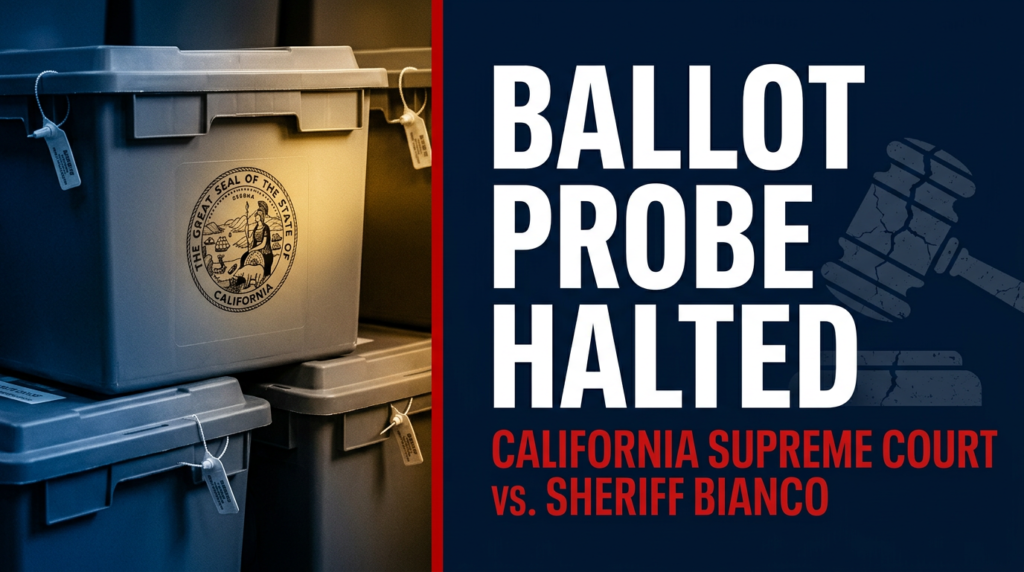
On April 8, 2026, the California Supreme Court ordered Riverside County Sheriff Chad Bianco to immediately pause his investigation into the November 2025 special election — a vote that determined whether California would adopt a new Democratic-drawn congressional redistricting map, a measure with enormous implications for the balance of power in the U.S. House. The court agreed to review legal challenges to the probe while ordering all seized materials preserved. Before the halt, Bianco’s team had already recounted 12,561 ballots. Whether those counts revealed anything significant has not been made public.
Support Independent Local Journalism
TheTownHall.News is a non-profit reader-supported journalism. Just $5 helps us hire local reporters, investigate important issues, and hold public officials accountable across Alameda County. If you believe our community deserves strong, independent journalism, please consider donating $5 today to support our work.Whatever one thinks of Bianco’s politics or his gubernatorial ambitions, the underlying question of whether California’s election produced an accurate result deserves a serious, honest answer — not a court-ordered gag.
What Sheriff Bianco Actually Did — and Why It Matters
Bianco did not act recklessly or unilaterally. He obtained three search warrants — reviewed and signed by a sitting judge — authorizing the seizure of election materials from Riverside County officials. That is standard law enforcement procedure. Sheriffs investigate potential crimes. Judges authorize warrants when probable cause is presented. That process played out here.
The investigation was triggered by claims from the Riverside County Election Integrity Team, a citizen group that said it identified a discrepancy of approximately 45,896 votes between the number of ballots cast and the number certified in the county. Whether that discrepancy reflects data-entry errors, procedural irregularities, or something more serious is precisely the kind of question a law enforcement investigation is designed to answer.
The registrar denied any discrepancy, arguing the activists used incomplete data. That may well be true. But “the registrar says everything is fine” has never been — and should not be — the final word in a democratic audit. Public confidence in elections is not built on trust alone. It is built on verification.

The Rush to Stop the Investigation Before It Concludes
Attorney General Rob Bonta moved swiftly to shut the investigation down, filing suit against Bianco and calling the probe a “partisan fishing expedition” with no probable cause. He accused the sheriff of defying direct orders and creating a “constitutional emergency.”
Strong words. But consider what Bonta is actually arguing: that a law enforcement officer should be blocked from completing an investigation — one authorized by a court-issued warrant — based on the AG’s political judgment about its merit.
That is a troubling standard, and it cuts in dangerous directions regardless of party. If an attorney general can terminate a sheriff’s investigation because he disagrees with its premise, what does that mean for the independence of local law enforcement? What does it mean for the next investigation — one that might target a Republican-connected institution?
When the most powerful law enforcement officer in California rushes to stop a ballot investigation before the ballots are fully counted, the burden of explanation falls on him — not on the sheriff.
The California Supreme Court’s intervention, while legally within its authority, does not resolve the underlying question of whether the election results were accurate. It simply ensures that question goes unanswered — at least for now.
Support Independent Local Journalism
TheTownHall.News is a non-profit reader-supported journalism. Just $5 helps us hire local reporters, investigate important issues, and hold public officials accountable across Alameda County. If you believe our community deserves strong, independent journalism, please consider donating $5 today to support our work.The Stakes: More Than One County, More Than One Election
This is not a local dispute. The November 2025 special election asked California voters statewide whether to approve a new congressional map drawn by Democrats. The measure passed. According to analysts, that map could position Democrats to gain as many as five additional U.S. House seats in the 2026 midterms.
Five House seats. Driven in part by a ballot measure. Investigated by a county sheriff. Shut down by a state supreme court.
The citizens who raised concerns about Riverside County’s vote totals may ultimately be proven wrong. The registrar’s explanation may be entirely accurate. But the sequence of events — an election with major national implications, a citizen-flagged discrepancy, a law enforcement investigation, and a rapid legal campaign to end that investigation — deserves more scrutiny than California’s political class has shown any interest in providing.
Election integrity is not a partisan issue. It is a civic one. Every American voter, regardless of party, has a stake in knowing that elections are conducted accurately and that questions about them can be pursued through lawful means without being shut down by officeholders whose party benefits from the outcome.
What Critics Get Wrong About This Case
Critics of Bianco’s investigation have made two primary arguments: first, that the warrant lacked a co-signature from the Riverside County District Attorney’s office; and second, that it relied solely on citizen research without corroborating forensic analysis.
Both are legitimate procedural concerns worth examining. A robust investigation should involve coordination with the DA and independent forensic expertise. These are fair critiques of how the probe was initiated.
But neither criticism addresses whether the underlying question is worth asking. Procedural imperfections in how an investigation begins do not make the investigation itself illegitimate — particularly when authorized by a sitting judge. If the warrants were legally defective, courts can say so. That is precisely how the system is supposed to work.
What should concern everyone is the speed with which state officials mobilized to halt the inquiry before it could produce findings. An investigation that concludes “nothing to see here” strengthens confidence in elections. An investigation stopped mid-count does the opposite.
How This Affects Public Trust — and Why That’s Everyone’s Problem
Public trust in elections does not survive on official assurances alone. It survives on transparent processes and the willingness of institutions to allow scrutiny — even uncomfortable scrutiny — to run its course.
When voters see a legal investigation shut down by the state’s most powerful officials, many will not conclude the election was clean. They will conclude the opposite. That outcome serves no one.
The Riverside County controversy may ultimately prove to be a case study in overzealous activism. Or it may reveal genuine procedural failures. We do not yet know — because the investigation was stopped.
The answer to questions about election integrity is never less transparency. It is always more.
Conclusion: The Question That Still Needs an Answer
The California Supreme Court has the authority to pause Sheriff Bianco’s investigation. What it cannot do is restore public confidence in an election that was never fully examined.
California’s voters are owed a complete and honest accounting of what happened in November 2025 — one that comes through a rigorous, independent, forensically sound process, not a state-ordered halt that leaves the most important question unanswered.
In a functioning democracy, elections must not only be conducted fairly. They must be seen to be conducted fairly. That requires institutions willing to let verification run to completion — even when results might be inconvenient.
The legal battles will continue. But the integrity of the vote will not be resolved by court orders alone. It will only be resolved by the truth.
🔑 Key Takeaway
The California Supreme Court’s order to halt Sheriff Bianco’s election probe does not answer whether Riverside County’s 2025 ballot count was accurate. It ensures that question remains open — and that public confidence in California’s elections takes another hit in the process.
Stay Informed. Stay Engaged.
This story is developing. Share this article with anyone who believes election transparency matters — regardless of party. Independent journalism that asks hard questions depends on readers who demand answers. Bookmark this page, follow for updates, and join the conversation in the comments below. Your civic engagement is what holds institutions accountable.