California’s AI Overreach: How Sacramento’s New Tech Regulations Threaten Innovation and Free Markets
The Golden State’s Latest Regulatory Experiment
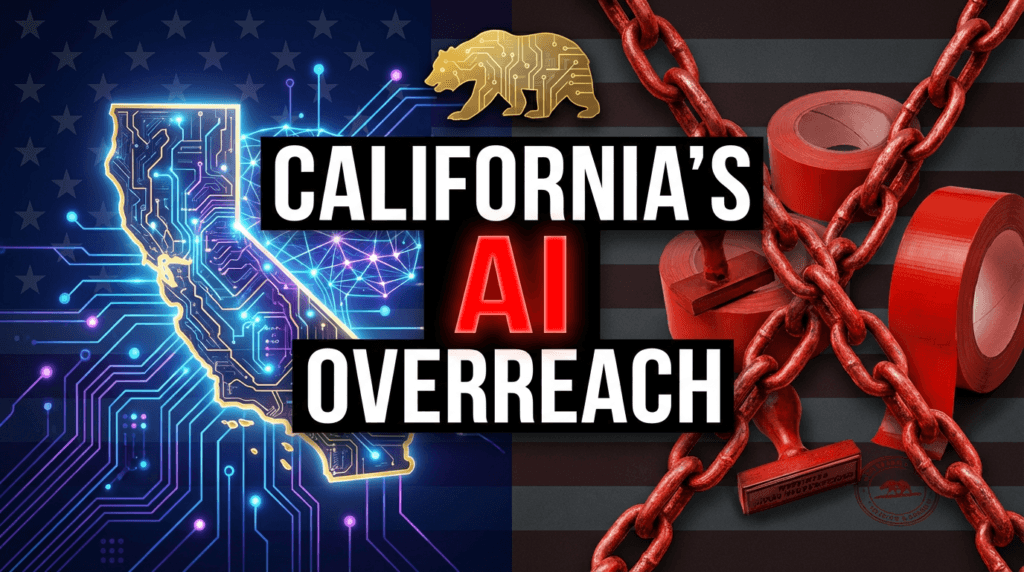
On January 1, 2026, nearly 800 new laws took effect in California—and among the most consequential are a sweeping package of artificial intelligence regulations that place the Golden State at the forefront of tech governance. While proponents celebrate California as a “leader” in AI regulation, conservatives should recognize these measures for what they truly are: another example of Sacramento’s reflexive impulse to regulate first and ask questions later.
California has enacted 18 AI-related laws in 2024 alone, with additional measures already moving through the 2025 legislative session. These regulations span everything from mandatory disclosure of AI training data to restrictions on chatbots to new liability frameworks for AI developers. Governor Gavin Newsom and the state legislature frame this regulatory blitz as necessary consumer protection. But the reality is far different: California’s AI laws represent government overreach that will stifle innovation, burden businesses with compliance costs, drive tech companies out of state, and ultimately harm the very consumers these laws purport to protect.
The stakes couldn’t be higher. California is home to more than half of global AI venture funding and hosts the world’s leading AI companies. The regulatory framework established in Sacramento won’t stay in California—it will influence national policy and potentially cripple America’s competitive advantage in the most important technology of the 21st century. Conservatives must understand what’s at stake and push back against this regulatory overreach before it’s too late.
Support Independent Local Journalism
TheTownHall.News is a non-profit reader-supported journalism. Just $5 helps us hire local reporters, investigate important issues, and hold public officials accountable across Alameda County. If you believe our community deserves strong, independent journalism, please consider donating $5 today to support our work.The Regulatory Avalanche: What California Actually Passed
To understand the threat, we need to examine what California has actually done. The 18 AI laws enacted in 2024 cover six primary areas, with several additional measures taking effect in 2026.
Assembly Bill 2013, effective January 1, 2026, requires developers of generative AI systems to publicly disclose detailed information about their training data—including sources, data owners, the number of data points, whether copyrighted or personal information was used, and collection timelines. This isn’t a simple transparency measure; it mandates 12 separate disclosures that could reveal trade secrets and proprietary information that took years and billions of dollars to develop.
Assembly Bill 1008 extends California’s already-burdensome Consumer Privacy Act (CCPA) to cover AI systems, requiring developers to potentially alter the architecture of their AI models every time an individual requests their personal information be scrubbed from the system. The technical challenges alone could make certain AI applications economically unviable.
Assembly Bill 1064 prohibits operators from making chatbots available to children if they could “foreseeably” encourage self-harm or suicidal ideation. While protecting children is a worthy goal, the vague “foreseeably” standard creates massive legal uncertainty and potential liability for any company offering conversational AI.
Additional laws regulate deepfakes, require disclosures about AI-generated content, impose restrictions on AI use in healthcare, mandate educational guidance on AI, and create new protections for digital likenesses. The California Civil Rights Council has also finalized regulations requiring employers using AI in hiring to retain records for four years and prove their tools don’t produce discriminatory outcomes—effectively presuming guilt until innocence is proven.
The Conservative Case Against California’s AI Regulations
Stifling Innovation and Economic Growth
The first and most fundamental problem with California’s AI regulations is that they will inevitably stifle the innovation that has made America the global leader in artificial intelligence. Every new compliance requirement, every mandatory disclosure, every legal uncertainty adds friction to the development process.
Consider AB 2013’s training data disclosure requirements. AI companies invest billions of dollars and years of effort into curating training datasets and developing proprietary methods for processing that data. Forcing public disclosure of these details doesn’t just create compliance costs—it hands competitors and foreign adversaries a roadmap to replicate American innovations. China and other nations are racing to dominate AI; California is essentially requiring American companies to publish their playbooks.
The regulatory burden falls especially hard on startups and smaller companies that lack the legal departments and compliance infrastructure of tech giants. Large incumbents like Google and Microsoft can absorb these costs; the next generation of AI innovators working in garages and dorm rooms cannot. California’s regulations will entrench existing players and raise barriers to entry—the opposite of a competitive free market.
Government Knows Best? The Arrogance of Central Planning
California’s regulatory approach reflects a fundamentally progressive worldview: that government bureaucrats and politicians in Sacramento are better positioned than market participants to determine how AI should be developed and deployed. This is central planning applied to cutting-edge technology, and it will fail for the same reasons central planning always fails.
Support Independent Local Journalism
TheTownHall.News is a non-profit reader-supported journalism. Just $5 helps us hire local reporters, investigate important issues, and hold public officials accountable across Alameda County. If you believe our community deserves strong, independent journalism, please consider donating $5 today to support our work.The AI field is evolving at breakneck speed. Techniques that were state-of-the-art six months ago are obsolete today. Yet California is locking in regulatory frameworks based on today’s understanding—or more accurately, politicians’ limited understanding—of a technology that will look radically different in two years. By the time regulators recognize their rules are outdated, the damage to innovation will already be done.
The free market, by contrast, provides dynamic feedback mechanisms that government regulation cannot match. Companies that develop unsafe or harmful AI products face reputational damage, loss of customers, and civil liability. Companies that develop useful, safe products succeed and grow. This process doesn’t require Sacramento’s intervention—it requires getting government out of the way.
Undermining Free Speech and Open Source Development
Several of California’s AI laws raise serious First Amendment concerns that should alarm any conservative who values free speech. AB 2839, which took effect immediately upon passage in September 2024, restricts AI-generated election content. While combating misinformation is a legitimate concern, giving government the power to determine what AI-generated political speech is permissible creates an obvious potential for abuse.
The open-source AI community—which has been instrumental in democratizing access to AI technology—is particularly threatened by California’s regulatory approach. When SB 1047 (which would have imposed even stricter safety requirements on AI developers) was being debated, open-source developers warned that once a model is publicly released, ensuring compliance with vague safety mandates becomes nearly impossible. Though Governor Newsom ultimately vetoed SB 1047, the scaled-back version (SB 53) that became law in 2025 still imposes transparency requirements that create uncertainty for open-source projects.
Open-source AI represents the democratization of powerful technology—putting tools in the hands of individuals and small organizations rather than concentrating them among a few large corporations. California’s regulations threaten this democratization by making it legally risky to freely share AI innovations.
The Compliance Burden: Death by a Thousand Cuts
The sheer scope of California’s AI regulatory framework creates a compliance nightmare that will drain resources away from productive innovation. Companies must now:
- Document and disclose training data sources and methodologies (AB 2013)
- Implement systems to identify and remove personal information from AI models on request (AB 1008)
- Ensure chatbots don’t “foreseeably” cause harm to children (AB 1064)
- Retain AI-related employment records for four years and prove non-discrimination (Civil Rights Council regulations)
- Disclose AI-generated content in various contexts (AB 2905, SB 942, SB 896)
- Comply with restrictions on deepfakes and digital likenesses (AB 2602, AB 1836, AB 1831)
- Navigate healthcare-specific AI regulations (AB 3030, SB 1120)
Each requirement individually might seem reasonable to its proponents. But cumulatively, they represent a massive regulatory burden that will require armies of lawyers, compliance officers, and consultants to navigate. Those costs don’t disappear—they’re passed on to consumers through higher prices and reduced innovation.
Driving Business Out of California
California already suffers from a business climate problem. High taxes, burdensome regulations, and an expensive cost of living have driven companies to relocate to Texas, Florida, Tennessee, and other business-friendly states. California’s AI regulations will accelerate this exodus among the very tech companies that have been the engine of the state’s economy.
Why would an AI startup choose to base itself in California when it can locate in a state without these regulatory burdens? The traditional answer—access to talent and venture capital—is increasingly obsolete in an era of remote work and distributed teams. As more AI companies relocate or launch elsewhere, the talent and capital will follow, creating a vicious cycle that erodes California’s competitive position.
The irony is that California’s regulations won’t actually prevent harmful AI development—they’ll just ensure it happens somewhere else, beyond the reach of California law. If the goal is to ensure AI is developed responsibly, driving development offshore or to other states with less regulatory capacity is counterproductive.
What Conservatives Should Support Instead
Rejecting California’s regulatory overreach doesn’t mean ignoring legitimate concerns about AI development. Conservatives should support a different approach grounded in our principles:
Rely on existing law. Much of what California’s AI regulations purport to address is already covered by existing legal frameworks. Fraud is illegal whether committed by AI or humans. Copyright infringement doesn’t become legal because an AI is involved. Discrimination in employment violates federal civil rights law regardless of whether an algorithm is used. We don’t need new AI-specific regulations—we need to enforce existing laws.
Embrace industry standards and self-regulation. The tech industry has a strong incentive to develop AI safely and responsibly. Industry-led standards, best practices, and self-regulatory frameworks can address safety and ethical concerns more flexibly and effectively than government mandates. Conservatives should support these voluntary efforts rather than displacing them with government regulation.
Protect property rights and liability. Rather than mandating specific development practices, we should ensure clear property rights (including intellectual property) and maintain robust civil liability for actual harms. If an AI system causes damage through negligence, the developer should be liable. This creates proper incentives without micromanaging the development process.
Prioritize national security. The one area where government has a legitimate and necessary role is preventing AI technology from falling into the hands of foreign adversaries. Export controls and security reviews for sensitive AI applications are appropriate—but these should be handled at the federal level, not through a patchwork of state regulations.
Let markets work. Ultimately, the best regulation of AI will come from market competition. Companies that develop harmful products will lose customers. Companies that solve real problems responsibly will succeed. This process has driven American technological leadership for generations. We should trust it to work for AI as well.
The National Implications
California’s AI regulations won’t stay in California. The state’s size and economic importance mean its regulatory framework will influence policy nationwide. Already, other states are considering similar measures, and federal policymakers look to California as a model.
This makes the stakes even higher. If California’s approach becomes the national template, we’ll see innovation stifled and American competitiveness undermined on a massive scale. China, which takes a very different approach to AI governance—one focused on state control and national advancement—will be the beneficiary.
Conservatives must make the case for a different path at both the state and federal levels. We need to articulate clearly why free markets, limited government, and individual liberty are better suited to fostering responsible AI development than California-style regulatory mandates.
Conclusion: Choose Innovation Over Regulation
California’s sweeping AI regulations represent a fundamental choice between two visions of America’s technological future. One vision—the one embodied in these new laws—sees government as the wise arbiter that must guide and constrain technological development through detailed mandates and compliance requirements. The other vision trusts in free markets, individual initiative, and the competitive process that has made America the world’s innovation leader.
The conservative choice is clear. We should reject California’s regulatory overreach and instead support policies that unleash innovation, protect property rights, maintain accountability for actual harms, and keep government within its proper limited sphere. The future of American AI leadership—and with it, economic prosperity and national security—depends on getting this right.
California has long been a laboratory for progressive policy experiments. Too often, those experiments fail, imposing costs on Californians before being quietly abandoned. But when it comes to AI regulation, we can’t afford to wait for California’s experiment to fail. The damage to American innovation and competitiveness could be irreversible. The time to push back is now.
Call to Action
Stay informed. Follow developments in AI policy at both the state and federal levels. Organizations like the Chamber of Commerce, TechFreedom, and the Competitive Enterprise Institute provide excellent resources on tech policy from a free-market perspective.
Make your voice heard. Contact your state and federal representatives to express opposition to California-style AI regulations. If you live in California, urge your lawmakers to reconsider these burdensome mandates before they drive innovation out of the state.
Support pro-innovation candidates. In 2026 and beyond, support candidates who understand that American technological leadership depends on free markets and limited government, not regulatory micromanagement.
Share this article. Help spread awareness of the threats posed by AI overregulation. The more people understand what’s at stake, the more effectively we can push back against the regulatory state.
The battle over AI regulation is just beginning. Conservatives must engage now to ensure that America’s AI future is built on freedom and innovation, not government mandates and bureaucratic control.