Newsom’s Political Theater: Why California’s Governor Is Wrong About Crime, Pardons, and Presidential Authority
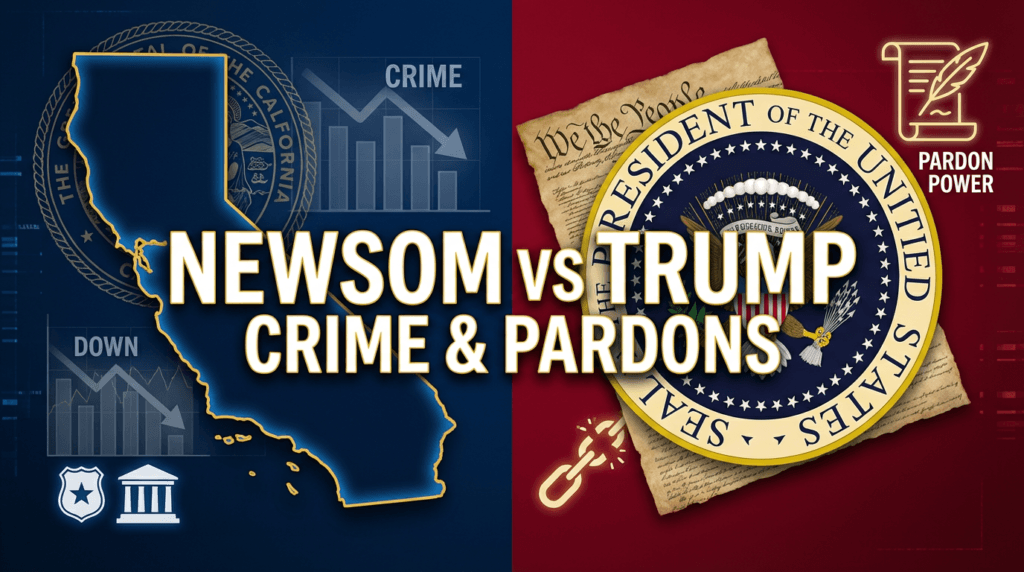
Governor Gavin Newsom just launched a new website attacking President Trump’s use of the pardon power, calling it a list of “criminal cronies” while simultaneously claiming credit for California’s falling crime rates. It’s a masterclass in political distraction—and conservatives shouldn’t fall for it.
The timing is no coincidence. As California continues to struggle with homelessness, drug addiction, and quality-of-life crimes that don’t show up in Newsom’s cherry-picked statistics, the governor is trying to change the subject. Rather than address his state’s very real problems, he’s launching partisan attacks on a president exercising his constitutional authority.
Let’s separate fact from fiction and examine what’s really happening with crime in California, presidential pardons, and Newsom’s desperate attempt to position himself as a national political figure.
Support Independent Local Journalism
TheTownHall.News is a non-profit reader-supported journalism. Just $5 helps us hire local reporters, investigate important issues, and hold public officials accountable across Alameda County. If you believe our community deserves strong, independent journalism, please consider donating $5 today to support our work.Understanding Presidential Pardon Power: A Constitutional Foundation
Before we address Newsom’s attacks, conservatives must understand something fundamental: the presidential pardon power is not a suggestion—it’s an explicit constitutional authority granted in Article II, Section 2 of the Constitution. The Founders deliberately made this power broad and unreviewable by other branches of government.
Presidents from George Washington to Barack Obama have used this power in ways that sparked controversy. President Carter pardoned hundreds of thousands of Vietnam draft dodgers. President Clinton pardoned his own brother and controversial figures on his last day in office. President Obama commuted the sentences of hundreds of drug offenders and even commuted the sentence of Chelsea Manning, who leaked classified military documents.
The point isn’t whether we agree with every pardon—it’s that this is the president’s constitutional prerogative. Newsom’s website isn’t a public service; it’s a political hit job designed to undermine presidential authority and score cheap points with progressive voters.
The Real Story Behind California’s Crime Statistics
Newsom points to data from the Major Cities Chiefs Association showing drops in violent crime: homicides down 18%, robberies down 18%, and aggravated assaults down 9% year-over-year. These numbers sound impressive until you examine the context.

First, these statistics represent a recovery from historic highs. California’s violent crime rate increased significantly during the pandemic years and following the 2020 social unrest. When Newsom took office in 2019, California’s crime rate was at near-historic lows. It then spiked dramatically. The current “drops” are simply a return toward pre-pandemic levels—not some revolutionary achievement.
Second, these statistics don’t capture the complete picture of public safety in California. Property crimes, retail theft, car break-ins, and quality-of-life offenses have plagued California cities for years. San Francisco, Los Angeles, and Oakland have become synonymous with visible homelessness, open-air drug markets, and brazen retail theft. Major retailers have closed stores in California cities citing unsustainable theft levels.
Third, Newsom conveniently ignores that crime is dropping nationwide—not just in California. According to FBI data, violent crime has decreased across the country, including in states that didn’t adopt California’s progressive criminal justice policies. In fact, many conservative-led states are seeing similar or better results without releasing criminals early, defunding police, or reducing penalties for theft.
The reality? California’s crime improvements have come despite Newsom’s policies, not because of them. After years of progressive prosecutors refusing to charge criminals, Proposition 36 passed in 2024 with overwhelming voter support, rolling back some of the most damaging aspects of Proposition 47. Voters demanded accountability—and only then did Newsom reluctantly sign legislation increasing penalties for retail theft.
Newsom’s $1.7 Billion Question: Where Did the Money Go?
Newsom boasts about investing $1.7 billion in public safety since 2019. That’s a staggering amount of taxpayer money. Yet California’s major cities still struggle with crime, homelessness, and disorder. Where did that money actually go?
Support Independent Local Journalism
TheTownHall.News is a non-profit reader-supported journalism. Just $5 helps us hire local reporters, investigate important issues, and hold public officials accountable across Alameda County. If you believe our community deserves strong, independent journalism, please consider donating $5 today to support our work.This is the problem with big-government solutions: massive spending doesn’t guarantee results. Conservatives understand that effective law enforcement requires more than just throwing money at the problem. It requires political will to prosecute criminals, support for police officers, and policies that prioritize victims over offenders.
California has done the opposite. Progressive district attorneys in Los Angeles, San Francisco, and other cities have systematically declined to prosecute entire categories of crimes. Police departments have been demoralized and defunded. Bail reform has put dangerous criminals back on the streets. And Proposition 47 effectively decriminalized theft under $950, creating an open invitation for organized retail crime.
When voters finally had enough and passed Proposition 36 to restore accountability, Newsom opposed it. He only changed course when it became clear the measure would pass overwhelmingly. That’s not leadership—that’s political calculation.
The Pardon Controversy: Selective Outrage
Newsom’s website attacks Trump for pardoning January 6 defendants, drug offenders, and others with criminal records. Let’s address this honestly.
The January 6 pardons are controversial, and conservatives can disagree about whether every individual deserved clemency. However, the facts matter: many January 6 defendants were charged with non-violent offenses like trespassing. Some were held in pretrial detention for years without bail—a practice progressives typically oppose. The judicial process became politicized, with some defendants facing dramatically harsher treatment than participants in other political protests.
Trump’s pardon of these individuals reflects his belief that the prosecution was politically motivated and disproportionate. You don’t have to agree with every pardon to recognize the president’s constitutional authority to make that judgment.
As for drug offenders like Ross Ulbricht and Juan Orlando Hernández, these cases are complex. Hernández’s pardon is particularly controversial, and even many conservatives have questioned it. However, Trump has argued that Hernández was prosecuted by a politicized Justice Department and that the case against him was flawed. Whether you agree or not, this is precisely the kind of situation where presidential pardon power exists—to provide a check on prosecutorial overreach.
The selective outrage is telling. Where was Newsom’s website when President Obama commuted sentences for drug dealers? Where was the outrage when President Clinton pardoned Marc Rich, a fugitive financier whose ex-wife donated heavily to Democrats? Presidential pardons have always been controversial, and they’ve always been political.
The Real Crisis California Won’t Address
While Newsom attacks Trump’s pardons, California faces crises that demand actual leadership:
Homelessness: California has nearly 30% of the nation’s homeless population despite representing only 12% of the U.S. population. Tens of billions have been spent with minimal results.
Drug epidemic: Open-air drug markets operate in major California cities. Fentanyl deaths continue to rise. Yet progressive policies prioritize “harm reduction” over treatment and enforcement.
Cost of living: Californians pay the highest taxes in the nation while experiencing declining quality of life. Middle-class families are fleeing the state.
Education: California’s public schools rank near the bottom nationally despite massive per-pupil spending. Parents have limited school choice options.
Fiscal mismanagement: California faces recurring budget deficits despite record tax revenues. The state’s unfunded pension liabilities exceed $200 billion.
These are the issues Californians care about—not political theater about presidential pardons.
Law and Order Means Accountability at Every Level
Conservatives believe in law and order, which means accountability for everyone—criminals, prosecutors, and elected officials. It means:
- Prosecuting criminals who break the law, regardless of their background
- Supporting police officers who put their lives on the line
- Protecting victims’ rights over offenders’ convenience
- Ensuring that penalties are proportionate but certain
- Holding elected officials accountable for failed policies
California’s progressive experiment has failed these principles. Criminals face minimal consequences. Police are vilified. Victims are forgotten. And when policies obviously fail, politicians like Newsom change the subject rather than change course.
The Constitutional Conservative Position
Conservatives can simultaneously believe that:
- The president has broad constitutional authority to grant pardons, even controversial ones
- Some of Trump’s pardons are questionable and merit criticism
- Presidential pardon power should not be restricted based on partisan disagreement
- Governors attacking presidential authority for political gain undermine federalism
- California’s crime problems are real and require honest solutions, not spin
This isn’t contradictory—it’s principled. We can defend constitutional authority while debating its application. We can acknowledge crime statistics while demanding context. We can support law enforcement while questioning specific decisions.
What we shouldn’t do is let progressive politicians gaslight us about crime, distract from their failures, and attack constitutional principles for partisan advantage.
Call to Action: Demand Accountability, Not Theater
Governor Newsom’s website is political theater designed to boost his national profile while distracting from California’s real problems. Don’t let it work.
Here’s what you can do:
Stay informed: Look beyond headlines and cherry-picked statistics. Understand the full context of crime trends, pardon decisions, and policy impacts.
Demand accountability: Ask your local and state officials what they’re doing about crime in your community. Don’t accept excuses or deflection.
Support law enforcement: Back the police officers, prosecutors, and judges who prioritize public safety over political correctness.
Vote: Support candidates who believe in law and order, fiscal accountability, and constitutional principles—not political stunts.
Share the truth: When you see political spin like Newsom’s website, call it out. Share articles like this one that provide context and conservative perspective.
The battle for law and order, constitutional government, and common-sense policies won’t be won by politicians seeking headlines. It will be won by informed citizens demanding better from their leaders.
California deserves honest leadership that addresses real problems instead of creating political websites attacking the president. America deserves a debate about crime and justice based on facts, not partisan spin. And conservatives deserve to understand these issues clearly so we can fight effectively for our principles.
The next time you hear a politician bragging about crime statistics while their cities descend into disorder, ask yourself: are they solving problems or just changing the subject?