Springs Fire California: How Policy Failures Turned a Brush Fire Into a 4,000-Acre Crisis
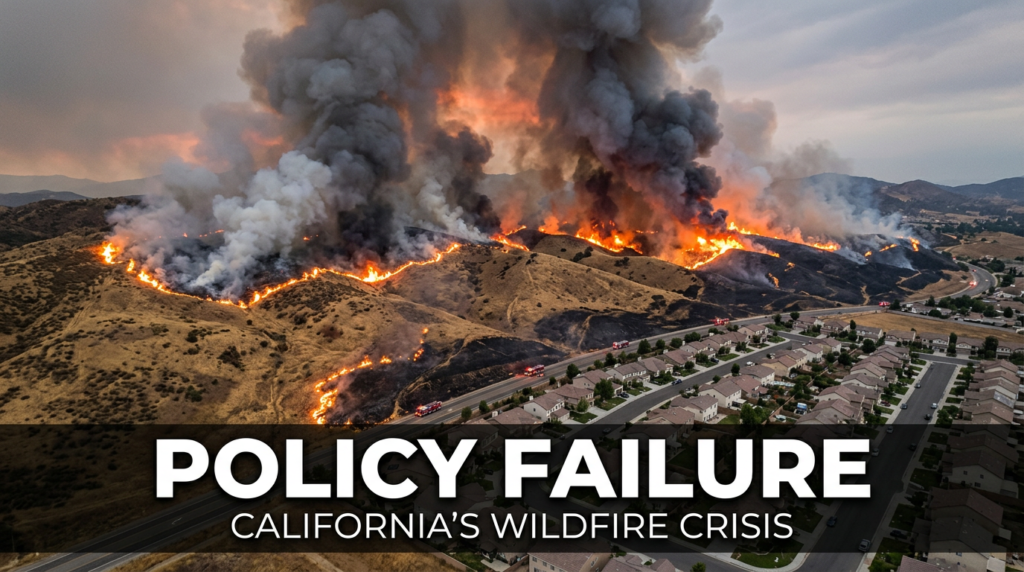
Aerial footage of the Springs Fire ripping through Riverside County shocked the nation. But behind the dramatic images lies a more troubling story: years of failed land management, delayed prevention, and government inaction that left California communities dangerously exposed.
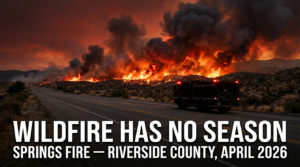
When a massive brush fire erupted along Gilman Springs Road east of Moreno Valley on the morning of Friday, April 3, 2026, it didn’t wait for permission to grow. Fueled by 50 mph Santa Ana wind gusts, bone-dry vegetation, and steep terrain, the Springs Fire exploded from roughly 50 acres to more than 4,176 acres in a matter of hours — forcing mandatory evacuation orders across multiple zones in Riverside County and displacing thousands of residents before firefighters could even establish a perimeter.
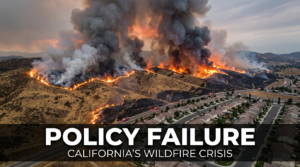
Helicopter aerial footage captured the terrifying scale of the blaze, the kind of images that go viral for good reason: they remind us of nature’s raw power. But they should also remind us of something else. Catastrophic wildfires in Southern California are not simply acts of God. They are, increasingly, the predictable consequence of decisions made — and not made — by the officials Californians have trusted to protect them.
Support Independent Local Journalism
TheTownHall.News is a non-profit reader-supported journalism. Just $5 helps us hire local reporters, investigate important issues, and hold public officials accountable across Alameda County. If you believe our community deserves strong, independent journalism, please consider donating $5 today to support our work.A Fire That Grew Faster Than Government Could React
By 1:00 p.m. on April 3, the Springs Fire had already reached 1,000 acres. By 3:00 p.m., it had more than doubled to 2,817 acres. By early evening, it was mapped at 4,176 acres — where it held. CAL FIRE and Riverside County responders ultimately deployed 147 personnel, 15 engines, 6 hand crews, 2 water tenders, and multiple aerial tankers. The response was substantial. The firefighters performed heroically.
And yet, the fire had to reach catastrophic scale before meaningful containment lines could be drawn. The cause of ignition remains under investigation. No injuries were officially reported, and no structures were confirmed destroyed — an outcome that owes more to fortune and wind direction than to proactive preparation.
The National Weather Service had issued a wind advisory for San Bernardino and Riverside County valleys ahead of the fire, warning of gusts up to 50 mph. The conditions were known. The fuel was there. The question that demands an answer is: why wasn’t the landscape better prepared?
The Real Problem: Decades of Mismanaged Land
The Moreno Valley region is what fire scientists call a wildland-urban interface — where expanding residential development meets dry brushland. It is, by any honest assessment, one of the most fire-prone corridors in the United States. The Springs Fire didn’t discover that. Fires have repeatedly erupted along routes like Gilman Springs Road for decades, driven by the same combination of drought, invasive grasses, and seasonal Santa Ana winds.

California’s wildfire crisis isn’t a climate-only story — it’s a land management story.
Experts, including forestry professionals and independent researchers, have long argued that strategic prescribed burns and aggressive fuel reduction are the most effective tools for reducing catastrophic fire risk. The evidence is clear: controlled burns reduce the volume of dry brush that turns small ignitions into infernos. Yet California and federal land managers have historically been slow to implement them at meaningful scale, hamstrung by bureaucratic hurdles, environmental regulations, and a risk-averse culture that prefers delay to action.
The U.S. Forest Service has at various points paused prescribed burning programs entirely. When beneficial burns are delayed, fuel loads accumulate. When fuel loads accumulate, the next wind event becomes a catastrophe.
What Critics Get Wrong About “Climate Change Fixed Everything”
There’s a reflexive tendency in certain political circles to reduce every California wildfire to a single cause: climate change. And while shifting weather patterns do play a role in creating drier, hotter conditions, this explanation too often serves as a political shield — a way to avoid accountability for the management failures that turn dry years into disaster years.
Blaming climate alone removes responsibility from state agencies, utilities, and regulators who have repeatedly failed to maintain defensible space, clear overgrown corridors, or invest seriously in fire-resilient infrastructure. It also conveniently removes the conversation from anything voters can actually hold officials accountable for at the ballot box.
Support Independent Local Journalism
TheTownHall.News is a non-profit reader-supported journalism. Just $5 helps us hire local reporters, investigate important issues, and hold public officials accountable across Alameda County. If you believe our community deserves strong, independent journalism, please consider donating $5 today to support our work.The residents of Moreno Valley — a working-class city of roughly 200,000 people, 64 miles east of Los Angeles — didn’t choose to live in a tinderbox. Many of them had little option in a housing market that pushes families further into fire-prone areas because urban centers have become unaffordable. The responsibility to keep those communities safe doesn’t disappear because the political answer is inconvenient.
The Cost Communities Bear — And Politicians Don’t
When evacuation orders go out, the costs fall immediately on individuals and families. Lost workdays. Hotel costs. Disrupted childcare. Evacuated livestock. Anxiety for the elderly, the disabled, those without the means to leave quickly. These are not abstract policy consequences — they are the lived reality of people who did everything right and still found themselves fleeing with what they could carry.
Real communities pay real prices for elite policy failures.
Meanwhile, California continues to rank among the highest-taxed states in the nation. Residents and businesses pay steeply for government services that, in the most fundamental test — protecting people from foreseeable disasters — have repeatedly come up short. The question isn’t whether the firefighters did their jobs. They did, with skill and bravery. The question is whether the officials above them did theirs.
Fire prevention funding, brush clearance mandates, and streamlined permitting for controlled burns are not partisan fantasies. They are common-sense fiscal investments that save billions in suppression costs, property damage, and economic disruption downstream.
A Counterpoint Worth Addressing
Some will argue that California has, in recent years, increased its prescribed burn targets and invested more in fire resilience — and that’s partially true. Governor Newsom’s administration has announced ambitious goals for treating millions of acres. The state has expanded its fire prevention strategy and signed legislation aimed at accelerating fuel reduction.
These are steps in the right direction, and they deserve acknowledgment. But announcements are not outcomes. Targets are not results. The gap between stated policy goals and on-the-ground execution in California remains wide — and the Springs Fire is the latest reminder that the landscape hasn’t caught up to the press releases.
Accountability requires measuring what actually happens in the field, not what gets promised in Sacramento.
What This Means for Every California Community
By Saturday evening, April 4, all evacuation orders for the Springs Fire had been lifted. Containment reached 95%. The immediate crisis passed. Residents returned home. The aerial footage cycled off the news cycle.
But the conditions that made the Springs Fire possible haven’t changed. The dry brush is still there. The wind corridors are still there. The wildland-urban interface communities — across Riverside, San Bernardino, Los Angeles, and beyond — are still there, waiting for the next red flag warning.
The Springs Fire should be a turning point, not just another entry in a long list of California disasters. It should prompt honest conversations about land management policy, utility accountability, prescribed burn permitting, and the real costs of inaction. It should remind every voter — regardless of political affiliation — that government’s most basic obligation is to protect the people it serves.
When that obligation is met with bureaucratic delay, regulatory paralysis, or the substitution of talking points for action, communities pay the price.
The Takeaway
The Springs Fire was contained. The next one may not be so forgiving.
California cannot keep reacting to predictable disasters while neglecting the prevention strategies that would reduce their severity. The men and women of CAL FIRE and Riverside County emergency services performed admirably under brutal conditions. Now it’s time for the state’s policymakers to match that standard — with real investment, real accountability, and real results.
Californians deserve no less.
Stay informed. Share this article with your community. Support independent journalism that asks the hard questions — and demands real answers.