April’s Wake-Up Call: The Springs Fire Proves Wildfire Preparedness Is a Year-Round Duty
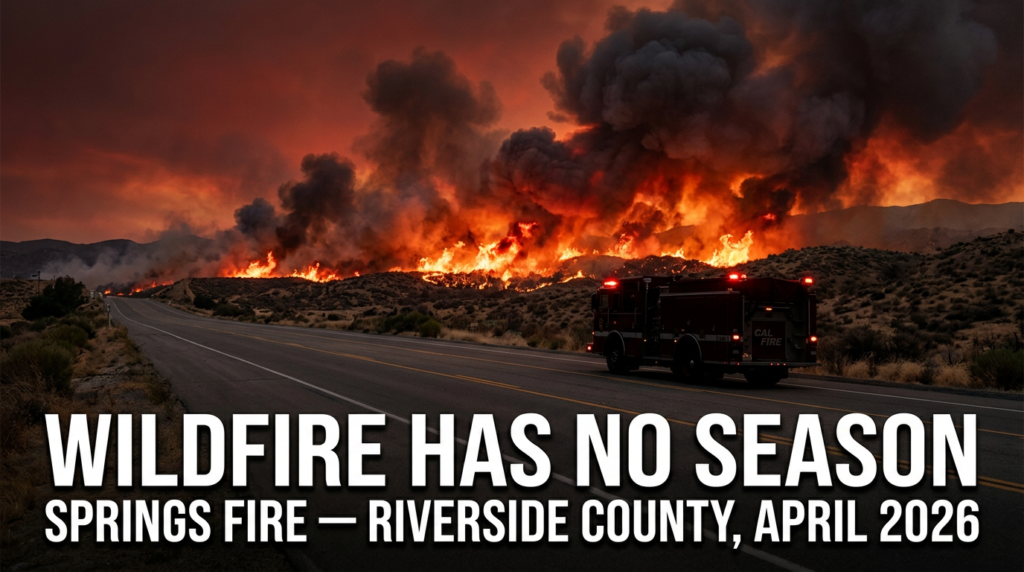
California’s Springs Fire burned more than 4,100 acres in Riverside County in a matter of hours — a jarring reminder that complacency, not just wind and dry brush, is the deadliest fuel of all.
The calendar said April. The fire didn’t care.
On the morning of April 3, 2026, a fast-moving vegetation fire ignited near Gilman Springs Road east of Moreno Valley in Riverside County, California. Driven by Santa Ana winds gusting up to 50 miles per hour, the Springs Fire exploded across 4,176 acres within hours, triggering mandatory evacuation orders across multiple neighborhoods and sending hundreds of residents scrambling for safety. By Saturday, April 5, firefighters had reached 75% containment — a testament to a coordinated, aggressive response. But the fire’s rapid rise should be a wake-up call for residents, policymakers, and civic leaders alike: wildfire is no longer a summer problem. It is a year-round reality.
Support Independent Local Journalism
TheTownHall.News is a non-profit reader-supported journalism. Just $5 helps us hire local reporters, investigate important issues, and hold public officials accountable across Alameda County. If you believe our community deserves strong, independent journalism, please consider donating $5 today to support our work.No structures were destroyed. No lives were lost. Those outcomes were not accidents — they were the product of prepared communities, responsive first responders, and individuals who took evacuation orders seriously. But the window for complacency has permanently closed.
Why Wildfire No Longer Has a Season
For decades, Californians operated on a familiar mental calendar: summer heat arrives, fire season begins, fall rains end it. That model is dangerously outdated.
The Springs Fire ignited in early April — a month many residents still associate with spring blooms and cooler temperatures. Yet the same dry, wind-driven conditions that fuel August infernos were present in Riverside County this week. Data from the National Interagency Fire Center shows that as of early April 2026, wildfire activity across the U.S. was running 168% above the historical average, with 16,746 wildfires already reported. California is not an outlier — it is the epicenter.
Fire scientists and meteorologists have documented the steady lengthening of the fire window across the American West. The Springs Fire is not an anomaly. It is the new normal.

“Even in April, #wildfire is a threat.” — CAL FIRE Chief, April 4, 2026
That single statement should be printed on every community preparedness pamphlet in the state.
Personal Preparedness: The First Line of Defense
The Springs Fire moved fast. Residents in evacuation zones had little time to deliberate. Those who had emergency plans, go-bags, and clearly identified evacuation routes fared far better than those who did not.
This is not a moment for government to lecture homeowners — it is a moment for individuals and families to act. Defensible space around structures, fire-resistant landscaping, and family evacuation plans are not bureaucratic checkboxes. They are survival tools. CAL FIRE and local agencies have long offered free resources, inspections, and guidance on home hardening. The question is whether residents take that responsibility seriously before fire season — or during it.
The Springs Fire response also benefited from something no government agency can mandate: civic cooperation. Residents followed evacuation orders. Volunteers staffed shelter locations. Communities looked out for one another. That is the kind of personal responsibility and social cohesion that saves lives — and no policy document creates it. People do.
The Real Cost of Delayed Preparedness
With 260 personnel deployed, air tankers mobilized from across the state, 36 engines, 7 hand crews, and helicopter support, the Springs Fire response was substantial. California’s 2026–27 budget allocates $2.1 billion toward wildfire and climate resilience — a massive public investment that reflects the scale of the ongoing threat.
Support Independent Local Journalism
TheTownHall.News is a non-profit reader-supported journalism. Just $5 helps us hire local reporters, investigate important issues, and hold public officials accountable across Alameda County. If you believe our community deserves strong, independent journalism, please consider donating $5 today to support our work.Fiscal conservatives are right to scrutinize how those dollars are spent. The question is not whether wildfire preparedness deserves investment — it clearly does. The question is whether that investment is being directed at the right priorities: pre-fire fuel management, defensible space enforcement, infrastructure hardening, and community-level education. Prevention is almost always cheaper than suppression.
CAL FIRE reported that firefighters used existing equestrian trails in Riverside County to build containment lines during the Springs Fire. That kind of practical, low-cost advantage underscores a point worth emphasizing: land management decisions — trail maintenance, brush clearing, fuel reduction — have direct consequences on how fires behave. Smart, targeted investment in land stewardship pays dividends when the winds pick up.
What Critics Get Wrong About Wildfire Policy
Some voices argue that the answer to California’s wildfire crisis lies primarily in expanded government programs, larger state budgets, and sweeping climate regulations. That framing misses a more immediate truth.
The most effective wildfire mitigation measures are practical and local. Clearing dry brush from around homes. Maintaining defensible space. Updating building codes in fire-prone zones. Enforcing existing regulations that already require property owners to reduce fuel loads. These actions do not require new bureaucracies or billion-dollar mandates. They require accountability — from property owners, local governments, and land management agencies.
There is also the matter of grid infrastructure. Several of California’s most destructive fires in recent years have been linked to power line failures. Holding utility companies to rigorous maintenance standards and enforcing legal liability is not an anti-business position — it is basic law and order. Communities have a right to expect that the infrastructure running through their neighborhoods meets the highest safety standards. When it doesn’t, there must be consequences.
None of this diminishes the value of state-level firefighting resources or the courage of the men and women who battled the Springs Fire this week. But effective wildfire policy requires honesty about root causes — not just bigger budgets for suppression after the fact.
How This Affects Families and Communities
Beyond the headlines, the Springs Fire disrupted real lives. Moreno Valley College closed its main campus due to smoke impacts, affecting students and staff mid-week. Families with pets scrambled to reach animal evacuation shelters. Businesses in affected zones shuttered temporarily. The ripple effects of a single fast-moving fire extend far beyond the fire line.
For parents, this is a conversation worth having with children: What do we do if we have to leave quickly? Where do we go? Where do we meet? These are not fearful questions — they are responsible ones. Schools in fire-prone areas have a role to play too, incorporating basic emergency preparedness into civic education. Communities that prepare together survive together.
The good news from Riverside County this week is real and worth acknowledging. No one died. No homes were lost. Containment was achieved within 48 hours. That outcome reflects well on CAL FIRE, cooperating agencies, and the residents who acted quickly and responsibly. It is the model for how communities should respond — and prepare.
The Takeaway: Preparedness Is a Civic Duty
The Springs Fire is contained. The lesson it teaches is not.
Wildfire in California is no longer a seasonal inconvenience to be managed when summer arrives. It is a permanent feature of the landscape — one that demands year-round vigilance from every property owner, every local government, and every family. The tools exist. The knowledge exists. What is required now is the will to act on it.
Government has a role to play in funding suppression, enforcing land-use standards, and coordinating emergency response. But it cannot substitute for the individual decisions made by millions of Californians about how they maintain their properties, prepare their families, and engage in their communities.
This week, a fire burned more than four square miles of Riverside County in April. Next time — and there will be a next time — the outcome may not be as fortunate. The time to prepare is now, not when the smoke is already on the horizon.
Stay Informed. Stay Ready. Stay Engaged.
The Springs Fire is a local story with a national lesson. If you live in a fire-prone community — and more Americans do every year — your preparedness is not just a personal matter. It protects your neighbors, your first responders, and your community’s resources.
Share this article to help spread awareness about year-round wildfire risk. Subscribe to your local emergency alert system. Visit CAL FIRE’s official website for free home hardening and defensible space resources. And if you value independent, fact-based journalism that covers the stories that matter to your community, support the outlets doing that work.
Civic life requires an informed, engaged public. Start with your own backyard — literally.
Sources: CAL FIRE incident updates (April 3–5, 2026); National Interagency Fire Center 2026 Outlook; California Governor’s Office; National Today / Riverside Today (April 5, 2026); Press Enterprise; Desert Sun.