Supreme Court to California: Parents Have the Right to Know
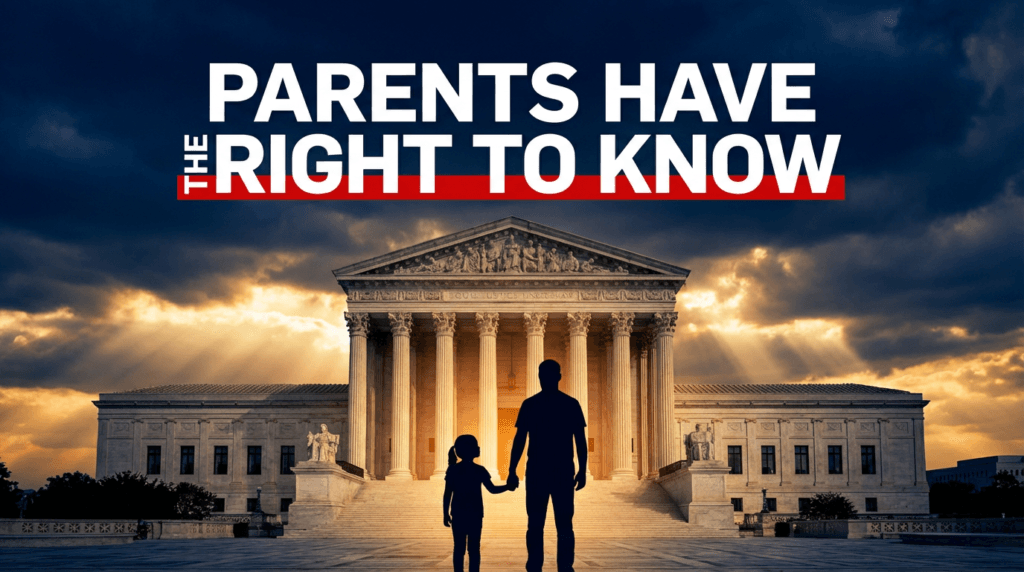
The State Has Overstepped — And the Supreme Court Said So
Imagine sending your child to school and not knowing — for nearly an entire year — that the staff was treating your daughter as a boy. No phone call. No letter home. No conversation. Just silence, by government mandate.
That is not a hypothetical. That is exactly what happened to a family in California, one of several parents at the center of a landmark legal battle that reached the highest court in the land. On March 2, 2026, the U.S. Supreme Court delivered a resounding answer to the question of who holds authority over a child’s upbringing: it is the parent — not the state.
In a 7-2 ruling in Mirabelli v. Bonta, the Supreme Court blocked California’s controversial law that barred public school staff from notifying parents when their child changed their name, pronouns, or gender identity at school. It is a victory not just for the families who fought this battle, but for every American who believes that government has no business inserting itself between a parent and their child.
What California Did — and Why It Was Wrong
In July 2024, Governor Gavin Newsom signed AB 1955, known as the SAFETY Act, making California the first — and only — state in the nation to prohibit school districts from requiring staff to notify parents about a student’s gender identity changes. Effective January 1, 2025, the law forbade schools from disclosing a student’s expressed gender identity or pronoun preferences to parents without the student’s explicit consent.
On its face, proponents argued this was a protective measure for vulnerable LGBTQ+ youth. But the practical reality was far more troubling: California’s public schools were, by law, permitted to withhold significant information about a child’s mental and social life from the very people responsible for raising them.
One set of parents in the case — practicing Christians — reported that their junior-high daughter was being treated as male at school for most of an academic year, and they were never told. Another family said teachers actively lied to them about how their daughter was being addressed at school. These were not edge cases or bureaucratic oversights. They were the direct, intended consequence of a law designed to keep parents in the dark.
This is what government overreach looks like in practice: not dramatic and obvious, but quiet, incremental, and dressed up as compassion.
The Courts Speak: Parents, Not the State, Come First
The legal road to the Supreme Court was long. In December 2025, U.S. District Judge Roger Benitez in San Diego ruled clearly and decisively in favor of the parents. In his opinion, he wrote that California policymakers “do not trust parents to do the right thing for their child” — and barred educators from intentionally concealing gender transition information from parents. He went further, ruling that teachers could not socially transition a child over the explicit objection of that child’s parents.
The 9th U.S. Circuit Court of Appeals — the notoriously left-leaning federal appeals court based in San Francisco — stepped in and paused Benitez’s order, calling it “too sweeping.” The families, represented by the Thomas More Society, a Catholic public interest law firm, took their case directly to the Supreme Court.
The result was unambiguous. In a seven-page unsigned majority opinion, the Court reinstated the district court’s ruling, blocked California’s law from being enforced, and affirmed that parents are likely to succeed on the merits of their constitutional claims. The majority cited two powerful legal foundations: the Free Exercise Clause of the First Amendment, and the long-established due process right of parents to direct the upbringing and education of their children.
The Court’s language was pointed and principled:
“Under long-established precedent, parents — not the State — have primary authority with respect to the upbringing and education of children. The right protected by these precedents includes the right not to be shut out of participation in decisions regarding their children’s mental health.”
Seven justices agreed. Only Justices Elena Kagan and Ketanji Brown Jackson dissented — and notably, their dissent focused not on the substance of parental rights, but on procedural objections to the use of the emergency docket.
Justice Amy Coney Barrett, joined by Chief Justice John Roberts and Justice Brett Kavanaugh, authored a concurring opinion that cut to the heart of the matter:
“Under California’s policy, parents will be excluded — perhaps for years — from participating in consequential decisions about their child’s mental health and wellbeing.”
That is not a policy disagreement. That is a constitutional violation.
Religious Freedom Is Not a Footnote
At the core of this case is something deeper than bureaucratic procedure: the right of religious parents to raise their children according to their sincerely held beliefs. The families who brought this case are Christians. Their faith shapes how they understand human nature, identity, family, and the responsibility of parents before God and law.
California’s policy directly undermined that. By allowing — even encouraging — schools to socially transition a child without parental knowledge or consent, the state was not merely staying neutral. It was making an affirmative choice to exclude religious parents from participating in one of the most significant developments in their child’s life.
The Supreme Court’s majority recognized this explicitly, holding that California’s policies are subject to strict scrutiny because they “substantially interfere with the right of parents to guide the religious development of their children.” Under that heightened standard, California’s law could not survive.
No government program, no matter how well-intentioned, has the authority to override a parent’s constitutional right to direct the moral and spiritual formation of their own child.
The Real Safety Net: Family, Not Government
California Attorney General Rob Bonta argued that the law was necessary to protect students who might face harm if their gender identity were disclosed to unsupportive parents. It is a serious concern — and one the Court addressed directly.
The majority opinion noted that California retains every tool it needs to protect children who are genuinely at risk: child-abuse laws already exist for that purpose. The existence of a small number of abusive households does not justify a blanket policy that treats every American parent as a suspect and strips millions of families of their fundamental rights.
This is a critical distinction. Conservatives do not argue that every parent is perfect, or that no child has ever faced a difficult home situation. The argument is that the proper response to abuse is the enforcement of existing law — not a sweeping government mandate that dismantles the presumption of parental fitness for the vast majority of loving, involved families.
As the Thomas More Society put it with characteristic bluntness: “California ‘balances’ the parents’ interests like McDonald’s balances the cow’s.”
The family is the first and most essential institution in a free society. When the state treats parents as obstacles rather than partners, it does not protect children — it replaces the irreplaceable.
A Win Today — A Warning for Tomorrow
This ruling is a victory, but it is an interim one. The Supreme Court’s order blocks California’s law while litigation continues — the final resolution of Mirabelli v. Bonta lies ahead. The battle is not over.
What the ruling does do is send a clear signal: the constitutional foundation for parental rights is strong, the Court’s conservative majority is willing to enforce it, and families have legal recourse when government oversteps. That matters enormously, not just in California, but in every state where similar policies are being debated or quietly implemented.
Across the country, parents are waking up to the reality that their schools are not always neutral institutions. Curriculum decisions, library selections, counseling practices, and administrative policies can and do carry ideological weight. The answer is not despair — it is engagement.
Conclusion: The Family Holds the Line
The Supreme Court’s ruling in Mirabelli v. Bonta is more than a legal decision about pronouns and school policies. It is an affirmation of a principle as old as the republic: that the family, not the government, is the cornerstone of a healthy and free society.
Parents are not obstacles to their children’s wellbeing. They are its primary guardians. The state serves families — not the other way around. When government forgets that, the courts must remind it. On March 2, 2026, they did exactly that.
This is what the defense of parental rights looks like. And it is only the beginning.