They Prey on the Homeless to Loot Medicare and Taxpayers Are Paying the Price
When the Most Vulnerable Become Tools for the Most Corrupt
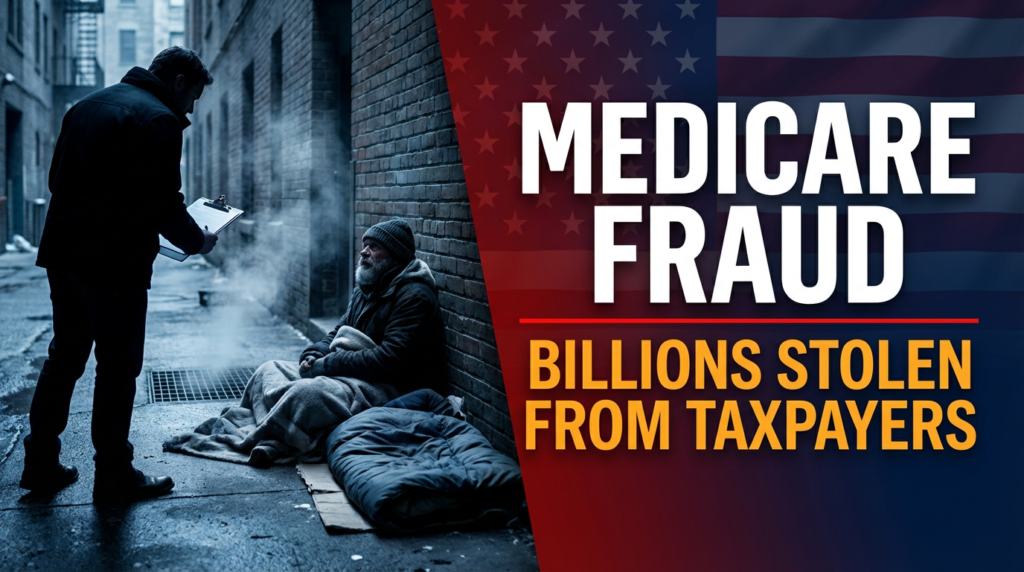
Imagine you are homeless, hungry, and someone walks up to you offering $15 in cash — all you have to do is let them take your blood pressure, check your pulse, and hand over your Social Security number. It sounds like charity. It is anything but.
Across California, recruiters — often working for criminal networks with ties to organized crime — are approaching vulnerable homeless Americans on the street, in shelters, and in encampments. They perform token health screenings, collect Medicare or Medi-Cal identification numbers, and then sell those numbers to fraudulent healthcare providers for anywhere between $1,000 and $3,000 each. Those providers then bill the federal government for medical services that were never rendered, treatments that were never needed, and patients who never consented.
This is not a conspiracy theory. It is a documented, prosecuted, and rapidly expanding criminal enterprise — and American taxpayers are footing the bill to the tune of billions of dollars every year.
The Case That Exposed the Playbook
The mechanics of this fraud were laid bare in the prosecution of James Roland Fuquay, a California man who became notorious enough in the healthcare underground to earn a nickname: the “Red, White and Blue Man” — a reference to the colors on a Medicare card.
Fuquay’s pitch to homeless individuals was brazen in its simplicity: “Red, white and blue. Let’s make it do what it do.” He recruited Medicare beneficiaries from homeless shelters in San Diego and Los Angeles, paying them small sums to accompany him to fraudulent medical clinics and durable medical equipment suppliers. Once there, the homeless individuals were instructed to request services and equipment — including power wheelchairs — that they neither needed nor actually received.
Fuquay was sentenced to 21 months in federal prison and ordered to pay more than $550,000 in restitution. His scheme generated $220,000 in illegal recruiter fees before investigators caught up with him.
His case is not an outlier. It is a template — one that has since been replicated, industrialized, and scaled to a degree that federal prosecutors now describe as nearly beyond comprehension.
A Fraud Ecosystem Built on the Backs of the Vulnerable
The exploitation of homeless Americans for Medicare and Medi-Cal fraud is part of a far broader criminal infrastructure that has taken root in California — particularly in Los Angeles County.
According to Dr. Mehmet Oz, Administrator of the Centers for Medicare and Medicaid Services (CMS), $3.5 billion in fraudulent hospice and home healthcare billing has been identified in LA County alone. The county is home to 1,923 hospice providers — more than 36 U.S. states combined, and 33 times more than Florida or New York, despite having a comparable senior population. Hospice services in LA have seen a sevenfold increase in just five years — with no corresponding rise in the number of deaths.
At the street level, recruiters target homeless individuals and offer small cash payments for their Medicare numbers — slang in the fraud world for “bennies.” Those numbers are sold upward through a criminal supply chain, eventually landing with fraudulent hospice and home healthcare providers who bill the government $260 per day per enrollee — for patients who may be perfectly healthy, completely unaware they have been enrolled, or in some cases entirely fictitious.
Federal prosecutors have linked much of this activity to Russian and Armenian organized crime networks, including the previously charged Mirzoyan-Terdjanian crime ring, whose members operated between the United States and Armenia and stole over $100 million from Medicare through phantom clinics. As one whistleblower bluntly put it: “I could fill out an application from Kazakhstan and get a hospice license.”
The GAO has estimated the federal government loses between $233 billion and $521 billion annually to fraud across all programs. Healthcare fraud alone accounts for tens of billions of that total each year, with the HHS Office of Inspector General identifying more than $16.6 billion in healthcare fraud, overpayments, and improper payments in its Spring 2025 report.
The Conservative Case for Outrage — and Action
This story is not merely about dollars and cents. It is about the fundamental compact between government and citizen — and what happens when that compact is systematically exploited.
Fiscal accountability demands that we recognize this for what it is: the looting of a program funded by American workers, retirees, and taxpayers. Every dollar stolen from Medicare is a dollar not available for a veteran who actually needs hospice care, a senior who genuinely requires home health services, or a disabled American dependent on the system. Fraud does not exist in a vacuum — it crowds out the truly vulnerable and drives up costs for everyone.
Law and order requires that we treat this with the severity it deserves. This is not petty theft. These are sophisticated criminal enterprises — many with foreign ties — that have systematically corrupted medical licensing systems, co-opted unscrupulous physicians, and built multi-billion-dollar criminal networks inside a government-funded healthcare program. The penalties must be swift, severe, and consistent.
Personal responsibility and the rule of law go hand in hand. When recruiters approach a homeless person and offer them $15 to hand over their Medicare number, they are not offering charity — they are committing a federal crime and conscripting a vulnerable person as an unwitting accomplice. The individuals running these networks deserve prosecution to the fullest extent of the law.
Limited government advocates have long warned that massive, poorly overseen entitlement programs create fertile ground for exactly this kind of abuse. A program so large and so loosely administered that a single county can house nearly 2,000 hospice providers — many operating out of strip malls with no staff present — is a program that has grown beyond its own ability to govern itself. Reform is not optional; it is urgent.
And there is a deeper moral dimension here. The homeless men and women being recruited on the streets of San Diego and Los Angeles are not abstractions. They are Americans — often struggling with addiction, mental illness, or sheer poverty — who are being exploited by criminal networks for profit. A society that claims to care about its most vulnerable must be furious that predators are using them as instruments of fraud against the very government programs meant to serve them.
Oversight Failures and the Political Dimension
To be fair, this is not a problem that appeared overnight — and it is not exclusively a political failure of one party or one administration. The Los Angeles Times first exposed the bogus hospice industry as far back as 2020. California Attorney General Rob Bonta has pursued prosecutions. The state has imposed a moratorium on new hospice licenses.
But the scale of what has been uncovered suggests those efforts were nowhere near sufficient. When 18% of the entire country’s home healthcare billing flows out of a single county — as Dr. Oz pointed out in January 2026 — something has gone structurally and systemically wrong. Oversight mechanisms failed. Licensing requirements were laughably easy to circumvent. And for years, the financial incentives to commit fraud far outweighed the risk of getting caught.
Federal prosecutors have now launched what they describe as an unprecedented investigation into California’s healthcare fraud ecosystem. Whether that investigation produces prosecutions at scale — or becomes another political press conference that yields little — remains to be seen. But the pressure must be maintained.
What Needs to Happen Now
The Fuquay case showed us the street-level mechanics. The LA hospice scandal shows us the industrial scale. Together, they point toward a set of clear demands that any serious policymaker should be willing to make:
- Strict caps on hospice provider licensing, with rigorous physical inspections before any license is issued or renewed
- Real-time billing surveillance to flag anomalous patterns before billions are paid out — not after
- Mandatory criminal background checks and verified proof of operations for all Medicare and Medi-Cal providers
- Enhanced penalties for using vulnerable populations — including the homeless and elderly — as instruments of fraud
- Full transparency from state governments on how federal healthcare dollars are being spent, with independent audits
A Call to Action
The exploitation of homeless Americans to fuel a multi-billion-dollar Medicare fraud machine is a scandal that should unite every taxpayer, every conservative, and every American who believes that government programs exist to serve people — not to be looted by criminal networks.
Stay informed. Share this article with your community. Contact your congressional representatives and demand that the investigations underway produce real prosecutions — not just press conferences. Support organizations working to protect both Medicare’s integrity and the dignity of homeless Americans being used as pawns in this scheme.
The “Red, White and Blue Man” went to prison. The networks behind him — the ones billing billions — must face the same reckoning.
Sources: HealthcareInfoSecurity, Fox News, NY Post, LA Times, U.S. GAO, HHS Office of Inspector General, Centers for Medicare & Medicaid Services, U.S. Department of Justice