Trump Targets State Farm and Insurance Giants Over California Wildfire Claim Failures
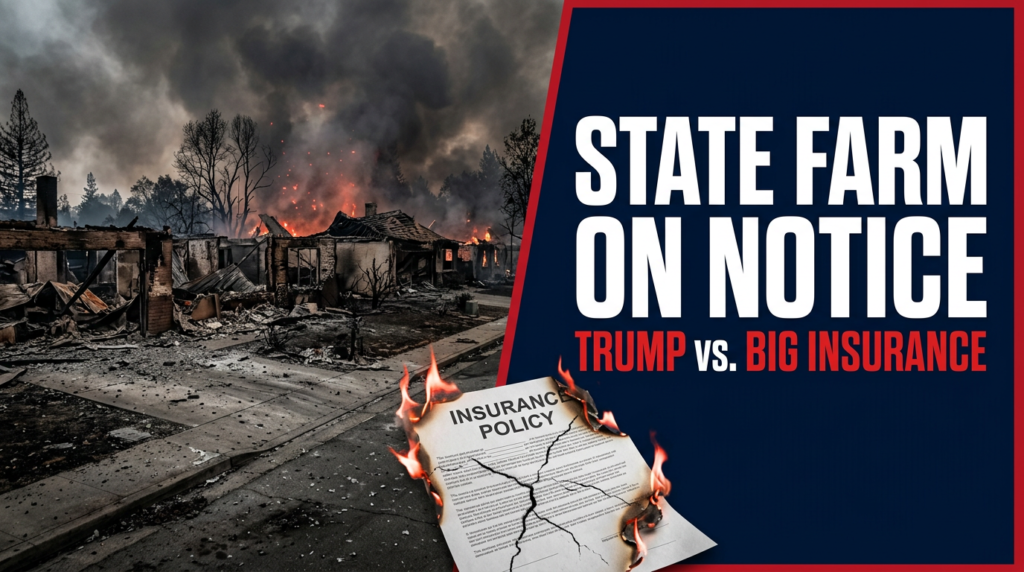
After years of collecting premiums and abandoning policyholders when disaster struck, America’s insurance industry is finally facing a reckoning — and the White House is leading the charge.
When the fires tore through Los Angeles in January 2025, they didn’t just destroy homes. They exposed a quiet betrayal that had been years in the making. Families who had faithfully paid their insurance premiums for decades discovered, at the worst possible moment, that the companies they trusted had already walked away — or worse, were now slow-walking, lowballing, and denying the very claims those families depended on to rebuild their lives.
Now, President Donald Trump is making it clear: that kind of corporate negligence will not go unanswered. In a March 31, 2026 post on Truth Social, Trump called out insurance companies — State Farm by name — for being “absolutely horrible to people that have been paying them large Premiums for years.” He announced that his administration is actively looking into the matter, and that he has tasked EPA Administrator Lee Zeldin with compiling a list of which companies honored their legal obligations — and which ones did not.
Support Independent Local Journalism
TheTownHall.News is a non-profit reader-supported journalism. Just $5 helps us hire local reporters, investigate important issues, and hold public officials accountable across Alameda County. If you believe our community deserves strong, independent journalism, please consider donating $5 today to support our work.The Betrayal Was Already in Motion Before the First Flame
The story of California’s insurance crisis didn’t begin when the fires started. It began long before, as major insurers quietly executed a calculated retreat from high-risk markets while continuing to collect premiums in the meantime.
State Farm — the nation’s largest home insurer — had already dropped approximately 1,600 home insurance policies in Pacific Palisades alone as of July 2024, according to the California Department of Insurance. That represents roughly 18 percent of owner-occupied homes in the neighborhood. Across California, State Farm was in the process of non-renewing 72,000 policies statewide, citing “catastrophe exposure” as justification — even as it sought a $1.3 billion rate hike from state regulators.
Let that sink in: the company was asking Californians to pay more while simultaneously abandoning them.
When the fires came in January 2025 and consumed thousands of homes, many of those same families turned to their insurers for help — only to find delayed responses, lowball settlements, and bureaucratic stonewalling.

Policyholders Paid In. The Companies Checked Out.
The complaints that followed were not isolated incidents. In November 2025, the Los Angeles County Counsel opened a formal investigation into State Farm’s handling of wildfire claims, focusing on potential violations of California’s Unfair Competition Law. The investigation came after a wave of complaints from residents who said the company had delayed, underpaid, or denied legitimate claims.
In April 2025, following direct talks with Trump envoy Richard Grenell, State Farm announced it would raise personal property payouts from 50% to 65% of claim value before requiring full itemization. The concession was welcomed — but it also revealed just how low the baseline had been. Paying out only half the value of a destroyed home before demanding exhaustive documentation from traumatized fire survivors is not the conduct of a company acting in good faith.
“People paid their premiums for decades. They held up their end of the deal. The insurance companies did not.”
This is not a regulatory abstraction. These are real families — teachers, small business owners, retirees — who lost everything and were then handed forms instead of checks.
Trump’s Move: Pressure, Accountability, and Political Signal
Trump’s Truth Social statement carries clear political weight. After meeting with California political representatives affected by the wildfires, he took the unusual step of asking EPA Administrator Lee Zeldin to compile two distinct lists: companies that acted honorably, and companies that did not.
The choice of Zeldin — an EPA administrator rather than the Department of Justice or a federal insurance regulator — has drawn questions. Critics are correct to note that insurance regulation in the United States is primarily a state-level function, governed by state insurance commissioners rather than federal agencies. The EPA has no traditional enforcement jurisdiction over insurance practices.
Support Independent Local Journalism
TheTownHall.News is a non-profit reader-supported journalism. Just $5 helps us hire local reporters, investigate important issues, and hold public officials accountable across Alameda County. If you believe our community deserves strong, independent journalism, please consider donating $5 today to support our work.But dismissing Trump’s action as legally toothless misses the larger point. The power of public accountability lists should not be underestimated. When the federal government formally flags which companies failed their policyholders, it accelerates state-level investigations, strengthens the hand of plaintiffs’ attorneys, shapes public perception, and puts boardrooms on notice. In a market where reputation is currency, being named by the President of the United States as a company that “was not there to help” carries real consequences.
What Critics Get Wrong
Predictably, some observers have framed this as government overreach — an administration meddling in private contracts and the free market. That argument deserves a serious response.
The free market functions when contracts are honored. Insurance is not a voluntary feel-good product; in most states it is legally required. Families are not choosing between competing luxury goods — they are complying with the law, entering into binding agreements, and paying premiums in good faith. When an insurer collects those premiums for years and then abandons its obligations at the moment of greatest need, that is not a “market outcome.” That is breach of contract, potential fraud, and — in some cases — regulatory violation.
Limited government does not mean unaccountable corporations. It means government stays in its lane and lets markets work honestly. When companies exploit legal gray zones to deny legitimate claims to disaster survivors, accountability is not overreach. It is justice.
The Real Stakes: Trust, Contracts, and the Rule of Law
At its core, this issue is about something more fundamental than insurance policy. It is about whether ordinary Americans can trust that a legal agreement — one they’ve honored faithfully for decades — will be honored in return.
California’s wildfire crisis has exposed a systemic failure: insurers gaming risk models, quietly exiting markets, and structuring claims processes to minimize payouts to vulnerable survivors. That is not how a functioning, honest market operates.
“If you can’t trust your insurance company when your house burns down, what exactly did you pay for?”
The administration’s intervention may be imperfect in its mechanism, but the instinct behind it is sound. State and federal regulators should now be compelled to act with urgency — not conduct investigations that drag on for years while survivors wait in limbo.
Conclusion: Accountability Is Not Optional
The California wildfire insurance scandal is a test of a basic American principle: that contracts mean something, that honesty matters, and that no company — however large or well-connected — gets to take your money for years and then disappear when you need them most.
Trump’s directive to produce an accountability list is a first step. It will mean more if it leads to real regulatory action, enforceable consequences, and structural reform of how insurance companies process disaster claims.
The families of Pacific Palisades, Altadena, and greater Los Angeles deserve answers. They deserve their claims paid in full. And they deserve to know the system is working for them — not against them.
Holding State Farm and others accountable isn’t about politics. It’s about keeping a promise.
Key Takeaway: Insurance companies collected premiums for years, dropped thousands of policies months before the wildfires hit, then delayed or denied claims from survivors. The Trump administration is now applying federal pressure to force accountability — and Americans across the country are watching to see if it works.
Stay informed. Share this article with someone who deserves to know the truth. Independent journalism depends on readers like you.