While LA Sits on $473 Million, Its Homeless Are Living in Sewers
There’s a moment that says everything you need to know about the state of government in Los Angeles.
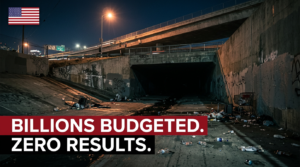
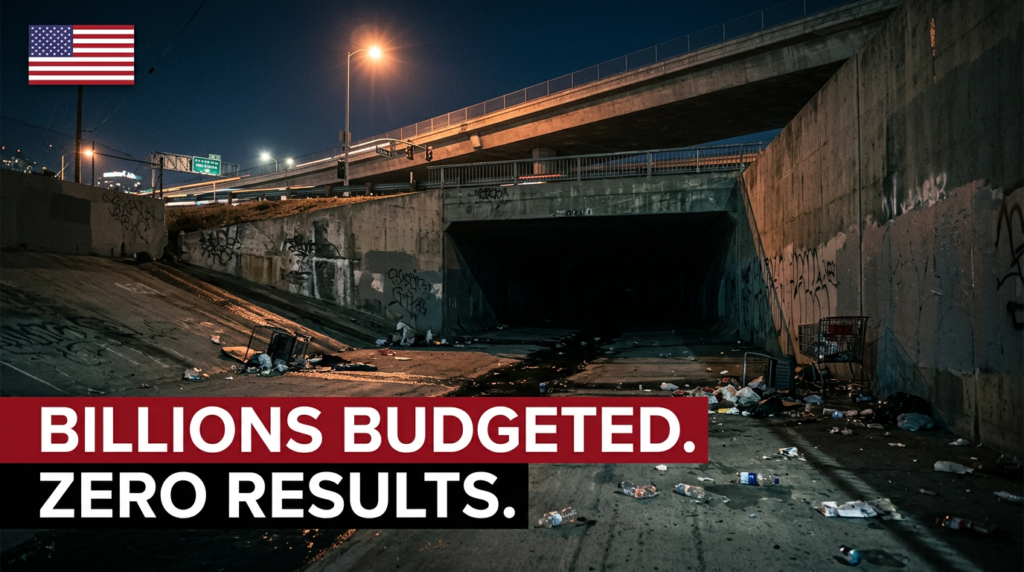
A woman — disheveled, clearly suffering from mental illness, clearly in distress — is living inside a storm drain off the 110 Freeway in South Los Angeles. The 10-foot concrete tunnel she calls home is filled with trash, human waste, and swarming flies. There is no running water. She has no idea how she ended up there. And when a reporter asks whether anyone from the city has ever come by to offer housing or help, her answer is simple: No.
Meanwhile, just two days before this footage aired on KTLA and FOX 11, the Los Angeles City Controller’s Office released a report revealing that the city left $473 million in homelessness funding unspent in fiscal year 2025–26. The year before that, it was more than $500 million. Combined, over two consecutive fiscal years, Los Angeles failed to deploy more than $973 million it had committed to solving this very crisis.
This is not a funding problem. This is a governance failure — and it is happening in plain sight.
Support Independent Local Journalism
TheTownHall.News is a non-profit reader-supported journalism. Just $5 helps us hire local reporters, investigate important issues, and hold public officials accountable across Alameda County. If you believe our community deserves strong, independent journalism, please consider donating $5 today to support our work.Billions Budgeted, Billions Burned
To understand the scale of what is going wrong in Los Angeles, you have to follow the money.
The city’s homelessness budget for fiscal year 2025–26 was approximately $961 million — rising to over $1.1 billion when accounting for additional appropriations and prior-year carryover. Out of that staggering sum, the city spent only $516 million, with another $119 million merely “encumbered” — committed on paper but not guaranteed to be spent. That left $473 million sitting idle, according to City Controller Kenneth Mejia.
“For the second year in a row, the city ended up spending much less on homelessness than it promised,” Mejia said in his official statement. “People need housing and services today, not a year or two from now.”
Even more damning, Mejia identified the structural reasons for the dysfunction: homelessness efforts are decentralized with no single department in charge, approvals for spending plans are perpetually delayed, staffing is insufficient, and funds are routinely rolled over year after year without accountability. In short, Los Angeles has created a bureaucratic maze so complex that it cannot efficiently spend a billion dollars even when the human cost of failure is on full display in its own storm drains.

Councilwoman Nithya Raman, chair of the Housing and Homelessness Committee, said it herself: “The city has once again spent far less than its allocated homelessness budget.” She added that a Bureau of Homeless Oversight she proposed to centralize accountability had, nearly a year later, failed to hire a single staff member.
This is what unchecked government expansion looks like in practice — not a compassionate safety net, but a labyrinthine spending apparatus that burns through taxpayer resources while delivering next to nothing to the people it claims to serve.
The Human Cost of Bureaucratic Indifference
Juan Naula is not a city official. He is not a politician. He is one man who founded a nonprofit called Clean LA With Me and spends his own time cleaning streets and reaching out to unhoused neighbors in South Los Angeles. He is the one who found the woman in the storm drain. He is the one who documented men living in stripped-down cars. He is the one who contacted the Department of Sanitation and received, in response, an email saying they planned to seal the sewer.
“I’m just a guy,” Naula told KTLA. “I’m just one person trying to fix these things. But the city has to jump in.”
What Naula embodies is the conservative value of personal responsibility and civic action — the idea that ordinary citizens, not government programs, are often the first and most effective line of community care. But his work also illustrates the hard truth: no single volunteer, no matter how dedicated, can compensate for a government that absorbs billions, delivers bureaucracy, and calls it compassion.
Support Independent Local Journalism
TheTownHall.News is a non-profit reader-supported journalism. Just $5 helps us hire local reporters, investigate important issues, and hold public officials accountable across Alameda County. If you believe our community deserves strong, independent journalism, please consider donating $5 today to support our work.When KTLA called 311 to report the conditions near the 110 Freeway, they were told it could take up to 90 days for the Department of Sanitation to respond. Two city street sweepers eventually came through — and did a “superficial cleanup” that changed nothing. This location, it should be noted, is not new to the city. KTLA covered a city-led cleanup and tent removal at the same site in September 2025. The people came back. Because without consistent enforcement, without consequences, and without real follow-through, cleanups are nothing more than theater.
Law, Order, and the Right to Safe Neighborhoods
The residents living near 88th Street and South Grand Avenue are not wealthy. They are working-class South Angelenos who have repeatedly called the city for help and been told, in effect, to wait. Their cars have been vandalized. Metal wiring has been stripped from their street. Drug activity is rampant around their homes and near their children.
“It pisses me off,” said Latoia Thomas, a neighbor who has watched the situation deteriorate. “We need your help. The public here needs that.”
These are law-abiding residents exercising their most basic right: the right to live in a safe, orderly neighborhood. That right is being eroded — not by a lack of compassion, but by a city government so ideologically committed to a single approach that it refuses to enforce basic public safety laws.
Conservatives have long argued that genuine compassion does not mean tolerating dangerous encampments indefinitely. It means enforcing the law equitably, connecting people with meaningful help, and maintaining the public order that makes safe communities possible for everyone — including the most vulnerable. The Supreme Court’s 2024 ruling in City of Grants Pass v. Johnson affirmed that cities can enforce anti-camping ordinances in public spaces. Los Angeles has the legal authority to act. What it lacks is the political will.
The 17% Talking Point and the Reality Beneath It
Mayor Karen Bass has repeatedly cited a 17% decline in street homelessness under her watch, pointing to two consecutive years of improvement in the annual point-in-time count. And to be fair — any measurable decline is better than an increase. Progress should be acknowledged.
But a 17% improvement — measured by a single-night snapshot count that critics have long called methodologically questionable — does not square with the image of a woman living in a concrete sewer in March 2026. It does not explain why the city left nearly half a billion dollars on the table for the second year running. And it does not address the deeper question: at what cost, and to what long-term effect?
Los Angeles County has approved $908 million in homelessness funding for fiscal year 2025–26 alone. If the benchmark for success is a 4% reduction in the overall county count — as the 2025 LAHSA report showed — then taxpayers deserve a much more rigorous accounting of what they are getting for that money. Fiscal accountability is not cruelty. It is a fundamental obligation elected officials owe to the public.
What Real Solutions Look Like
The conversation about homelessness has been trapped in a false binary for too long: either spend more, or you don’t care. But the evidence in Los Angeles makes clear that spending more is not the same as doing more. What is needed is a fundamental rethinking of how taxpayer dollars are deployed, who is accountable for results, and what outcomes are acceptable.
Real solutions include centralized oversight with a single accountable department — something City Controller Mejia explicitly recommended. They include enforcing existing laws against illegal encampments with consistency, not just during election cycles. They include targeted mental health intervention that matches the scale of need, not watered-down outreach with 90-day response windows. And they include being honest with the public about what the numbers actually mean.
Most critically, they include protecting the dignity of the people caught in this crisis — people like the woman in the storm drain who said she would like safer, more permanent housing and was told by no one that help existed. Her suffering is a direct consequence of a system that mistakes money allocated for money spent, and process for outcome.
Conclusion: Government Must Be Held Accountable
The storm drains of South Los Angeles are not just a humanitarian story. They are a political accountability story. A city that budgets over a billion dollars for homelessness and cannot figure out how to spend nearly half of it — while a volunteer with a nonprofit finds people living underground — has a governance crisis, not just a housing crisis.
Conservatives believe that government should be lean, effective, and accountable to the people it serves. They believe that public safety is a core function of civic life. They believe that real compassion means results, not just rhetoric. And they believe that citizens — taxpayers, neighbors, volunteers like Juan Naula — deserve better than performative cleanups and budget theater.
The people living in Los Angeles’s sewers deserve better too.
Take Action
Stay informed. Share this article and follow the Los Angeles homelessness debate closely as Mayor Bass faces reelection.
Demand accountability. Contact your Los Angeles City Council representative and demand monthly public reporting on how homelessness dollars are actually being spent — as City Controller Mejia has formally recommended.
Support local solutions. Organizations like Clean LA With Me are doing the work that government has failed to do. Consider supporting community-led initiatives that prioritize direct, accountable action.
Vote informed. Know where every candidate stands — not on how much they want to spend, but on how they plan to be accountable for results.
The time for excuses is over. The drains are full. The budget isn’t.