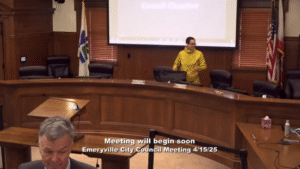
lanetary environment. The goal is to address inequities in energy access and prioritize the health of people and the environment. And now, therefore, it be resolved by the city council of the city of Emeryville that 04/22/2025 is hereby proclaimed as Earth Day in the city of Emeryville, and all residents, businesses, and institutions are urged to advocate for policy changes, adopt renewable energy solutions, and work towards a cleaner and more sustainable future for our planet as proclaimed by the mayor of the city council of the city of Emeryville at a regular meeting held Tuesday, 04/15/2025. We now have item 4.2, a presentation from the police department for the annual report. Chief Jennings. Alrighty. Good evening, vice mayor Carr, mayor Moore, and our former first mayor, Courtney Welch. So this is gonna be a brief, overview of our annual report. Normally, luckily, I have the 3 people who've been on my public safety committee who've seen this or a version of this before. Car just saw it a couple months ago. So, you know, what it normally looks like, but it's also for, community members who did not have an opportunity to see it. They can see it through on, the webpage or the large gallery we have here today. So, with that, you see our annual picture we got right here behind us. You see a very eclectic, happy group. Next slide. Basically, my message, and my message is always the same. I appreciate the fact that I have a council that has given us the tools and the support to do what we've done, and I definitely appreciate my officers who have gotten the job done, bringing more trust in, community engagement, with the city. So I can't I can't do it without the officers that we have. Next slide. This is my former command staff. Everyone here is gone besides acting Lieutenant Dauer and PSM, Buze, but they'll both be leaving shortly also, so that that'll be different next year. Next slide. You'll see my my main sergeants here. 3 of these people will be gone, in the next future. And, special thanks to Sergeant Pablo Roxas, who actually put the PowerPoint together and is our community engagement liaison, and also my, recruiting and training officer, which is critical to the growth of our organization. Next slide, please. Again, about staffing. You see some pictures, lovely folks, that we just hired. 1 of the highest, honors to bring new people into their organization. It's important to hire good folks. That's the beginning of having a good organization. At 1.1 glorious moment, we were totally staffed in October, but that has changed, with attrition and injuries and some people moved on. So you see the numbers right there. And at any point in time, feel free to ask me any questions. We can engage in this. We're gonna keep it going. But again, you've seen this before. Next slide, please. Another thing that I'm proud of in our organization is the demographics. You see, we're a very, diverse organization, by our numbers and by the photos that you saw. We definitely represent the community that we serve. 1 of the things I'm most proud of is the fact that I've made it intentional to hire, great qualified female officers. The national average for female officers is less than 10%. We're up to 19% and, we're on our way to get to 30%. That's the national 30 on 30, initiative that's been put on by the National Chiefs of Police. And, I'm informally a part of that. I'm going to, I'm going to get there. So we're going to get there. Next slide, please. Again, our female, statistics, demographics are sworn. Again, seem very diverse. Nice. Next slide, please. Again, so what we hear about, our primary focus is to thwart crime, drive down crime, driving down the fear of crime. We've done an excellent job of doing that, and this is a for how you wanna get into it, a very layered, nuanced way of driving down crime that, with me and my 34 years of experience and my officers with a lot of experience have focused on with a with a vision of making sure that we're integrated with the growth of the city and also the, the feeling of, togetherness in the city. So most of our crime is property crime. 85% of our crime is property crime. We have a rich, diverse, commercial, area. We have a lot of apartment complexes and most of our crimes are petty theft, based on opportunity to commit those thefts. Next slide, please. Or violent crime. Any crime of violence is also, you know, is a threat to our society, the fabric of our society. But our crime rate, again, is low, especially compared to our regional partners. 1 of the things also I pride myself on is I did a, longitudinal study of our crime from 2010 till now, where you'll see across the region that most people most agencies' crime is down 15% to 20%, if not higher. But a lot of those crimes are, are down from, a high point that they've had. We've never reached our high point in the last, 15 years. Our higher point of crime was 2019, and we've never gotten to that number back yet. So I'm pretty pleased with that number. The numbers went up during, went down during COVID, and then they shot up exponentially, 21, 22, 23. And we're seeing, we've, ours was going up, but we've kept it below that high point number, which is really pleasing for us. Next slide. Again, showing that a crime is down 20%. The number is up to right now. We're down another 10 to 15% on most crimes compared to last year. So, again, this is due to several factors in my opinion, 1 being a change in, public policy, that's going across our region. Another is the fact that we've gotten the flock camera system. Another factor is that we had a significant increase in our staffing. So instead of running overtime to run the day to day operations of the police department, we're using the overtime to thwart crime by using some of the graph, the grant money that you'll see there on that we've used to put those strategically in areas that were crime was occurring to actually drive down crime further. So multi layered and everyone buying in on my vision And, the new hires are very enthused. Next slide, please. Again, breaking down the crime numbers. Again, petty theft being the highest. Our our, our crimes of violence are being the lowest, which is great. But, you know, any crime. We're trying to get to a utopia where there is no scribe, and you don't need police officers. And then our breakdown by demographics, and their rest. Next slide. Our juvenile rest remain consistently low. We consistently return juveniles to their homes, 79, 80 percent. The 1 the juveniles that end up going to juvenile hall usually have a warrant for the arrest for some other, reason. Possession of a firearm is automatic, take to juvenile hall. Usually, the robberies are depending how the robbery was committed. Was it force or fear? Was there actual violence used? They they automatically go to juvenile hall. So those numbers remain low, which is good for us at the win. Next slide, please. To me, this is important. And it really would be more important for the members who have not been on the, public safety committee. But this really explains how our use of force is used. Try to give an explanation. So if if you were to arrest me and then, Mayor Moore put me in a twist lock and Vice Mayor Moore put me in another twist lock is 1 victim or 1 suspect, but 2 incidents. So the numbers can be skewed in that sense, but every use of force is counted in our, in our matrix, and you can see less than 0.4% of our, our calls for service involve force, which is different from what you see in the news, it's different from what you see, what you read in the paper. But that's how, California counts our, our incidents of uses of force. Vast majority of our, contacts are traffic and a lot of talking. Next slide, please. Usually, we use the forces that will come complaints. Those are definitions of our dispositions of uses of, complaints. Not really nuanced. Either you, you know, we have very you'll see the next we'll just go to the next slide. Unless you have any questions. So you'll see our numbers. Very part of our trans our transparency portal. All this is on our web page. You can find all this information. It's on there. You'll see that most of our sustainer for policy violations. And, essentially, every day, there's somebody who's doing a policy violation. It could be as as minor as not having your, your correct uniform on. So there's policy violations day to day. But every time that we do a, internal affairs complaint, we look at it from top to bottom. If we find policy violations, you see those are sustained, but you don't see any sustained for any, force, violence, rudeness. Well, there's some rudeness in the sustained policy violation. But the ones that really get us in trouble of, the ones we don't like, the mistake of the mind, where or the specific mistake of the heart. Whereas the heart where you're you're you're malicy by malice committing, you know, hurting someone, believing in someone, we don't have that in our organization. And those are born out in our internal affairs investigations, which are, which are low. Next slide. 1 of the reasons why I think that our crimes are down again, nuanced approach is the flock cameras. Thank you, council for approving that. Some of the numbers that come with that, 2,000,000 license plates are scanned monthly. Same license plate can run through the town 16 time. You count 16, 16 other times. But you'll see some of the things. And these are numbers are just from, October when the cameras were fully off automated to December. So this is a short, snapshot of how the cameras have affected us. But the most important number to me, besides the ones we've arrested, is the 3 96 to 1 vehicles alerted and the 20 felony vehicles alerted. When officers are alerted, they see it. They go. They drive the car out of town. That anecdotally would be the reason why crime could be done also. So there's several things that go involved with, fighting crime. This is a very good tool. City, manager Bellos just had me talk to our state senator regarding giving another federal grant, to maybe possibly or asking for, the rest of the cameras, to be paid for through a grant. So we'll see how that that goes. So, I talked to Luca for quite a bit. I sent her our our staff report. So we'll see what comes out of that. Next, slide, please. My staff, again, my my beautiful communication staff with part of my, parking enforcement staff, you see the amount of calls. A lot of calls for service. I'm very pleased that our 911 answers are 20 seconds or less, which is, integral to people feeling like they're gonna be served when they call us. We're a full full service organization. We have a we respond. And, I can't say that for for everybody. You see the amount of calls for service that we have, significant amount of calls, 38,000, and the amount of reports are generated, 4,000. Next slide. 1 person doing this property and evidence booking, almost 2,000 items booked in a year, over 2,000 other items purged. That's done with the group on overtime and 500,000,000 pounds of drugs purged. That's done by 1 person's, 1 person, Adrian Robinson, and she's also the 1 that does all the stats that you see. So I I know the public safety committee under understands that. Everyone's listening on the watching the television. 1 wonderful person does all that work. Next slide, please. Another 1 person does our records. With a little help from our, my, my public safety manager, Duchess Bouzet. So again, a lot of calls for requests. These things are not easy to do, redacting, finding them, mailing reports out, and sending subpoenas. So that was simply done by 1 or 2 people in my organization. Next slide, please. And she's also my chaplain. So a lot of people doing multiple things. Traffic enforcement. So this is 1 of the things that caused me concern last year when I saw the amount of traffic actions that we had. Back in the day, well, before any of us, there used to be 4 traffic enforcement officers. We're down to 1, Steve Hindergard. Everyone's responsible for doing traffic. Every officer is supposed to be doing some, but that number had significantly dropped after COVID. It was like hands off. So I, reenergized the folks into doing these things because we wanna drive down, injury accidents, accidents where people really get, who die. And also, it's proven that when you're having, proactive enforcement, that it drives down crime in your town. So you see that there's a 27 increase in traffic stops, 70% increase in moving violations. My emphasis to answer some of the, qualitative issues regarding our stops is to make sure you're moving doing moving violations opposed to mechanical violations. So we're looking at things that are gonna cause accidents, which is easier for me to defend if something goes wrong in doing that traffic stop. I'm not caring about expired, registration or your cracked windshield and this is so egregious that you're gonna imminently wreck. But I want you to do running red lights, running stop signs, you know, merging crazy. So those are why you see the 70% increase. We made an emphasis on that. Parking citations up 9%, which is amazing because those doom buggies that we have have been broken on and off. So they really again, the officers are doing some more park parking citations. So that's a significant, revenue maker. And also, it keeps the flow of traffic in our our commerce areas moving. And so that was a 9% increase. And that 1, Mike, is gone. It's only only 1 parking enforcement officer right now. So that's another vacancy that we're we're working to fix, because they pay for themselves. Next slide, please. Again, more of the traffic collision numbers. Next slide. 1 of the things that, again, I'm I'm pleased with that, you know, I had officers buy into doing these grants. There was no way that the command staff could do this on their own....