H Mart Dublin Grand Opening Draws 10,000: What It Really Means for the Bay Area
When a Korean supermarket draws a crowd the size of a small city on opening day, smart people take notice — this isn’t just a food story, it’s an economic and civic one.
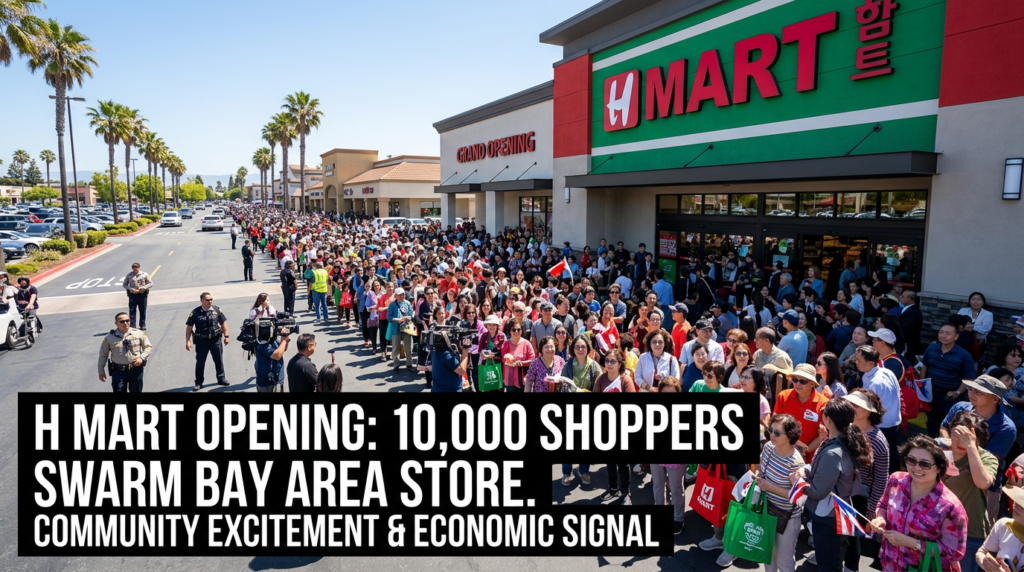
When the doors swung open at H Mart’s new Dublin location on March 26, 2026, the line already stretched around the block. By day’s end, an estimated 10,000 people had passed through a 27,237-square-foot store on Dublin Boulevard — a building that, just a few years ago, housed a hardware outlet. The crowd wasn’t manufactured by a tech company or government subsidy. It was the market speaking in the clearest possible language.
This is what organic community demand looks like. No mandate, no grant, no press release from a city task force. Just tens of thousands of people choosing, with their own time and their own dollars, to show up. In an era when policymakers often talk about “building community,” here was a grocery chain quietly doing it — one banchan container at a time.
Support Independent Local Journalism
TheTownHall.News is a non-profit reader-supported journalism. Just $5 helps us hire local reporters, investigate important issues, and hold public officials accountable across Alameda County. If you believe our community deserves strong, independent journalism, please consider donating $5 today to support our work.Why Dublin? The Numbers Behind the Buzz
Dublin isn’t an accident. It’s one of California’s fastest-growing cities, a suburb of roughly 75,000 residents in the Tri-Valley region anchored by the I-580/I-680 corridor — a stretch connecting Oakland to San Jose that has seen explosive residential and commercial development over the past decade. The city’s population has grown by over 50% since 2010, driven substantially by professional families, many of them first- and second-generation Asian Americans who have built careers in the Bay Area’s tech economy.
H Mart recognized what planners took longer to see. The chain began planning the Dublin conversion in 2022, transforming a shuttered Orchard Supply Hardware store into the company’s fourth Bay Area location and first in the East Bay. H Mart operates approximately 100 stores across 18 states and generates roughly $1 billion in annual sales — and notably, about 30% of its customer base is now non-Asian. This is not a niche ethnic market. This is mainstream American grocery retail, with a distinctly community-rooted character.
The market found the people before the bureaucrats drew the map.
The Private Sector Does What Government Never Could
There’s a lesson here that goes beyond food. H Mart’s Dublin store features an 8,552-square-foot food hall anchoring six independent vendors: Korean fried chicken, soft-tofu soup, French-Asian pastries, Korean-Chinese noodles, and more. Each of those vendors represents a small business owner — an entrepreneur who bet their capital and sweat on a location because the demand was real and the infrastructure was there.

This is the private sector functioning as it should: reading consumer signals, deploying capital efficiently, creating jobs, and enriching a community — without a city council vote, a diversity consultant, or a taxpayer subsidy. Dublin’s Vice Mayor Jean Josey acknowledged the store as “a huge boon for the local economy” and called it “a regional draw.” She’s right. But she didn’t build it. H Mart did.
That distinction matters enormously. When government takes credit for economic vitality it didn’t create, it distorts the public’s understanding of what actually drives prosperity — and sets the stage for policies that crowd out the private initiative that made success possible in the first place.
A Wave, Not a Ripple: The Asian Grocery Expansion Reshaping the Bay Area
The Dublin H Mart opening is not an isolated event. It’s the most visible moment in a broader, market-driven restructuring of the Bay Area’s retail food landscape. Consider what’s coming:
- H Mart Fremont — Planned for late 2026 at Pacific Commons Shopping Center, the new Fremont location is expected to span 100,000 square feet across two stories, making it the largest H Mart in the entire United States.
- Mega Mart — A second Korean supermarket chain is set to open at 2480 Dublin Blvd., less than five miles from H Mart, in the former Lucky Supermarket building.
- T&T Supermarket — The Canada-headquartered Asian grocery chain is targeting three Bay Area openings in 2026: San Francisco, San Jose, and Millbrae.
- Tokyo Central opened in Emeryville in January 2026.
- Osaka Marketplace launched in Foster City in December 2025, with a Pleasant Hill location in development.
The I-680 corridor, from Dublin south through Fremont and into San Jose, is emerging as a genuine economic spine for the region’s diverse, entrepreneurially minded middle class. These are privately owned businesses responding to real demand — not redevelopment zones, not enterprise tax schemes, not government-designated “opportunity corridors.”
What Critics Get Wrong About “Ethnic” Retail
Some urban commentators have a habit of categorizing stores like H Mart as community-specific amenities — good for “representation,” perhaps, but not central to the broader economic story. That reading is both condescending and empirically wrong.
Support Independent Local Journalism
TheTownHall.News is a non-profit reader-supported journalism. Just $5 helps us hire local reporters, investigate important issues, and hold public officials accountable across Alameda County. If you believe our community deserves strong, independent journalism, please consider donating $5 today to support our work.H Mart’s 30% non-Asian customer base is the data point that ends that argument. What began as a specialty Korean grocer in Queens in 1982 — serving immigrants who needed specific ingredients, familiar tastes, and an affordable price point — has evolved into a billion-dollar national retailer with a food culture following that cuts across ethnicity, age, and income bracket. The Dublin opening drew families from across the Bay Area: Oakland, San Jose, Fremont, Walnut Creek.
This is integration achieved through commerce, not coercion. It’s the story of a first-generation Korean-American grocery concept growing into a mainstream American institution by earning it — through quality, value, and an understanding of what customers actually want. It’s a model worth studying, and worth defending against the reflexive impulse to bureaucratize success.
What This Means for Families, Property, and Community
For families in the Tri-Valley and South Bay, the arrival of H Mart — and the wave of Asian grocery expansion surrounding it — is a genuine quality-of-life signal. Access to diverse, high-quality, affordable food is not a luxury. It’s a marker of a functioning local economy and a thriving civic culture.
For property owners and prospective buyers, the implications are equally clear. Retail amenities of this caliber — a food hall, a destination grocery, walkable community gathering space — are among the strongest leading indicators of neighborhood appreciation. Realtors, investors, and families tracking the Dublin–Fremont–San Jose corridor should be paying close attention.
Where a community chooses to spend its Saturday morning says more about that neighborhood’s future than any city planning document ever will.
The first person in line for Dublin H Mart’s opening arrived at 6:45 a.m. — three hours and fifteen minutes before the doors opened. She wasn’t responding to a government incentive. She was responding to something far more powerful: a business that earned her trust, her time, and her loyalty.
Key Takeaway
The H Mart Dublin opening is a case study in what happens when private enterprise meets genuine community demand. Ten thousand people don’t stand in line for a store out of civic obligation. They do it because the market delivered something worth waiting for. The Bay Area’s Asian grocery expansion — from Dublin to Fremont to San Jose — is being built without a government blueprint. That’s not a bug. That’s the feature.
Conclusion: The Market Knows the Neighborhood
The conversation around Bay Area economic vitality too often centers on what government can do — zoning reforms, development authorities, tax incentives. The H Mart story offers a bracing counterpoint. Here is a New Jersey-headquartered company, founded by Korean immigrants in a Queens storefront in 1982, that quietly identified a market gap in the East Bay, navigated four years of development, and delivered a destination that drew ten thousand people on its first morning.
No task force scheduled this. No subsidy made it viable. A company read the community, made the investment, and the community responded. That’s the engine of American civic and economic life working as it should.
The Bay Area’s Tri-Valley corridor is sending clear signals about where growth is headed. Families, businesses, and elected officials alike would do well to read them — and to get out of the way.
Stay informed. Share this article with someone who needs to hear it. Subscribe to independent journalism that follows the facts, not the narrative.