When the World Burns, Americans Pay at the Pump: The Iran Conflict and the True Cost of Energy Vulnerability
The Bill Always Comes Home
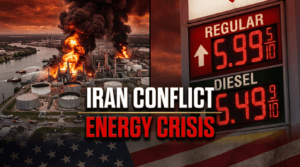
On February 28, 2026, U.S. and Israeli forces launched coordinated strikes against Iran, targeting its military leadership, missile infrastructure, and nuclear program. Within hours, global oil markets shuddered. Brent crude surged nearly $10 per barrel, reaching close to $80 — a roughly $20 increase since late January. Natural gas prices spiked. Tankers began diverting from the Strait of Hormuz. And somewhere in Middle America, the price on the gas station sign quietly crept upward.
This is the moment to be clear-eyed. Whatever one believes about the strategic merits of the strikes on Iran, the economic consequences are real, immediate, and landing squarely on the shoulders of ordinary American families. After five years of stubborn inflation, rising grocery bills, and a Federal Reserve still fighting to return prices to its 2% target, the last thing working Americans needed was another shock to the energy markets. The Iran conflict has delivered exactly that — and it demands an honest reckoning about how we got here, what’s at stake, and what a truly responsible American energy policy should look like.
The Numbers Don’t Lie: What’s Happening in Energy Markets
The scale of the disruption is not hypothetical. The Strait of Hormuz — a narrow waterway on Iran’s southern border — carries approximately 15 million barrels of crude and condensate per day, representing nearly one-third of all global seaborne oil exports. About 20% of the world’s liquefied natural gas (LNG) flows through it as well. Iran’s strategic position along that chokepoint gives Tehran enormous leverage, and it has not hesitated to use it: oil tankers have been attacked, shipments suspended, risk insurance canceled, and freight rates have skyrocketed.
EY-Parthenon Chief Economist Gregory Daco warned this week that a sustained disruption of Hormuz transit could push Brent crude toward $110 per barrel — a level not seen since the post-COVID energy crisis — while European natural gas prices could surge by 150%. Bob McNally, a former White House energy advisor, was even more blunt: “A prolonged closure of the Strait of Hormuz is a guaranteed global recession.”
Meanwhile, Saudi Arabia’s Ras Tanura refinery — processing 550,000 barrels per day — has been struck in Iranian retaliatory attacks. Qatar’s Ras Laffan LNG facility, which supplies much of Europe and Asia, has faced shutdowns. According to Columbia University’s Center on Global Energy Policy, the market’s inventory buffers would be “swiftly depleted” if Hormuz disruptions extend beyond a short period.
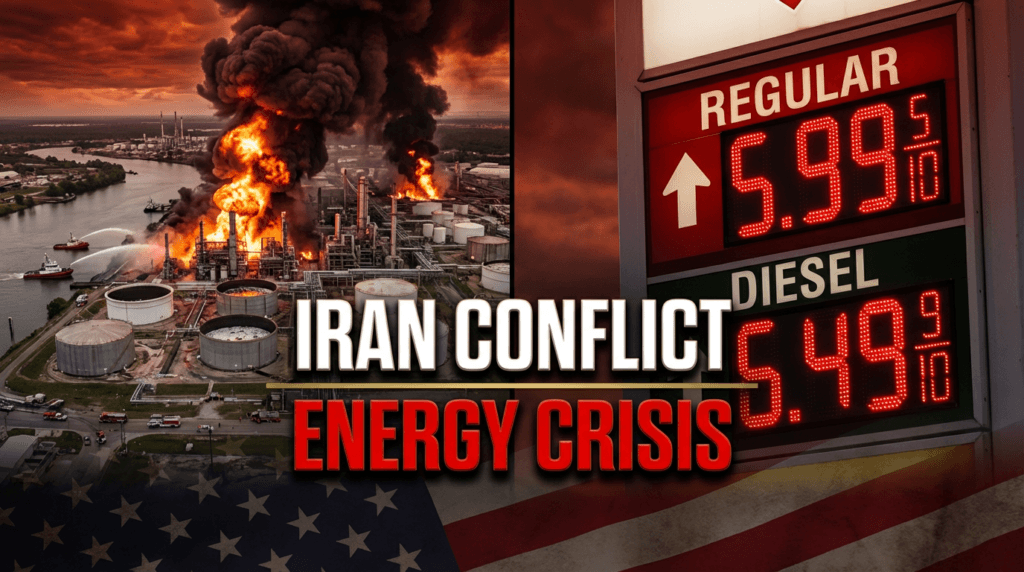
At home, U.S. crude oil was up roughly 6% on Monday, March 2, settling near $71 per barrel. Gasoline futures rose 4%. The national average for gas was already near $3.00 a gallon — and economists warn it could climb toward $3.50 or higher if the conflict drags on.
Inflation’s Third Act — And Families Are Paying for the Ticket
Americans have already endured five consecutive years of inflation above the Federal Reserve’s 2% target. The Fed’s preferred inflation gauge — the Personal Consumption Expenditures (PCE) index — sat at approximately 3% as of December 2025, with tariffs alone accounting for an estimated 0.5 to 0.75 percentage points of that pressure, according to New York Fed President John Williams.
Now comes a potential third act: an energy-driven price surge layered on top of tariff-driven inflation and lingering pandemic-era distortions. Higher oil prices don’t stay in the gas tank. They ripple through the entire economy — into airfares, shipping costs, heating bills, and grocery prices. Natural gas, already up 10% over the past year due in part to surging AI data center demand, faces additional upward pressure as Qatari LNG exits the market.
Bond markets are already reading the situation clearly. Treasury yields rose — not fell — after the strikes, signaling that investors are more worried about inflation than recession. That matters enormously, because it signals the Federal Reserve may be forced to keep interest rates higher for longer, delaying the rate relief that millions of homeowners, small business owners, and consumers are desperately waiting for.
Personal fiscal responsibility is a cornerstone of conservative values. But individual responsibility can only go so far when government policy — or its failures — drives the cost of basic necessities beyond what careful budgeting can absorb. That’s the position too many Americans find themselves in today.
The Silver Lining: America’s Energy Revolution Is Our Shield
Here is where the conservative case for domestic energy dominance becomes not just persuasive — but urgent and proven.
The United States entered this conflict in a fundamentally stronger position than it has occupied in any previous Middle East crisis, precisely because of free-market energy policy. Thanks to the shale revolution and the Trump administration’s renewed focus on energy dominance, the U.S. became a net oil exporter — a historic transformation that has insulated the American economy from the worst of these geopolitical shocks.
In 2025, U.S. natural gas production and demand reached record highs, with a 16% increase in recoverable supply. LNG export records were broken for four consecutive months. The U.S. now supplies 55% of Europe’s LNG, helping allies reduce dependence on Russian gas. The EIA forecasts domestic crude production averaging 13.5 million barrels per day in 2026 — among the highest levels in American history.
As Axios noted this week, for the U.S. today, “higher oil prices would be expected to be more than offset by higher incomes for U.S. drillers, their shareholders, suppliers and employees.” Oil-producing regions — Texas, Oklahoma, North Dakota — stand to benefit. The economic pain is real but diffuse, not the crippling supply shock that devastated the American economy during the 1973 Arab oil embargo or the 1979 Iranian Revolution.
This is the direct result of policies that prioritized American production over foreign dependence: permitting reform, LNG export authorizations, offshore leasing expansion, and the removal of regulatory barriers that for years kneecapped domestic energy investment. These are not abstractions — they are the policies that are actively buffering American families from the worst of this crisis.
Energy independence is not just an economic policy. It is a national security and fiscal responsibility imperative. Every barrel we produce at home is a barrel that cannot be weaponized against us abroad.
The Road Not Taken: The Cost of Dependency
It is worth pausing to consider what this moment would look like had the policies of the prior administration remained in place. From 2021 to 2024, the U.S. curtailed domestic production through leasing moratoriums, permitting delays, and regulatory hostility toward the fossil fuel industry. LNG export authorizations were frozen. Infrastructure projects were blocked.
Had that trajectory continued, the United States would be entering this crisis with significantly less production capacity, less global LNG market share, and far greater vulnerability to a Hormuz shock. The Strategic Petroleum Reserve — which currently holds approximately 415 million barrels — would be the only buffer, and even the Department of Energy has acknowledged that a full Hormuz closure could outstrip what strategic reserves can realistically offset.
Limited government conservatives have long argued that the role of federal policy should be to remove barriers to American enterprise — not to pick winners and losers, and certainly not to handicap the industries that power the national economy. The energy sector is the clearest proof of that principle in action.
Fiscal Accountability: The Hidden Cost of Geopolitical Risk
There is also a broader fiscal reckoning due. Military engagements in the Middle East have historically carried enormous price tags — in treasure, and in American lives. The 2003 Iraq War cost over $2 trillion by some estimates. Fiscal conservatives have every right to demand transparency about the costs of the current Iran operation, a clear strategic objective, and an exit strategy that does not commit the American taxpayer to an open-ended commitment.
Law and order — applied internationally — means holding adversaries like Iran accountable for state-sponsored terrorism, nuclear ambitions, and regional aggression. That case is legitimate and serious. But accountability must also run in the other direction: elected officials must be accountable to the American people for the economic consequences of military decisions. The two are not in conflict — they are the same principle applied consistently.
Conclusion: Strength, Self-Reliance, and a Clear-Eyed Reckoning
The Iran conflict is a reminder that global stability is fragile, that geopolitical risk is always one headline away, and that the decisions made in Washington — on energy, on foreign policy, on fiscal discipline — have direct consequences for the family filling up their tank in Ohio, the small business owner watching shipping costs rise in Georgia, and the retiree on a fixed income watching heating bills climb in Minnesota.
The conservative response to this moment is not panic — it is principle. Maximize domestic energy production. Cut red tape that blocks American enterprise. Demand fiscal accountability for military commitments. Keep inflation in check by refusing to pile new government spending on top of an already-strained monetary environment. And above all, trust the American people — not foreign regimes and not Washington bureaucrats — to power this nation’s future.
America has the resources, the ingenuity, and the workforce to be genuinely energy dominant. The Iran crisis isn’t an argument against that vision. It’s the most urgent argument for it.