California’s Bitcoin Seizure Law SB 822: Government Overreach or Consumer Protection?
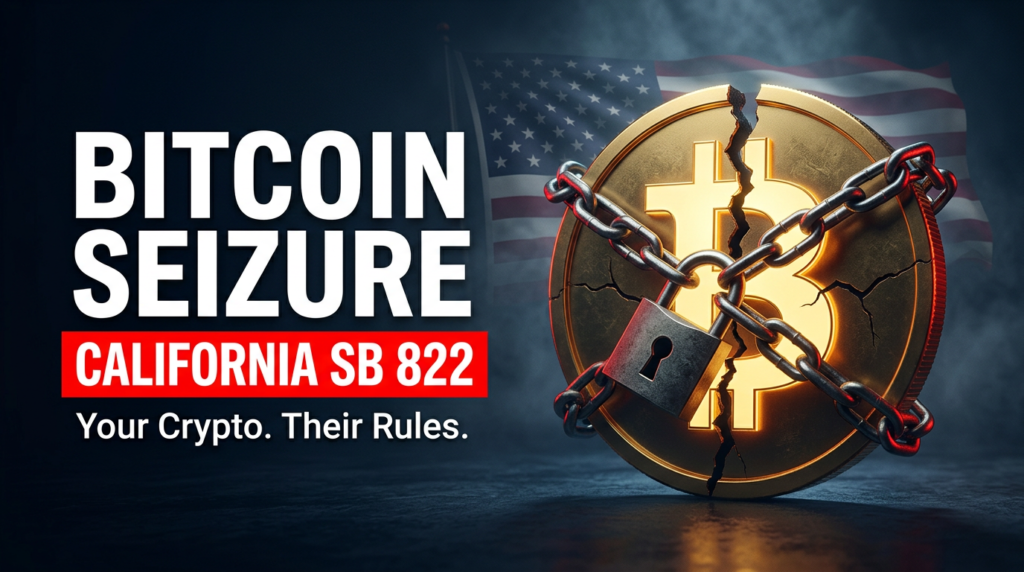
California’s SB 822 allows the state to take control of your idle cryptocurrency after three years. Supporters call it a safeguard. Here’s why Americans who value property rights should be paying very close attention.
Imagine putting your savings in a bank, taking a long sabbatical off the grid, and returning to find the government has claimed your account because you weren’t active enough. For most Americans, that scenario sounds like something from a Soviet-era cautionary tale. Yet in California, that is now the law — and this time, it applies to your Bitcoin.
On October 11, 2025, Governor Gavin Newsom quietly signed Senate Bill 822, formally extending the state’s Unclaimed Property Law to cover digital financial assets held on centralized cryptocurrency exchanges. Effective in 2026, the law empowers California to seize control of dormant crypto accounts after just three years of inactivity. The bill passed with broad legislative support and minimal public debate. The crypto community is only now waking up to its full implications — and the anger is building.
Support Independent Local Journalism
TheTownHall.News is a non-profit reader-supported journalism. Just $5 helps us hire local reporters, investigate important issues, and hold public officials accountable across Alameda County. If you believe our community deserves strong, independent journalism, please consider donating $5 today to support our work.What the Law Actually Does — And Why It Matters
SB 822 is not, on its face, a new idea. California has applied so-called “escheatment” laws to bank accounts, insurance payouts, and uncashed checks for decades. The concept is simple: if you abandon property and can’t be reached, the state steps in as a temporary custodian. Proponents frame this as protecting consumers from losing forgotten assets.
The extension to cryptocurrency, however, is a different matter entirely.
Under SB 822, if a digital asset account on a centralized exchange — think Coinbase, Kraken, or any similar platform — shows no “ownership activity” for three years, and the exchange cannot make contact with the account holder, the assets are classified as “unclaimed property.” The exchange is then required to transfer those assets to the California State Controller’s Office, which places them with a state-licensed custodian.
The state is then authorized to liquidate — that is, sell — those assets between 18 and 20 months after taking possession. If you don’t claim your property in time, you get the cash proceeds. Not your Bitcoin. Not your Ethereum. Whatever the state decided it was worth when it chose to sell.

The Three-Year Clock Is Ticking — Whether You Know It or Not
Supporters of the law point out that the bar for “activity” is broad. Logging into your exchange account resets the three-year clock. So does making a trade, sending an email to customer support, or clicking a link in a notification. In theory, even a passive investor who checks their balance once every couple of years is protected.
But this framing misses the forest for the trees. The law places the burden of compliance squarely on the individual. Miss three years of logins — perhaps because of illness, travel, a family emergency, or simply because you believe in the long-term “hold” strategy that defined the early crypto movement — and the state begins its process. Exchanges must issue a warning notice 6 to 12 months before reporting assets to the state, but that notice only works if you receive it. Change your email. Miss the alert in a crowded inbox. Go through a difficult period of life. Suddenly, your private property is in the hands of Sacramento.
“The state is not protecting your assets. It is conditioning your ownership on your obedience to an activity schedule it designed.”
A Dangerous Precedent for Property Rights
The philosophical problem with SB 822 runs deeper than its mechanics. This law establishes — in statute — that the state has a legitimate claim on private property simply because its owner chose not to use it in a manner the government finds sufficiently active. That principle is corrosive to the American concept of property rights.
Private property ownership has never required periodic government validation. You do not have to drive your car every three years to maintain ownership. You do not have to use your savings bond, your gold coins, or your vacation home on a state-mandated schedule. The idea that digital assets are categorically different — that your Bitcoin ownership must be demonstrated through logged behavior on a third-party platform — is a standard no other asset class is held to.
Worse, SB 822 creates a perverse incentive. By holding assets “in kind” for 18 to 20 months before liquidating, the state exposes California taxpayers to significant market volatility risk while simultaneously making the government a direct participant in cryptocurrency markets. Government-as-crypto-custodian is not a role the state has earned — or should want.
Support Independent Local Journalism
TheTownHall.News is a non-profit reader-supported journalism. Just $5 helps us hire local reporters, investigate important issues, and hold public officials accountable across Alameda County. If you believe our community deserves strong, independent journalism, please consider donating $5 today to support our work.What Critics Get Wrong About “Consumer Protection”
Defenders of the law make two main arguments. First, that escheatment prevents exchanges from quietly absorbing dormant accounts — a real risk, especially after the catastrophic collapse of FTX in 2022. Second, that California is simply modernizing existing property law to account for new asset classes. Both arguments carry a grain of truth.
But neither argument justifies the specific mechanism chosen here. The FTX collapse was a fraud problem — a failure of regulatory oversight and criminal accountability, not a consequence of crypto assets lacking escheatment rules. Solving the risk of exchange malfeasance by handing the state a new pathway to asset seizure is like treating a broken window by tearing down the whole house.
Furthermore, the law does not apply to self-custodied wallets — assets held via hardware wallets where the individual controls their own private keys. That carve-out inadvertently reveals the law’s true target: it is not about protecting property. It is about asserting state authority over the segment of the crypto market that runs through regulated, trackable, taxable intermediaries.
The Real-World Impact on Ordinary Americans
This is not just an abstract debate for libertarian theorists or crypto whales. SB 822 will have practical, tangible consequences for everyday Californians.
Consider the long-term investor who bought Bitcoin during the 2017 boom, moved it to an exchange for safekeeping, and then dealt with a health crisis that kept them away from their accounts for a few years. Consider the retiree whose adult children purchased Ethereum as part of an inheritance plan — and who passed away without telling their heirs where it was held. Consider the small business owner who accumulated crypto and then focused entirely on keeping their business alive through an economic downturn.
For all of these people, SB 822 does not offer protection. It offers a bureaucratic obstacle course with their own property as the prize.
Key Takeaway
California’s SB 822 is not a consumer protection law. It is a government activity mandate attached to private property ownership — with seizure as the penalty for non-compliance. The law creates a new class of conditional ownership: you own your Bitcoin, provided you check in regularly enough to prove it to the state’s satisfaction.
That is a standard no free society should accept without vigorous debate — and California passed it with almost none.
What You Can Do Right Now
If you hold cryptocurrency on a centralized exchange, the most immediate step is straightforward: move significant holdings to a self-custodied hardware wallet. Assets held under your own private keys are explicitly excluded from SB 822’s jurisdiction. Log into your exchange accounts at least once a year — a simple precaution that resets the dormancy clock. And document your digital assets as part of your estate planning so your heirs aren’t left navigating the State Controller’s Office to reclaim your inheritance.
Laws like SB 822 are rarely reversed unless citizens push back. California may be the first state to apply escheatment to crypto, but it will not be the last if no one raises the alarm.
“Property rights do not erode all at once. They erode one quiet bill at a time.”
Stay Informed. Stay Engaged.
If this story concerns you, share it. Ask your state representative where they stand on digital asset property rights. Support the independent outlets — like this one — that cover the policies reshaping your financial freedoms before the mainstream press catches up. The government works best when citizens are paying attention. Keep watching.
Have thoughts on California’s SB 822? Share this article and join the conversation. Independent journalism depends on readers like you.