Emeryville City Council Fiscal Accountability Put to the Test as Budget Deficits, Juvenile Crime, and Culture Wars Collide
A small Bay Area city’s February 17 meeting reveals the tensions every American community faces: how to keep residents safe, spend their money wisely, and avoid symbolic distractions while real problems mount.
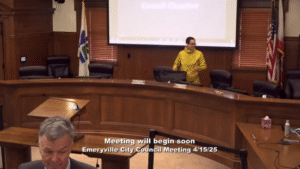
On the evening of February 17, 2026, the Emeryville City Council held a meeting that, on paper, looked routine — no public hearings, no major action items. Councilmember David Mourra was absent. Councilmember Sam Gould participated remotely. And yet, what unfolded inside City Hall offered a strikingly clear window into the fault lines running through local governance in the Bay Area — and, frankly, across America.
The new Alameda County District Attorney presented her office’s crime-fighting priorities. A council member described by local media as the city’s “budget hawk” warned of a fiscal cliff that could reshape city services. And proposals to add a land acknowledgment and the Pledge of Allegiance to council meetings were both rejected, even as the council embraced the addition of the Black National Anthem, “Lift Every Voice and Sing.”
Taken together, the evening’s proceedings tell a story about what happens when fiscal reality, public safety, and symbolic politics compete for attention — and which one wins.
The DA Draws a Line on Juvenile Crime
Alameda County District Attorney Ursula Jones Dickson appeared before the council to update Emeryville on regional crime trends and her office’s approach to public safety. Jones Dickson was appointed unanimously by the Alameda County Board of Supervisors in early 2025 to replace Pamela Price, who was recalled by voters in November 2024 in a decisive rebuke of her lenient approach to prosecution.
Jones Dickson’s appointment was widely viewed as a signal that the county would take a tougher stance on criminals — particularly repeat offenders and violent juveniles. She has reversed many of her predecessor’s policies, including rescinding a directive that barred prosecutors from seeking to try juveniles as adults in serious cases. Under Jones Dickson, six juvenile cases have been petitioned for transfer to adult court, a move that juvenile-justice advocates have criticized but that many residents and law-enforcement officials view as a necessary correction.
Council Member Kalimah Priforce — who was formally censured by his four colleagues in late 2024 for ethics violations and who has publicly aligned himself with the recalled DA Price — pressed Jones Dickson on her approach to juvenile offenders and foster youth involved in the justice system. It was a predictable line of questioning from a council member who has consistently favored a softer prosecutorial posture, but Jones Dickson held her ground. Many viewed her appearance as a reassurance to residents that accountability — not ideology — would guide prosecutorial decisions in Alameda County going forward.
For anyone who believes that law and order is not just a slogan but a precondition for a functioning community, Jones Dickson’s presentation was a welcome development. When repeat juvenile offenders cycle through the system without meaningful consequences, the people who suffer most are the law-abiding families in the neighborhoods where those offenders operate. A DA willing to use every lawful tool at her disposal — including trying the most violent juveniles as adults — is exactly what communities like Emeryville need.
A $10 Million Annual Deficit Nobody Wants to Talk About
If public safety is the foundation of a livable city, fiscal discipline is the framework that holds it up. And on that front, the February 17 meeting delivered a sobering warning.
A council member characterized by local outlet The E’ville Eye as Emeryville’s “budget hawk” laid out a stark fiscal reality: the city faces a roughly $10 million annual deficit over each of the next two years. With sales tax representing a major portion of the city’s revenue, and with broader economic headwinds placing pressure on consumer spending, the shortfall is not a theoretical problem — it is an immediate one.
This is not a new crisis for Emeryville. The city finished its 2023–25 budget cycle with larger deficits than initially projected, and recent study sessions have estimated a five-year general fund shortfall ranging from $9.7 million to $14.6 million. The city council approved a two-year budget for fiscal years 2025 and 2026, using reserves and fund balance to cover the near-term gap — in other words, spending down savings rather than addressing the structural mismatch between what the city spends and what it brings in.
Every household in America understands this math. You cannot indefinitely spend more than you earn and paper over the difference with savings. At some point, you either cut spending, find new revenue, or go broke. For a small city of roughly 12,000 residents — one already ranked by some measures as among the most stressful communities in California — the stakes of getting this wrong are enormous.
Fiscal accountability demands that elected officials make hard choices: prioritize essential services like police and fire, scrutinize every discretionary expenditure, and resist the temptation to defer tough decisions to the next council. The budget hawk’s warning deserves more than a nod at a council meeting. It deserves action.
Culture Wars at City Hall: Symbols Over Substance
The most revealing moments of the February 17 meeting may have come during the council’s handling of three symbolic proposals.
First, a proposal to begin council meetings with a land acknowledgment — a statement recognizing that the land on which Emeryville sits was originally inhabited by the Ohlone people — failed to advance. The council had previously been unable to move the proposal forward, and once again it stalled. Second, a proposal to reinstate the Pledge of Allegiance at council meetings was also rejected.
But in the same meeting, the council voted to embrace the Black National Anthem, “Lift Every Voice and Sing,” as part of its proceedings for Black History Month.
Set aside, for a moment, any opinion about the merits of any individual proposal. What stands out is the pattern. The Pledge of Allegiance — the universal expression of civic unity and shared citizenship — was rejected. A land acknowledgment was shelved. But a racially specific anthem was adopted. The message, intentional or not, is that in Emeryville’s City Hall, identity-driven symbolism takes precedence over expressions of shared national identity.
This is a troubling signal from any local government. The Pledge of Allegiance is not a partisan statement. It is a 31-word affirmation of the republic and the values — liberty and justice for all — that bind Americans together across every background. When a city council rejects it while simultaneously adopting other symbolic gestures, it sends a message about whose identity is being elevated and whose is being set aside. Residents of all backgrounds deserve a local government that leads with unity, not division.
What Emeryville’s Meeting Tells Us About Local Government Everywhere
Emeryville is a city of about 12,000 people wedged between Oakland and Berkeley. It’s tiny. But the dynamics on display at its February 17 council meeting are anything but small. They are a microcosm of the challenges facing communities across the country:
On crime: Voters recalled a progressive DA who refused to hold violent offenders accountable. Her replacement is charting a tougher course — and is already facing resistance from some elected officials who prefer the old approach. The question is whether the new direction will hold.
On budgets: A city spending beyond its means is using savings to delay a reckoning. Without structural reforms — spending cuts, efficiency gains, or credible revenue measures — the deficit will only grow. Residents will eventually pay the price in reduced services or higher taxes, or both.
On culture: Symbolic debates about anthems, pledges, and land acknowledgments consume time and political energy that could be directed at the $10 million hole in the city’s finances or the safety of its streets.
None of these are uniquely Emeryville problems. They are American problems. And they share a common thread: they are best solved by leaders who prioritize personal responsibility, fiscal discipline, public safety, and the shared values that hold communities together — rather than the identity-driven symbolism that pulls them apart.
A Call to Pay Attention — and Show Up
Local government is where policy hits the pavement. It’s where your tax dollars are spent, where your streets are policed, and where the culture of your community is shaped — one council vote at a time.
If the February 17 Emeryville City Council meeting tells us anything, it’s that the people who show up are the people who shape the outcome. Council Member Priforce’s ideological challenge to a tough-on-crime DA gets heard because he’s in the room. The budget hawk’s warning gets a moment of attention — but without sustained public pressure, it risks becoming background noise.
Here’s what you can do: Watch your local council meetings. Read the budget reports. Ask your elected officials how they plan to close the deficit without raiding reserves. Demand that public safety remains the top priority — not an afterthought. And when symbolic proposals threaten to crowd out substantive governance, say so — respectfully, clearly, and on the record.
The principles that built this country — limited government, fiscal responsibility, law and order, and the shared bonds of citizenship — don’t defend themselves. They require citizens who are engaged, informed, and willing to hold their leaders accountable.
Share this article. Forward it to a neighbor. And the next time your city council meets, consider being in the room.