$12.69 Million Religious Discrimination Verdict Against Blue Cross Blue Shield Signals New Era for Workers of Faith
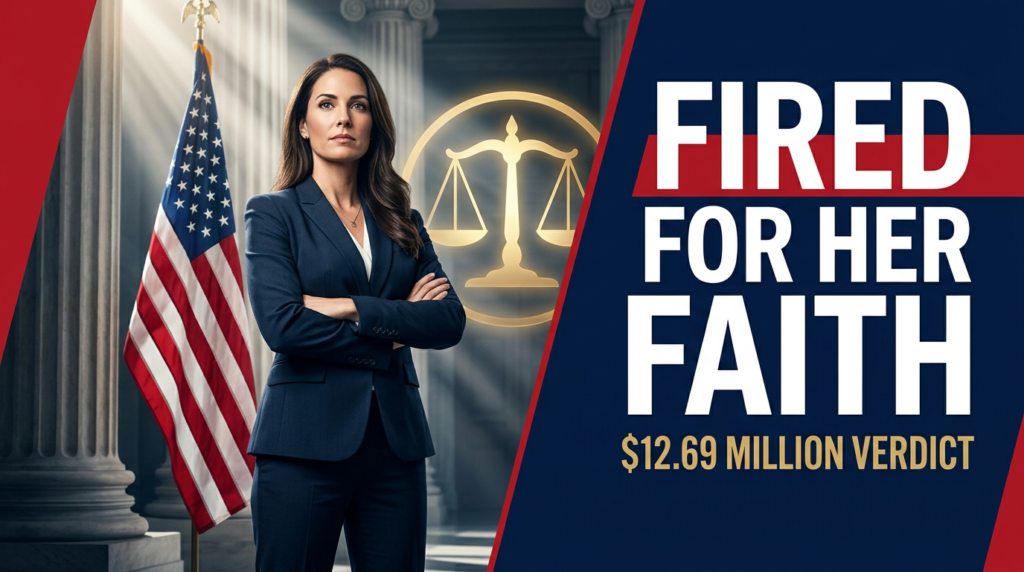
A federal jury handed down a stunning $12.69 million verdict against Blue Cross Blue Shield of Michigan for firing a 30-year employee who refused the COVID-19 vaccine on religious grounds. Now the company faces more than 100 similar lawsuits — and the outcome could redefine how every American employer handles faith in the workplace.
Lisa Domski did not ask for much. After more than three decades as an IT specialist at Blue Cross Blue Shield of Michigan, she simply asked her employer to respect her conscience. As a devout Catholic, she believed the COVID-19 vaccines had been developed using cell lines derived from aborted fetuses — a belief shared by millions of Christians who consider abortion a grave moral wrong. She filed for a religious exemption. Blue Cross said no. Then it fired her.
In November 2024, a federal jury in Detroit delivered its answer: $12.69 million in damages, including $10 million in punitive damages, $1 million for emotional distress, and roughly $1.69 million in lost wages. It was one of the largest religious discrimination verdicts in recent American history — and a warning to every large employer in the country that terminating employees of faith carries a steep price.
Support Independent Local Journalism
TheTownHall.News is a non-profit reader-supported journalism. Just $5 helps us hire local reporters, investigate important issues, and hold public officials accountable across Alameda County. If you believe our community deserves strong, independent journalism, please consider donating $5 today to support our work.What the Jury Found — and Why It Matters
The case, Domski v. Blue Cross Blue Shield of Michigan, was not complicated in its essentials. Lisa Domski held a sincere religious belief protected under Title VII of the Civil Rights Act of 1964. Her employer had a legal obligation to explore a reasonable accommodation before taking adverse action. Instead, Blue Cross denied her exemption request — in part, its lawyers argued, because she failed to participate in a follow-up interview to assess the “sincerity” of her beliefs.
The jury was not persuaded. After four days of testimony, it found that BCBS had engaged in unlawful religious discrimination and awarded damages accordingly.
For a company with tens of thousands of employees and billions in revenue, the burden of accommodating a single IT specialist who worked remotely was minimal. The jury saw that clearly.
“You can run a business. You can enforce standards. What you cannot do is treat a person’s faith as an obstacle to be managed away.”

The Bigger Picture: 100+ Lawsuits and a Company in Crisis
The Domski verdict was not an isolated event. It was a signal flare.
In February 2025, court records revealed that Blue Cross Blue Shield of Michigan is now in active mediation talks aimed at a “global resolution” of more than 100 similar lawsuits filed by former employees who were also terminated after seeking religious or medical exemptions from the company’s 2021 vaccine mandate. Both Blue Cross and Domski’s attorney, Noah Hurwitz, asked U.S. District Judge David Lawson to pause the Domski case while mediation proceeds.
When a corporation with deep legal resources seeks a pause to pursue a “global resolution,” it is not projecting confidence — it is looking for an exit.
There is one complicating factor for Domski personally: federal law caps punitive damages at $300,000 in Title VII cases. Her attorneys have acknowledged this, meaning the $10 million punitive award will almost certainly be reduced before any final judgment is entered. Judge Lawson heard arguments on the reduction in January 2025 but had not issued a ruling as of the latest reports. The compensatory damages — roughly $2.69 million in back pay and future wages — are not subject to the same cap.
The total payout will be lower than the headline figure. But the legal and reputational damage to BCBS is already done.
Support Independent Local Journalism
TheTownHall.News is a non-profit reader-supported journalism. Just $5 helps us hire local reporters, investigate important issues, and hold public officials accountable across Alameda County. If you believe our community deserves strong, independent journalism, please consider donating $5 today to support our work.Why Employers Keep Getting This Wrong
Corporate America has a pattern when it comes to religious accommodation, and it is not flattering. Large employers treat exemption requests with suspicion rather than respect, demanding that employees prove the depth of their faith as though sincere belief is a compliance checklist item rather than a constitutional right.
In Domski’s case, Blue Cross reportedly denied her exemption partly because she failed to show up for a follow-up interview to evaluate her sincerity. A company questioned whether a practicing Catholic who had held her beliefs for decades was sincere enough to deserve legal protection.
This is not just a legal failure. It is a cultural one. Somewhere along the way, institutional America decided that accommodation meant inconvenience rather than respect. The jury in Detroit sent a direct message: that approach is not only wrong — it is expensive.
What Critics Get Wrong
Opponents of religious exemptions argue that allowing them undermines public health and sets a precedent for employees to opt out of any policy they dislike. It is a fair concern — but it fails on the facts.
Title VII does not create a blanket right to ignore workplace rules. The belief must be sincerely held, the conflict with policy genuine, and the accommodation reasonable. Courts and the EEOC apply these standards rigorously.
In Domski’s case, the argument collapses entirely. She was an IT specialist who worked remotely. She posed no documented risk to anyone. Firing her was not a public health measure — it was a pretext. The jury recognized it as such.
Religious liberty is not a loophole. It is a foundational American right codified in the First Amendment and reinforced by federal civil rights law for over sixty years. Employers who treat it as an annoyance will keep finding themselves on the wrong end of federal verdicts.
How This Case Affects Every American Worker
The Domski verdict matters far beyond Detroit and far beyond the COVID-19 era.
Employment attorneys are already calling it a potential “template” for how courts and juries will evaluate future religious accommodation claims. It affirms that juries hold employers accountable when they make token gestures at accommodation before moving straight to termination. The era of mass corporate vaccine mandates implemented with little regard for individual conscience will carry a long legal tail.
For workers of faith across the country — Christians, Jews, Muslims, and members of any tradition whose beliefs sometimes conflict with employer mandates — the law is on their side when employers act in bad faith.
The message from that Detroit jury room was simple: your faith is not a bureaucratic inconvenience. It is a legal right. And it will be defended.
Key Takeaway
A jury of ordinary Americans concluded that Blue Cross Blue Shield of Michigan did not just make a mistake — it acted egregiously enough to deserve $10 million in punishment. Even after the legally required reduction of punitive damages, the company now faces more than 100 additional lawsuits and an active mediation process.
No corporation has the legal right to dismiss a sincerely held religious belief as an inconvenience. When they do, the consequences are real — financially, legally, and morally.
Conclusion
Lisa Domski was not an activist. She was a working woman of faith who asked her employer for a basic legal accommodation after thirty years of service. She was denied, then fired.
What followed has become one of the most significant religious discrimination cases of the post-pandemic era. A jury awarded her $12.69 million. Her former employer is now trying to settle over a hundred more cases just like hers. Employment lawyers across the country are studying the verdict as a benchmark for what happens when corporate policy runs roughshod over individual conscience.
The COVID-19 pandemic forced many difficult decisions. But using it as cover to dismiss employees who asked for nothing more than their legal rights — that was not a difficult decision. It was the wrong one. And the courts are making that unmistakably clear.
Stay Informed. Stay Engaged.
Religious liberty cases like this one are reshaping American employment law in real time — and most of the country won’t hear about them from mainstream outlets. If this story matters to you, share it with someone who needs to see it. Subscribe to stay ahead of the stories that affect your rights, your workplace, and your community. Independent journalism depends on readers who care enough to pass it on.
Sources: Associated Press / MLive (February 2025); Law360; JD Supra / Kelley Drye & Warren LLP; Detroit Catholic; HR Dive; The Catholic Herald; U.S. District Court, Eastern District of Michigan — Domski v. Blue Cross Blue Shield of Michigan, No. 2:2023-cv-12023