3D Printed Ear Bones Are Restoring Hearing Right Now — And One Surgeon Started It All
A South African surgeon refused to accept that hearing loss was permanent — and the results are rewriting what modern medicine can do without a government mandate or billion-dollar bureaucracy.
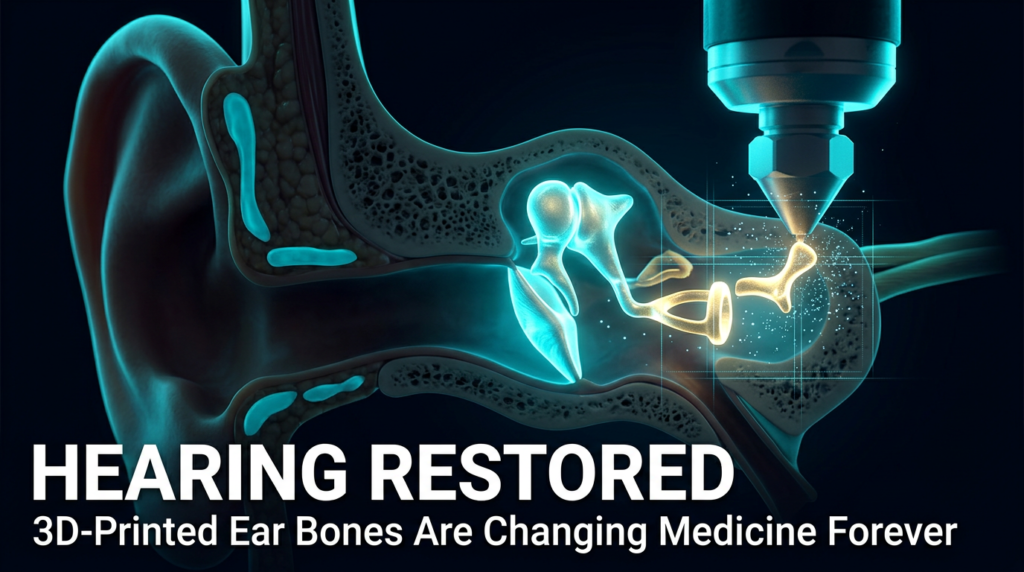
There are three bones inside your ear so small they could fit on your thumbnail. Together, they weigh less than a grain of rice. Without them, the world goes silent. And for millions of people around the world — from children born without functioning middle ears to adults who lost their hearing to infection, trauma, or disease — that silence has historically been permanent.
That is, until one surgeon decided the acceptable answer wasn’t good enough.
Support Independent Local Journalism
TheTownHall.News is a non-profit reader-supported journalism. Just $5 helps us hire local reporters, investigate important issues, and hold public officials accountable across Alameda County. If you believe our community deserves strong, independent journalism, please consider donating $5 today to support our work.A World First That Wasn’t Funded by a Government Mandate
In 2019, Professor Mashudu Tshifularo, head of the Department of Otorhinolaryngology at the University of Pretoria in South Africa, performed the world’s first successful middle ear transplant using 3D-printed bones. Not a government megaproject. Not a billion-dollar pharmaceutical trial. A focused surgeon, a precise technology, and a problem he refused to leave unsolved.
The procedure targets conductive hearing loss — a condition caused when the ossicles, the tiny trio of bones known as the hammer (malleus), anvil (incus), and stirrup (stapes), fail to transmit sound vibrations to the inner ear. Whether the cause is a birth defect, infection, trauma, or metabolic disease, the result is the same: silence.
Prof. Tshifularo’s solution was elegantly direct. Using 3D printing technology, his team fabricated titanium and silver replicas of a patient’s own ossicles — custom-fit to the individual’s anatomy — and implanted them endoscopically. The procedure is minimally invasive, leaves minimal scarring, and carries a significantly reduced risk of facial nerve paralysis compared to traditional surgical approaches.
Patients heard again. Including a man born without properly formed middle ear bones — who experienced sound for the first time in his life.

Why Precision Beats Scale Every Time
The broader lesson here is one that extends well beyond medicine, and it’s a lesson that bureaucracies consistently fail to learn: sometimes the most powerful solutions are the smallest ones, executed with precision.
This isn’t the story of a massive public health apparatus deploying a one-size-fits-all intervention. It’s the story of one specialist, one university, and one technology converging on a problem that affected real people — and solving it.
New peer-reviewed research published in April 2025 validated and advanced the science considerably. Using Micro-CT scanning at 40-micron resolution and Selective Laser Melting (SLM) 3D printing in titanium alloy, researchers produced prosthetic ossicles that deviated less than 0.04 millimeters from native bone dimensions. The printed prostheses demonstrated vibration responses comparable to a healthy ear and outperformed conventional partial ossicular replacement prostheses at low frequencies.
Critically, the custom fit reduced stress on the eardrum by approximately 43% compared to standard implants — meaning not just better hearing, but a safer surgical outcome.
“Sometimes the biggest breakthroughs come not from expanding government programs, but from empowering individuals to solve problems with precision and personal accountability.”
What This Means for Families and Children
The implications for families are profound — and deeply personal. Conductive hearing loss doesn’t only affect aging adults. It affects newborns with underdeveloped middle ear anatomy, children who suffer repeated ear infections, and young people whose hearing is damaged by physical trauma.
Support Independent Local Journalism
TheTownHall.News is a non-profit reader-supported journalism. Just $5 helps us hire local reporters, investigate important issues, and hold public officials accountable across Alameda County. If you believe our community deserves strong, independent journalism, please consider donating $5 today to support our work.Prof. Tshifularo confirmed the procedure can be performed on everyone, including newborns. That’s not a small detail. It means a child who would have navigated school, language, and social development in silence now has a viable, minimally invasive corrective option custom-tailored to their anatomy.
Parental choice in medical care matters. So does access to cutting-edge solutions that don’t require navigating layers of bureaucratic approval. The faster this technology reaches the clinical mainstream, the sooner parents have a real option — not a waiting list.
What the Critics Get Wrong
To be fair, not every expert is ready to declare victory. Some otologists have raised legitimate scientific questions: no long-term audiometric data has been published yet, high-frequency hearing restoration above 2,000 Hz remains technically challenging, and the weight of a full 3D-printed ossicular chain may slightly exceed the optimal threshold for high-frequency sound conduction.
These are real scientific considerations — and they deserve honest coverage. But they are also exactly the kind of questions that drive good science forward. The argument isn’t that this technology is perfect. The argument is that it is working for patients right now, and the research trajectory is pointing in one clear direction.
Peer-reviewed biomechanical studies are already addressing these limitations through refined prosthetic geometry and material composition. The iterative nature of innovation — not regulatory expansion — is what will close these gaps. The critics’ concerns aren’t a reason to slow down. They’re a reason to keep going.
Innovation Without Permission
There’s a broader civic principle embedded in this story that deserves to be named plainly.
Professor Tshifularo didn’t wait for a government agency to greenlight his vision. He worked within established academic and medical institutions, applied a commercially available technology to a clinical problem, and delivered results. His university supported the research. The patients consented. The technology did what it was designed to do.
No centralized mandate. No billion-dollar subsidy. No committee deciding whether a surgeon was allowed to try something new.
This is what medical freedom looks like when it functions properly — trained professionals, accountable institutions, and willing patients working together without a gatekeeping layer that slows innovation to a crawl.
“The most transformative medical breakthroughs in history weren’t the product of government roadmaps. They were the product of individuals who refused to accept that the impossible was settled.”
The Road Ahead: From Operating Room to Mainstream Medicine
The work is not finished. Wider clinical trials are needed before 3D-printed ossicular replacement becomes a standard-of-care procedure globally. Surgeons will need training. Imaging workflows will need standardization. Regulatory pathways — ideally streamlined, not bloated — will need to be navigated for device approval in major markets.
Harvard’s Wyss Institute is simultaneously developing the PhonoGraft, a 3D-printed biocompatible eardrum graft now entering commercial development. The picture emerging is one where the entire middle ear — eardrum, ossicles, the full sound transmission chain — could eventually be custom-rebuilt using a patient’s own imaging data and precision manufacturing.
That future is closer than most people realize. And it’s being built not by sweeping policy, but by focused, accountable professionals doing exceptional work.
Key Takeaway
Three tiny bones. One surgeon who refused to accept permanent silence as the answer. And a technology already restoring hearing — including for patients born without the ability to hear at all.
The story of 3D-printed ossicles isn’t just a medical story. It’s a story about what becomes possible when skilled individuals are empowered to solve real problems with precision, accountability, and the freedom to innovate. The smallest details, addressed with discipline, can change everything.
Stay Informed. Stay Engaged.
Breakthroughs like this rarely make the front page — but they should. Share this article with someone who has experienced hearing loss, or anyone who believes that innovation — not bureaucracy — is the engine of human progress. Subscribe to The Town Hall News for more coverage of science, health, and the ideas shaping our world.
Sources: University of Pretoria Faculty of Health Sciences; ScienceDirect / Bioprinting (April 2025); Harvard Wyss Institute; South African Hearing Institute.