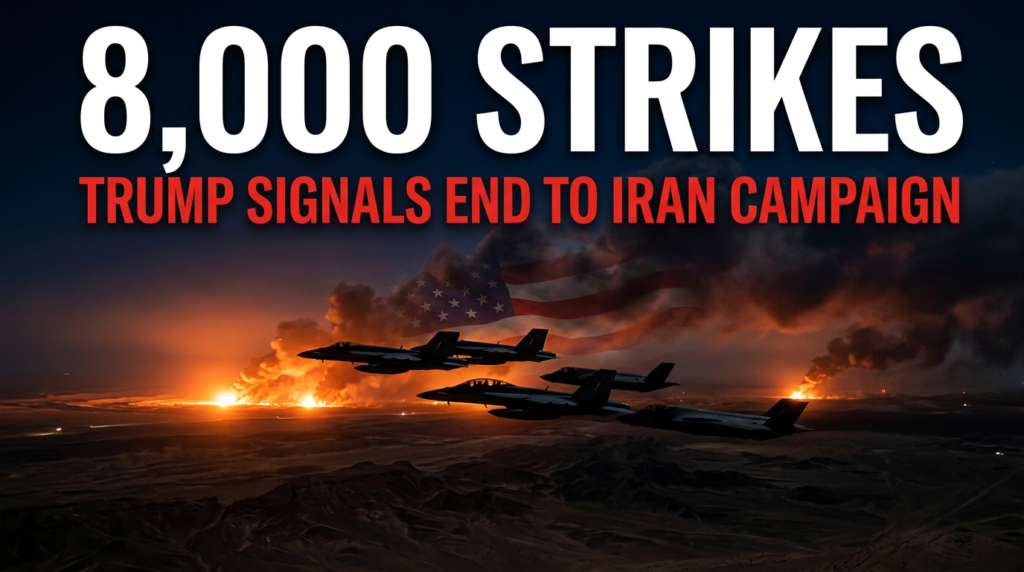
8,000 Strikes Later, Trump Signals End to Iran Campaign
When Strength Meets Strategy: The Case for a Decisive, Accountable Exit
America does not go to war lightly — or at least, it shouldn’t. When President Donald Trump announced the launch of major combat operations against Iran on February 28, 2026, he made a promise to the American people: this would be swift, targeted, and aimed squarely at neutralizing a regime that had long threatened U.S. interests, destabilized the Middle East, and funded terrorism across the globe. Three weeks and more than 8,000 military strikes later, Trump is now signaling that the United States is “getting very close to meeting our objectives” and considering “winding down” its military efforts.
That’s either a triumph of American resolve — or a test of whether Washington can actually keep its word to the taxpayers footing the bill. For conservatives who believe in limited government, fiscal accountability, and a strong but strategically disciplined military, the answer matters enormously.
The Mission: What Was the Goal?
Before judging the outcome, it’s worth asking what success was supposed to look like. The Trump administration launched what it called “Operation Epic Fury” alongside Israel with a clear set of stated objectives: degrade Iran’s nuclear capabilities, dismantle its missile and drone arsenal, and break the regime’s ability to threaten the Strait of Hormuz — a critical global shipping chokepoint through which roughly 20% of the world’s oil supply flows.
Support Independent Local Journalism
TheTownHall.News is a non-profit reader-supported journalism. Just $5 helps us hire local reporters, investigate important issues, and hold public officials accountable across Alameda County. If you believe our community deserves strong, independent journalism, please consider donating $5 today to support our work.By nearly every military metric reported so far, significant progress has been made. U.S. Central Command reported striking over 8,000 military targets. Iran’s ability to threaten the Strait of Hormuz has been described by U.S. military officials as “degraded.” The regime’s air defense and ballistic missile capabilities have been dramatically reduced — Pentagon briefings noted an 83% decline in Iranian drone launches and a 90% decline in ballistic missile launches by Day 5 of the operation.
These are not trivial achievements. For decades, Iran’s theocratic regime has been the world’s leading state sponsor of terrorism, a bully in the Persian Gulf, and a relentless pursuer of nuclear weapons. Degrading that capacity is a legitimate national security objective — one that previous administrations, both Republican and Democrat, repeatedly failed to achieve through diplomacy, sanctions, and strategic ambiguity.
The Price Tag: Fiscal Accountability Cannot Be an Afterthought
Here is where conservative principles demand honest reckoning. The first six days of the Iran war cost American taxpayers an estimated $11.3 billion, according to Pentagon figures provided to Congress. By Day 12, the Center for Strategic and International Studies (CSIS) estimated total costs had climbed to $16.5 billion — and the meter has kept running since.
The White House this week requested an additional $200 billion in emergency war funding from Congress.

Let that number sink in. Two hundred billion dollars. That is roughly the annual budget of the entire Department of Homeland Security multiplied several times over. That is money borrowed against the future of every American family, added to a national debt that already exceeds $36 trillion.
Conservatives have long championed fiscal accountability as a cornerstone of responsible governance. That principle does not disappear when the flag is flying and the missiles are flying. If anything, it becomes more urgent. War is the most expensive thing a government can do — and history is littered with conflicts that began with clear objectives and ended as open-ended fiscal sinkholes.
President Trump is right to talk about winding down. The question is whether “winding down” becomes a firm commitment or a rhetorical pivot while deployments quietly expand. This week alone, the administration announced the deployment of 2,500 additional Marines and amphibious warships to the region — even as Trump signals an exit. Pentagon officials, according to CBS News, have made detailed preparations for potential ground force deployment into Iran.
The American people deserve clarity. Not mixed signals. Not a $200 billion blank check with no defined endpoint.
Law, Order, and the Rules of Engagement
One area where the Trump administration deserves credit is in its unapologetic assertion of American strength. For too long, U.S. foreign policy operated under rules of engagement so cautious they amounted to strategic paralysis. Adversaries learned they could probe, provoke, and attack U.S. interests with minimal consequence.
Support Independent Local Journalism
TheTownHall.News is a non-profit reader-supported journalism. Just $5 helps us hire local reporters, investigate important issues, and hold public officials accountable across Alameda County. If you believe our community deserves strong, independent journalism, please consider donating $5 today to support our work.That calculus changed on February 28. The operation has been conducted with overwhelming air power and precision — a demonstration that when America chooses to act, it acts decisively. The shift from expensive standoff munitions to shorter-range, lower-cost weapons by Day 4 shows operational competence, not recklessness. The military adapted in real time, which is exactly what a well-led fighting force should do.
Law and order — whether domestically or on the world stage — depends on credible consequences. Iran’s regime spent years testing American patience through proxy attacks, hostage-taking, and nuclear brinkmanship. The lesson being delivered is long overdue.
The Burden-Sharing Problem: America First Means Europe Steps Up
One of Trump’s most pointed statements this week was directed not at Tehran, but at Washington’s allies. He demanded that Europe, China, and Japan — nations that depend far more heavily than the U.S. on oil flowing through the Strait of Hormuz — take responsibility for policing it. “The United States does not use it,” Trump posted. He called NATO allies “COWARDS” for refusing to help reopen the strait.
He’s not wrong. America First has never meant America Alone — and it certainly shouldn’t mean American taxpayers subsidizing the energy security of nations that lecture the U.S. from the sidelines. If Europe wants the oil flowing, Europe should be willing to share the risk and the cost. This is not isolationism; it is the bedrock principle of proportional burden-sharing that has been ignored by allies for decades.
For conservatives who believe in personal responsibility at every level — from the individual to the nation-state — the demand that allies carry their weight is not just politically satisfying. It is strategically essential for a sustainable foreign policy.
Energy Prices and the Kitchen Table Test
No matter how justified the military rationale, wars have consequences that land squarely on American families. Oil prices have jumped approximately 50% since operations began on February 28, according to BBC reporting. That means higher gas prices, higher heating bills, and higher costs for every product that moves by truck or plane across this country.
In a tacit acknowledgment of this pressure, the Trump administration on Friday waived sanctions on Iran to allow the sale of 140 million barrels of stranded Iranian oil — a pragmatic move to ease the energy shock. But it is also a reminder that military decisions have economic ripple effects that fall hardest on working Americans.
Traditional conservative values have always included protecting the economic wellbeing of ordinary families — not just the strategic interests of defense contractors and Washington think tanks. Any exit strategy from this conflict must factor in a path back to stable, affordable energy for American households.
The Conservative Case for a Clear Exit
President Trump has said he does not want a ceasefire — and he has a point. Ceasefire negotiations at this stage could lock in gains while leaving Iran’s regime intact and motivated to rebuild. The objective was never simply to pause the threat; it was to permanently degrade it.
But “no ceasefire” is not the same as “no end.” There is a critical difference between a strong, principled conclusion to combat operations — one that leaves Iran’s military capabilities in ruins and sends an unmistakable message to every other rogue state — and an open-ended military commitment that bleeds treasure, strains troop readiness, and invites congressional dysfunction.
The conservative tradition has always understood that strength without restraint is not virtue — it is recklessness. A government that commits to limited objectives, achieves them, and then brings the troops home with honor is not weak. It is exactly what a responsible, accountable government looks like.
If Trump truly believes the objectives are “very close” to being met, then the responsible next step is a clear articulation — to Congress, to the American public, and to the world — of what “done” looks like, a timeline for drawing down combat operations, and a credible accounting of what the nation has spent and why it was worth it.
Conclusion: Hold the Line — and Hold the Line on Accountability
The United States has demonstrated something important in the last three weeks: when America acts with conviction and overwhelming force, it achieves results. Iran’s military capacity is degraded, its threats to the Strait of Hormuz reduced, and the world’s bad actors have been put on notice.
But American strength is only sustainable when it is paired with American accountability. The $16.5 billion already spent, the $200 billion more being requested, the lives of seven American service members lost — these are not abstractions. They are real costs borne by real families and real taxpayers who deserve a government honest enough to say what they bought, and disciplined enough not to spend more than necessary.
8,000 strikes later, it is time to define victory, declare it, and come home. That is not retreat. That is exactly what a strong, fiscally responsible, law-abiding republic looks like.
📢 Call to Action
Stay informed. Stay engaged. Share this article.
The decisions being made in Washington right now — about war, spending, and America’s role in the world — will shape your family’s future for years to come. Don’t leave those decisions to the headlines alone. Demand accountability from your elected representatives, ask hard questions about the $200 billion emergency funding request, and share this article with anyone who believes America’s strength should be matched by America’s responsibility.