Alberta Independence Referendum 2026: Petition Passes 177,000 Signatures — October Vote Now Locked In
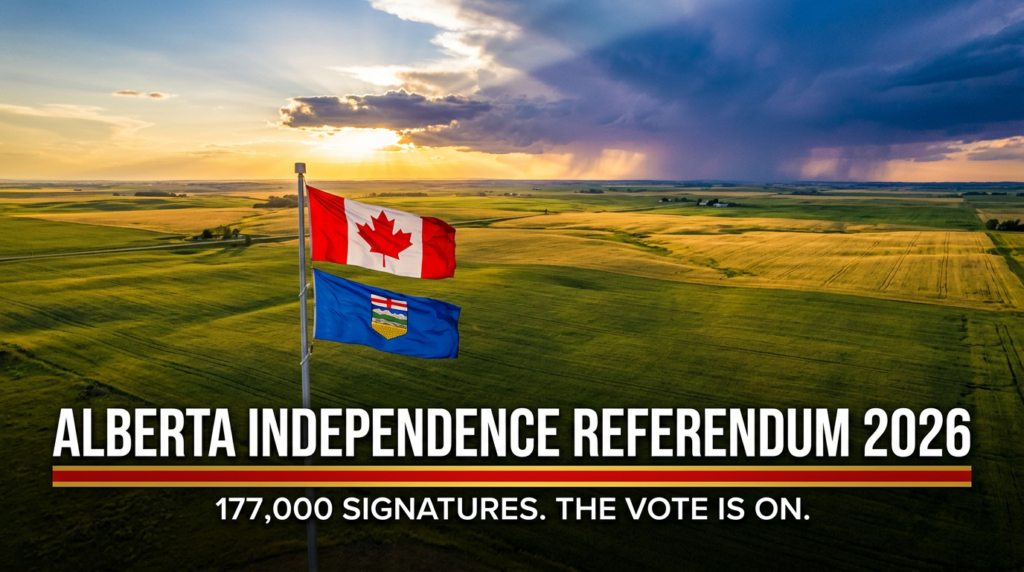
The Stay Free Alberta petition has crossed the legal threshold of 177,732 signatures, locking in a historic independence referendum for October 19, 2026. This is grassroots democracy in action — and the political establishment is rattled.
It started with a clipboard, a community hall, and a question most media dismissed as a fringe obsession: should Alberta leave Canada? Six months later, that question is headed to a provincial ballot. On March 30, 2026, organizers with Stay Free Alberta confirmed they had surpassed the 177,732 valid signatures required under Alberta’s Citizen Initiative Act — officially triggering the pathway to a constitutional referendum on October 19, 2026.
The achievement is remarkable. Not because the numbers are overwhelming — polling consistently shows a majority of Albertans lean toward staying in Confederation — but because ordinary citizens, standing in community halls and knocking on doors in sub-zero temperatures, forced the political class to take them seriously. In an era when government grows larger and citizen voices grow quieter, that matters enormously.
Support Independent Local Journalism
TheTownHall.News is a non-profit reader-supported journalism. Just $5 helps us hire local reporters, investigate important issues, and hold public officials accountable across Alameda County. If you believe our community deserves strong, independent journalism, please consider donating $5 today to support our work.What Grassroots Democracy Actually Looks Like
The petition was launched on January 3, 2026, when Alberta’s Chief Electoral Officer officially issued the citizen initiative petition for a constitutional referendum. The effort is led by Mitch Sylvestre, a private citizen who built the Stay Free Alberta campaign without the machinery of a political party behind him.
The question Albertans will be asked is unambiguous: “Do you agree that the Province of Alberta should cease to be part of Canada to become an independent state?”
Sylvestre has been clear throughout — this is not about anger. It is about accountability. “People said it was impossible when we started,” he said. “They said we would never receive the signatures. They said Albertans wouldn’t be interested enough to attend. However, I have seen the people of this province disprove them on a daily basis.”
This is what self-governance looks like. Citizens identifying a problem — decades of federal fiscal imbalance, resource policy disputes, and a growing sense that Ottawa neither understands nor respects western Canada — and using the tools of democracy to demand a conversation.

Why This Issue Matters Far Beyond Alberta’s Borders
Alberta generates an outsized share of Canada’s federal tax revenue. For decades, the province has sent billions more to Ottawa than it receives in federal transfers — a disparity that has fuelled legitimate frustration about fairness and representation in Confederation. Albertans are not asking for a handout. They are asking whether the current arrangement still serves them.
The petition’s success adds a citizen-driven independence question to a ballot already loaded with consequence. Premier Danielle Smith has separately announced a government-initiated referendum on October 19 covering nine questions — including immigration control, restrictions on services for non-permanent residents, and constitutional reforms. The independence question, if the petition is verified, would appear alongside these.
The October 19 ballot may be the most consequential vote in Alberta’s history. Regardless of the outcome, the conversation it forces — about provincial autonomy, federal overreach, and the balance of power in Confederation — is long overdue.
The Administrative Battle That Could Decide Everything
Reaching the numerical threshold is only half the challenge. The National Post reported a significant administrative hurdle: many rural Albertans — precisely the demographic most likely to support independence — cannot sign the petition with a standard driver’s licence alone.
Under Alberta’s rules, signers must present photo ID showing a current physical residential address. In rural Alberta, P.O. box numbers are common on driver’s licences. That means rural supporters must bring additional documentation — land title transfers, property tax assessments, or legal land descriptions — or make multiple trips to signing locations.
Support Independent Local Journalism
TheTownHall.News is a non-profit reader-supported journalism. Just $5 helps us hire local reporters, investigate important issues, and hold public officials accountable across Alameda County. If you believe our community deserves strong, independent journalism, please consider donating $5 today to support our work.Sylvestre called it “the biggest concern raised by volunteer canvassers,” acknowledging it has been “a hindrance.” He also, notably, said he supports the ID requirement: “That’s going to make it more legit.” That is the voice of someone who wants the result to withstand scrutiny — a principle worth applauding in any democratic exercise.
The rule is the same one that governs elections. If it’s good enough for casting a ballot, it’s good enough for signing a petition. The logistical burden for rural residents is real, but the solution is better outreach — not lowering the standard.
What Critics Get Wrong
Opponents of the referendum have largely fallen into two camps: those who dismiss the petition as a protest that will fail at the ballot box, and those who argue the entire exercise is destabilizing and irresponsible. Both miss the point.
Whether or not a majority of Albertans vote yes to independence on October 19 is secondary to whether they deserve the right to be asked. Polls showing roughly two-thirds of Albertans leaning toward staying in Canada do not diminish the democratic legitimacy of the question. Referendums are not guaranteed to pass — they are guaranteed to let citizens speak.
Constitutional experts have noted that even a majority yes vote would begin a complex legal and political negotiation process, not deliver automatic separation. Critics who cite this as a reason to dismiss the referendum get the logic backwards: if separation is so constitutionally unlikely, why are they so afraid of letting people vote?
The Real Stakes: Fiscal Accountability and Democratic Respect
At its core, the Alberta independence movement is a symptom of a deeper problem — the chronic failure of federal institutions to treat western Canada as an equal partner rather than a resource extraction zone with votes to be managed.
Albertans have watched federal energy policies constrain their largest industry. They have watched equalization formulas funnel their wealth to other provinces without serious reform. They have watched Ottawa impose national agendas that conflict with provincial values and democratic choices. The petition is not a tantrum. It is a formal, legal expression of frustration with a federal arrangement many Albertans believe has become one-sided.
Fiscal accountability — a principle that animates much of western Canadian political culture — demands that citizens know where their tax dollars go and have meaningful power to change arrangements they believe are unjust. The Citizen Initiative Act exists precisely to give Albertans that power.
What Comes Next
Signature collection continues until approximately May 2, 2026. After the deadline, all signatures are submitted to the Chief Electoral Officer for independent verification. Upcoming signing events include Whitecourt (March 31), Hinton (April 1), and Grande Cache (April 2), with more events planned across the province.
If the petition is verified, every eligible Albertan votes on October 19. The outcome is uncertain. The significance is not.
Whatever one thinks of Alberta independence as a policy outcome, the process unfolding right now — citizens petitioning their government, demanding a vote, exercising their legal rights under a democratic framework — is exactly how self-governance is supposed to work. It deserves serious engagement, not dismissal.
The Bottom Line
Alberta’s independence referendum is no longer a hypothetical. It is a scheduled event, built not by politicians or lobbyists, but by thousands of ordinary people who believed their voice deserved to be heard. That is worth respecting — even by those who plan to vote no.
The question on October 19 is about more than borders. It is about whether democratic institutions still serve the people who built them, and whether citizens still have the power to demand answers when they believe they do not.
If this story matters to you, share it. Independent journalism depends on readers who engage, discuss, and refuse to let important stories get buried. Stay informed — the next few months will be defining ones for Canada.