America Draws the Line: Why the U.S.-Israel Strike on Iran Was a Necessary Act of Strength
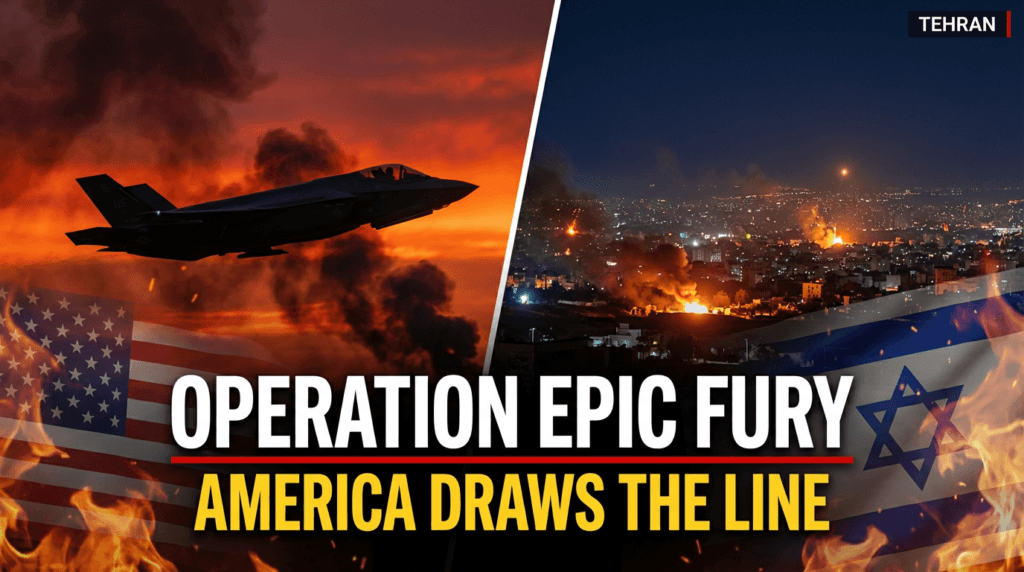
For four decades, the Islamic Republic of Iran has operated as the world’s most prolific state sponsor of terrorism — funding proxy armies, bankrolling missile programs, and relentlessly pursuing nuclear weapons capable of threatening not just Israel, but the American homeland itself. On the morning of February 28, 2026, the United States and Israel said, in the clearest possible terms: enough.
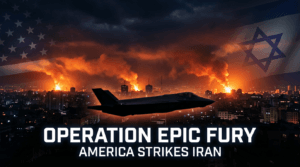
Operation Epic Fury, the joint U.S.-Israeli military campaign that killed Supreme Leader Ayatollah Ali Khamenei and dismantled Iran’s top military command, is already the most consequential national security decision of the 21st century. It is being met with the predictable chorus of international criticism and domestic hand-wringing. But stripped of diplomatic euphemism and political posturing, the core question is simple: Was America safer with a nuclear-armed, terror-sponsoring Iranian regime intact — or without it?
The answer, for anyone committed to the protection of American lives, American interests, and the security of our allies, is not a close call.
Forty-Seven Years of Unchecked Aggression
The Islamic Revolution of 1979 did not just overthrow a government — it declared war on the Western world order. Since that day, Iran has been responsible for the deaths of hundreds of American servicemembers through its proxy forces in Iraq and Lebanon, the financing of Hamas and Hezbollah terrorist operations, and the systematic destabilization of the Middle East.
More critically, Iran has spent decades — and billions of dollars — in relentless pursuit of nuclear weapons. In June 2025, the International Atomic Energy Agency (IAEA) declared Iran non-compliant with its nuclear obligations for the first time in 20 years, citing Iran’s failure to address questions about undeclared nuclear materials and its rapidly expanding enriched uranium stockpile, which had reached 60% purity — a step away from weapons-grade. Austria’s intelligence services separately assessed that Iran was actively pursuing an advanced nuclear weapons program.
This is not hypothetical. This is not speculation. This was a regime sprinting toward the capacity to incinerate Tel Aviv — or, once intercontinental ballistic missile development matured, cities far beyond.
Those who argue America should have “stayed out of it” must answer: at what point does inaction become abdication? At what point does patience become complicity?
Diplomacy Was Exhausted — Not Abandoned
One of the most dishonest arguments against Operation Epic Fury is that it bypassed diplomacy. The record shows precisely the opposite.
Beginning in April 2025, the Trump administration engaged in an unprecedented, good-faith diplomatic effort with Tehran. Five rounds of direct and mediated talks were conducted — in Oman, Rome, Muscat, and Geneva. The United States offered Iran a path forward: dismantle your enrichment program, accept rigorous inspections, and rejoin the community of nations. Iran’s answer, every time, was defiance.
When Oman’s mediators reported that a breakthrough was “within reach” in the days before Operation Epic Fury, the specific offer on the table was Iran retaining the right to enrich uranium — the very capability that enables a bomb. President Trump refused. That is not a failure of diplomacy. That is the discipline to know the difference between a real deal and a fig leaf.
Khamenei himself, on February 17, 2026, rejected Trump’s conditions and threatened to “sink the U.S. Navy.” A man who openly threatened to sink American warships was not a partner for peace — he was a countdown clock.
President Trump was direct and unapologetic in his video statement: “They will never have a nuclear weapon.” That is not bluster. That is the most fundamental promise any commander-in-chief can make to the American people.
Strength, Not Recklessness: The Strategic Case
Critics have raised two legitimate concerns worth addressing honestly: the question of congressional authorization and the risk of regional escalation.
On the constitutional question, the history is clear, even if inconvenient. No president since Harry Truman has sought a formal declaration of war before deploying military force. Presidents from both parties — Kennedy, Nixon, Obama, Biden — have ordered strikes and deployments without congressional authorization when time-sensitive national security imperatives demanded it. The Trump administration briefed congressional leadership before the strikes, as required under the War Powers Act. Senator Tom Cotton, Chairman of the Senate Intelligence Committee, put the military logic succinctly: “It’s much easier to kill the archer on the ground than to shoot his arrows out of the sky.” He is right. Waiting for a nuclear Iran to fire first is not a strategy — it is a gamble with American lives.
On escalation: yes, Iran has retaliated. Missiles and drones have been launched at Israel, at Gulf states, and at U.S. military installations. As of March 1, 2026, no American casualties have been reported. Kuwait, the UAE, Bahrain, and Qatar — with U.S. assistance — have intercepted the overwhelming majority of Iranian projectiles. Iran fired 165 ballistic missiles at the UAE; 152 were destroyed. The mullahs’ vaunted arsenal is being dismantled in real time.
The United States had pre-positioned the largest naval and air force in the Middle East in decades ahead of these strikes. This was not improvised. This was planned, deliberate, and executed with the precision that reflects the unmatched capability of the American military. Our troops are defending themselves and succeeding.
A Message to the Iranian People — and to the World
One of the most underreported dimensions of this operation is what it means for the Iranian people themselves. For years, Iranians have risked — and lost — their lives protesting the theocratic regime that has impoverished their nation, suppressed their freedoms, and conscripted their sons into proxy wars across the Middle East. Iranian security forces killed thousands of protesters in the months preceding these strikes.
When news of Khamenei’s death broke, some Iranians — at enormous personal risk — celebrated in the streets. A Tehran resident who asked to be identified only as “Roxana” told NPR that she and her friends “shouted in joy from the rooftops.” Another young man in Karaj was shot by regime paramilitary forces while dancing in the street. These are not the acts of a people who love their oppressors.
President Trump’s direct appeal to the Iranian people — “The hour of your freedom is at hand… when we are finished, take over your government” — is a statement rooted in the deepest American values: the belief that human beings, everywhere, deserve to live free from tyranny. That is not imperialism. That is the American creed.
For too long, Western foreign policy elites have treated the Iranian regime as a permanent fixture to be managed rather than a tyranny to be confronted. The result of that approach has been forty-seven years of terrorism, oppression, and nuclear brinkmanship. Operation Epic Fury represents a different bet: that a free Iran is possible, and that American strength can help make it so.
Accountability, Clarity, and the Conservative Principle
At its core, what Operation Epic Fury reflects is the conservative principle that strength deters aggression, and that the first duty of a government is to protect its citizens. Not endless negotiation. Not diplomatic theater. Protection.
Fiscal conservatives should note that every dollar Iran funneled into Hezbollah, Hamas, and its missile programs was a dollar made possible by sanctions relief, oil revenue loopholes, and the timidity of previous administrations. The true cost of inaction is always higher than the cost of decisive action taken at the right moment.
Law and order — the bedrock of any stable civilization — means nothing if it stops at the water’s edge. A regime that funds terrorist attacks on American troops, bankrolls the murder of Israeli civilians, and races toward nuclear weapons is not a diplomatic puzzle to be solved. It is a law enforcement problem on a geopolitical scale, and it demands a commensurate response.
History will record that on February 28, 2026, the United States chose strength over drift, clarity over ambiguity, and the safety of its people over the approval of its critics.
Conclusion: The Stakes Have Never Been Higher
The coming days and weeks will be turbulent. Iran will retaliate further. Critics at home and abroad will condemn the operation. There will be pressure to pull back, to negotiate, to declare victory and retreat.
Conservatives must hold the line. The doctrine of peace through strength — articulated by every great conservative leader from Ronald Reagan to the present — demands that America not flinch when the moment is hardest. The Strait of Hormuz must be kept open. American troops must be protected. And the Iranian regime — shattered, leaderless, and under fire — must not be given the breathing room to reconstitute the machinery of nuclear terror.
We owe that resolve to the men and women in uniform who are at this moment defending American interests in the Persian Gulf. We owe it to our Israeli allies who have lived under the shadow of Iranian-backed terror for decades. And we owe it to ourselves — a nation founded on the principle that freedom is worth defending, at any cost.
They will never have a nuclear weapon. Let’s make sure that promise is kept.