America’s Foreclosure Surge: What 12 Months of Rising Numbers Tell Us About Government, Responsibility, and the Cost of Broken Promises
Every month for the past year, a quiet alarm has been going off in the American housing market. Most people haven’t heard it. The media has been distracted. Washington has been busy. But the data doesn’t lie — and for the tens of thousands of American families who have lost their homes in 2026, the consequences are very real.
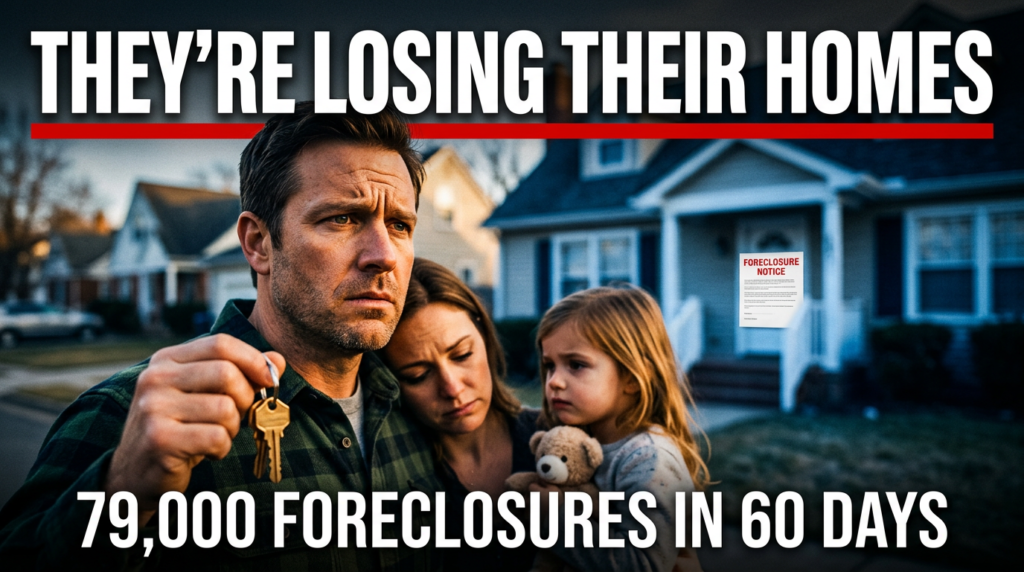
In January and February of this year alone, nearly 79,400 U.S. homes received foreclosure filings — default notices, auction schedules, or outright bank repossessions, according to ATTOM, the country’s leading property data provider. January saw 40,534 filings — a 32% jump from a year ago. February brought 38,840 more, up 20% year-over-year. February also marked the twelfth consecutive month of annual increases in foreclosure activity.
Twelve months in a row. Not a blip. A trend.
Support Independent Local Journalism
TheTownHall.News is a non-profit reader-supported journalism. Just $5 helps us hire local reporters, investigate important issues, and hold public officials accountable across Alameda County. If you believe our community deserves strong, independent journalism, please consider donating $5 today to support our work.And yet the official line remains oddly calm: “Foreclosure levels are still below historic norms.” That is technically true — but it is the kind of statement that tells a drowning man the ocean is mostly dry.
The Numbers Behind the Human Toll
Completed foreclosures — the final stage, where a bank physically repossesses a home — surged 35% year-over-year in February 2026. That’s not delinquency. That’s not a missed payment. That’s a family that ran out of options, ran out of time, and lost the roof over their heads. In January, lenders repossessed 4,714 properties. In February, another 4,077. These are not statistics. These are kitchen tables, children’s bedrooms, and decades of savings — gone.
The hardest-hit states tell a story about where economic stress concentrates when policy fails. Indiana leads the nation with one foreclosure filing for every 1,597 housing units. South Carolina, Florida, Delaware, and Illinois follow close behind. Among major metro areas, Lakeland and Punta Gorda, Florida have the worst rates of any city with a population over 200,000.
Texas, Florida, California, Georgia, and Indiana are driving the most foreclosure starts — meaning the pipeline of future repossessions is filling up even as current numbers continue rising.

This Didn’t Happen in a Vacuum
It would be convenient to blame this crisis on bad luck or pandemic aftershocks. But honest analysis requires tracing the path that led here.
For years, federal housing policy has been built on a foundational contradiction: the government simultaneously inflated the housing market with cheap money, restricted the supply of new homes through overregulation, and told Americans that homeownership was an entitlement rather than a financial commitment requiring preparation. The Federal Reserve held rates near zero for over a decade, flooding the market with cheap credit. Home prices ballooned. When rates normalized — as they always must — millions found themselves squeezed. Redfin estimates the average family now needs to earn $110,000 per year to afford a typical American home. The median household earns roughly $29,000 less than that.
That gap was built, brick by brick, through fiscal irresponsibility and a government that consistently chose short-term political comfort over long-term economic health.
The Affordability Crisis Is a Policy Crisis
Housing affordability is not a natural disaster. It is a policy outcome.
Local and state governments in the hardest-hit markets have spent years blocking new housing construction through restrictive zoning laws, lengthy permitting processes, and regulatory burdens that add tens of thousands of dollars to the cost of every new home. The result is a market starved of supply while demand has kept prices at historically elevated levels.
Support Independent Local Journalism
TheTownHall.News is a non-profit reader-supported journalism. Just $5 helps us hire local reporters, investigate important issues, and hold public officials accountable across Alameda County. If you believe our community deserves strong, independent journalism, please consider donating $5 today to support our work.Meanwhile, fiscal expansionism at the federal level has eroded the purchasing power of working families even as their nominal wages appeared to rise. When the true cost of groceries, energy, childcare, and insurance is factored in, millions of American households have been quietly losing ground for years. The foreclosure spike is simply where that quiet loss becomes impossible to ignore.
This is what happens when government overreaches, overpromises, and overspends. The bill always comes due — and it is ordinary families, not politicians, who pay it.
Personal Responsibility Cannot Be Separated From This Conversation
There is a dimension of this crisis too many commentators are reluctant to address: personal financial responsibility.
Not every foreclosure is the product of government failure alone. Some families took on mortgages they could not sustain, assuming prices would always rise and refinancing would always be available. Some borrowed against home equity to fund consumption rather than investment. This is not callousness — it is honesty, and honesty is what actually helps people. A culture that excuses every financial failure as the fault of banks or politicians robs individuals of the agency they need to make better decisions. Personal responsibility is not a punishment. It is a form of respect — the belief that Americans are capable of understanding their obligations and honoring them.
The conservative answer to this crisis is not another government bailout. It is financial literacy in schools, transparent lending, less regulatory interference in housing markets, and honest monetary policy that doesn’t punish savers through inflationary mismanagement.
The Macro Storm Gathering on the Horizon
If the current trend is concerning, the economic headwinds forming in 2026 make it more so. Oil prices have crossed $100 per barrel in the wake of the U.S.-Iran conflict, threatening to reignite inflationary pressures that families had only begun to recover from. Energy costs ripple through every corner of the economy and fall hardest on households with the least cushion.
Long-term unemployment is quietly ticking upward. Underemployment — workers in roles below their skill level — is more widespread than headline numbers suggest. These households appear stable on paper but are one emergency away from missing a mortgage payment.
Foreclosure is a lagging indicator — it represents people already 120+ days behind who have exhausted every alternative. The distress visible in today’s data began accumulating months ago. The distress accumulating right now hasn’t appeared in the numbers yet. The pipeline is filling.
What Sound Policy — and Sound Principles — Actually Look Like
The solution is not another federal housing program, another forbearance extension, or another bureaucratic initiative that redirects taxpayer dollars without addressing root causes.
It starts with monetary discipline — a Fed that prioritizes stable, honest money over political convenience. It continues with deregulation of housing supply — clearing the barriers that make building unnecessarily expensive. It demands fiscal responsibility in Washington, because every dollar of deficit spending today is a tax on tomorrow’s purchasing power — and the families losing their homes are already paying it.
It also requires an honest national conversation about what homeownership demands. It is not a government-guaranteed outcome. It is an earned achievement built on savings, planning, and accountability. America learned this the hard way in 2008. Those lessons should not have to be relearned.
Conclusion: The Alarm Is Ringing — Is Anyone Listening?
Twelve consecutive months of rising foreclosures. Nearly 79,400 homes lost in 60 days. Bank repossessions up 35% year-over-year. These are not the numbers of a healthy correction. They are the numbers of a system under compounding stress — stress born in policy choices that will not be resolved by more of the same.
The families losing their homes deserve more than bureaucratic reassurance. They deserve a policy environment built on the principles that made American homeownership possible: sound money, limited government, free markets, and the dignity of personal responsibility.
The alarm is ringing. The question is whether Washington — and the American people — are ready to listen.
Call to Action
Don’t let this story disappear. Share this article with anyone who cares about economic accountability and the future of the American dream. Subscribe to our newsletter to stay informed on the housing market and fiscal policy. And contact your representatives — demand housing policies built on fiscal responsibility, market freedom, and honesty about what government can and cannot fix.
The data is clear. The principles are sound. The choice is ours.