Beirut Is Burning Again. Here’s Who’s Really to Blame
A Sleeping Tiger, Kicked Awake
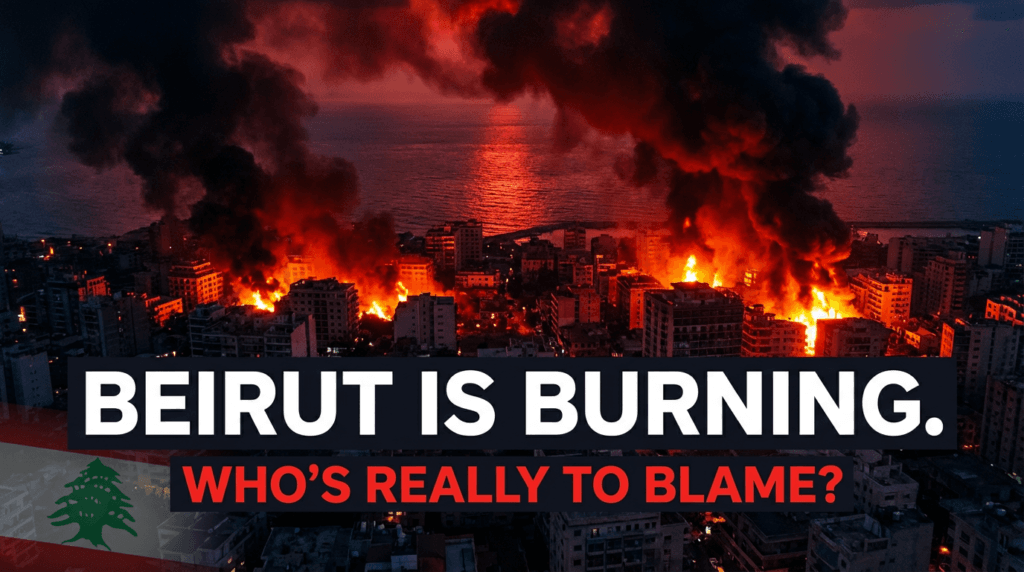
At 2:30 in the morning on March 2, 2026, families in Beirut’s southern suburbs were jolted from their beds by the thunder of Israeli airstrikes. Bumper-to-bumper traffic choked the roads as residents fled on foot, children crying in the dark. By sunrise, Lebanon’s Health Ministry confirmed at least 52 dead and 154 wounded. Buildings had collapsed in the south. Over 50 towns received Israeli evacuation orders. Flights in and out of Beirut were cancelled.
This was not Israel picking a fight. This was the inevitable consequence of decades of willful blindness — by the international community, by Lebanon’s own government, and by Western policymakers who convinced themselves that tolerating a U.S.-designated terrorist organization operating as a state-within-a-state was somehow a sustainable policy.
It is not. It never was. And the scenes unfolding in Lebanon today are the direct, predictable result of that failed experiment in appeasement.
Know Your Enemy: Hezbollah Is a Terrorist Organization
Let’s be precise about what Hezbollah is — because too many in the mainstream press refuse to say it plainly.
Hezbollah is not a “resistance movement.” It is not a political party with a militia wing. It is a U.S.-designated Foreign Terrorist Organization, listed as such by the State Department, the United Kingdom, Germany, and more than 60 other nations. It is financed, armed, trained, and ideologically directed by the Islamic Republic of Iran. It is the crown jewel of Tehran’s so-called “Axis of Resistance” — a network of terror proxies that includes Hamas, Yemen’s Houthis, and Iraq’s Popular Mobilisation Forces.
Since its founding in the early 1980s, Hezbollah has been responsible for hundreds of American deaths, including the 1983 Beirut barracks bombing that killed 241 U.S. servicemen — the deadliest single-day loss for the U.S. Marine Corps since Iwo Jima. It has smuggled weapons, laundered billions, threatened judges, and by credible accounts, orchestrated the killings of Lebanese officials who dared investigate its role in the catastrophic 2020 Beirut port explosion.
This is who Israel is fighting. Not civilians. Not a sovereign army. A heavily armed, Iran-controlled terrorist force that has embedded itself within a civilian population and dared the world to stop it.
The Ceasefire That Was Never Real
After fifteen months of brutal fighting — a campaign in which Israel killed Hezbollah’s Secretary-General Hassan Nasrallah, decimated its senior military leadership, and degraded its weapons stockpiles — a U.S.-brokered ceasefire was signed in November 2024. It was hailed as a diplomatic win.
It was nothing of the sort.
Within weeks, Israel was conducting near-daily strikes on Lebanese territory, citing Hezbollah’s ongoing ceasefire violations and active rearmament. Israeli military officials warned repeatedly that Hezbollah was rebuilding its training networks and missile arsenal — with Iran’s full backing. By February 2026, Lebanese Foreign Minister Youssef Rajji was publicly pleading with Hezbollah not to drag the country into another war. Sixty-four thousand Lebanese citizens were still internally displaced from the previous conflict.
Hezbollah’s response? It rejected the Lebanese government’s own national disarmament plan, dismissed peace talks as “unreciprocated concessions,” and — through its leader Naim Qassem — openly warned that the group was “preparing to confront potential U.S. action against Iran.”
A ceasefire is only as strong as the will to enforce it. When one side is a terrorist organization answerable not to the Lebanese people but to the mullahs in Tehran, a piece of paper means nothing. Strength deters. Weakness invites.
Lebanon’s Reckoning: Accountability Begins at Home
There is genuine tragedy in what is happening to Lebanese civilians. Families torn from their homes, children on sidewalks with nowhere to go — these images are heartbreaking, and no decent person dismisses their suffering lightly.
But accountability matters. And the Lebanese state bears serious responsibility for the crisis it now faces.
For decades, successive Lebanese governments allowed Hezbollah to operate a parallel military command structure, import Iranian weapons through the country’s ports and airports, and hold the Lebanese economy — and people — hostage to Tehran’s regional ambitions. Even now, as Israeli bombs fall, the Lebanese government has only just outlawed Hezbollah’s military activities and ordered the arrest of those who fired rockets at Israel. That action, long overdue, came only after the damage was done.
The United States has drawn a clear line: Lebanon must formally designate Hezbollah as a terrorist organization, or there will be no distinction between the Lebanese state and the terrorist group sheltering within it. That is not a harsh demand. That is the minimum standard of sovereignty and responsibility that any serious nation should be expected to meet.
Nations — like individuals — must own the consequences of their choices. A government that permits a terrorist army to operate from its soil cannot then plead innocent when that terrorist army starts a war.
Israel’s Right to Defend Its Citizens
When Hezbollah fired “a barrage of precision missiles and a swarm of drones” at a missile defense facility south of Haifa on the night of March 1–2, it made a choice. That choice was not made for the Lebanese people — analysts at the Atlantic Council and the Lebanese American University have called it an act of “strategic desperation,” driven not by Lebanese interests but by Iran’s command. Hezbollah knew, according to experts, that its own community would suffer the consequences.
Israel’s response has been overwhelming by design. Israel has called up more than 100,000 reservists. Defense Minister Israel Katz has authorized troops to advance and secure additional positions in southern Lebanon. The Israeli military has been explicit: these are defensive measures to protect Israeli civilians and strategic assets from further attack.
This is what law and order on the international stage looks like. A democratic nation — one of America’s closest allies and the Middle East’s only genuine liberal democracy — defending its citizens from a terror group that has pledged its destruction. Israel does not need to apologize for that. Neither does the United States for standing with her.
The Price of Half-Measures
The broader war now engulfing the region — U.S. and Israeli strikes on Iran, Iranian drone attacks on the U.S. Embassy in Riyadh, the closure of the Strait of Hormuz, six American service members already dead — did not materialize out of nowhere.
It is the bill coming due for years of half-measures, wishful thinking, and strategic timidity.
The 2015 Iran nuclear deal did not stop Tehran’s aggression — it funded it, freeing up billions in sanctions relief that flowed directly to Hezbollah, Hamas, and the Houthis. The 2024 Lebanon ceasefire did not disarm Hezbollah — it gave the group time to rearm. Every time the West blinked, Iran pushed further. Every time a red line was drawn and not enforced, the cost of the next confrontation grew higher.
Ronald Reagan understood that peace comes through strength, not concession. A foreign policy grounded in that principle would have confronted Iran’s proxy network years ago — at far lower cost in blood and treasure than what America and her allies are paying today.
Fiscal accountability applies in foreign policy too. The longer we delay confronting state-sponsored terrorism, the more expensive — in lives and dollars — the reckoning becomes.
Standing Firm: What Conservatives Must Demand
As this conflict evolves, conservatives must be clear-eyed and vocal about what they expect:
- Name the enemy. Hezbollah is a terrorist organization. Iran is a state sponsor of terrorism. Language matters, and calling things by their true names is the first step toward confronting them honestly.
- Support Israel unconditionally in its right to self-defense. A democratic ally defending its citizens from a U.S.-designated terrorist group deserves our backing, not our hand-wringing.
- Demand accountability from Lebanon. Diplomatic and economic pressure must accompany military realities. Lebanon must choose: sovereignty or subjugation to Tehran.
- Reject the false peace of appeasement. Every ceasefire that leaves Hezbollah armed and Iran unpunished is a delayed catastrophe, not a solution.
- Hold Congress accountable. The American people deserve a transparent accounting of U.S. military objectives, costs, and an exit strategy. Blank checks without clear goals are not conservative — they are reckless.
Conclusion: Clarity in a Dangerous Moment
The fires burning in Beirut’s southern suburbs this week are the fires of a war that the West refused to prevent when prevention was cheaper. That window is now closed. The question before us is not whether to engage — we are engaged. The question is whether we will fight with clarity of purpose and moral resolve, or stumble forward with the same confused half-measures that brought us here.
Conservatives have always understood that evil does not negotiate in good faith, that borders must be defended, that alliances with democracies must be honored, and that the world is safer when America leads with strength. Those principles are not abstractions. They are the roadmap out of this crisis.
The time for wishful thinking is over. The time for clarity — and courage — is now.