Camp Pendleton Marine Charged With Stealing Javelin Missile Systems — Millions of Rounds Still Missing
A 23-year-old corporal allegedly turned America’s most advanced anti-tank weapons into personal inventory. The charges raise urgent questions about military oversight, national security, and accountability inside the armed forces.
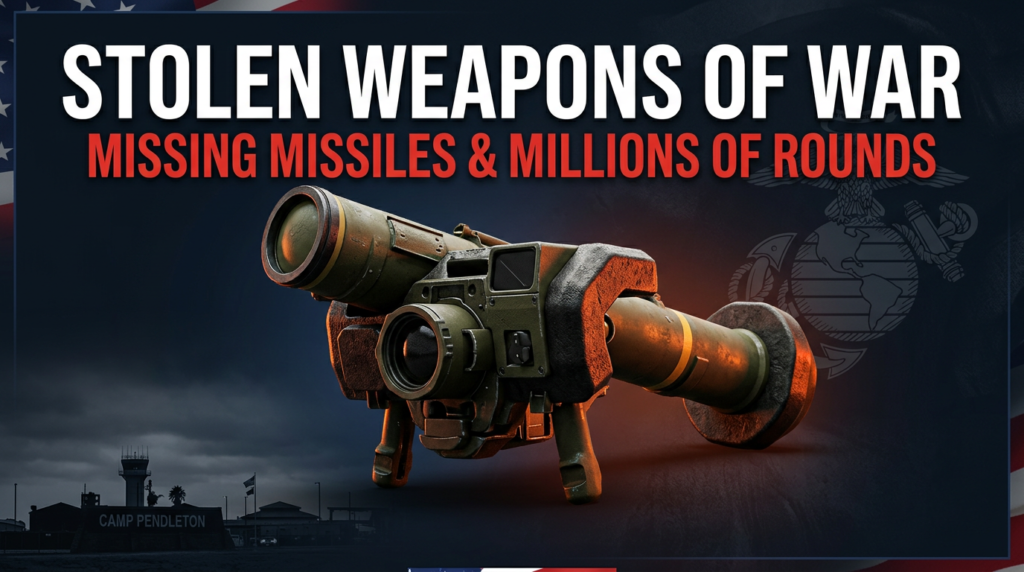
There’s a reason the Javelin missile system is one of the most closely guarded weapons in the U.S. military arsenal. A single unit costs roughly $200,000, weighs under 50 pounds, and can obliterate a main battle tank from miles away with near-perfect accuracy. It is a weapon of war — not a commodity. Yet federal prosecutors allege that a 23-year-old Marine corporal treated it like one.
Cpl. Andrew Paul Amarillas, an ammunition technical specialist stationed at Camp Pendleton’s School of Infantry West in San Diego County, was indicted by a federal grand jury in Arizona this week on charges of conspiracy to commit theft and embezzlement of government property, as well as possession and sale of stolen military ammunition. He is currently being held without bail. The case is a national security wake-up call — and a stark reminder that accountability must begin from the inside.
Support Independent Local Journalism
TheTownHall.News is a non-profit reader-supported journalism. Just $5 helps us hire local reporters, investigate important issues, and hold public officials accountable across Alameda County. If you believe our community deserves strong, independent journalism, please consider donating $5 today to support our work.Inside the Alleged Theft: A Weapons Specialist Who Abused His Access
Amarillas’s position gave him something most Americans never have: legitimate, authorized access to some of the military’s most lethal equipment. As an ammunition technical specialist, he could sign out weapons and munitions as part of his normal duties. According to federal court documents, he allegedly exploited that access to steal Javelin missile systems and restricted military-grade ammunition, then transported the stolen items to Arizona for sale.
Prosecutors allege that in one instance, Amarillas offered approximately 30 cans of M855 rifle ammunition — roughly 25,000 rounds — to a co-conspirator. Over a span of roughly two weeks, he allegedly stole and sold 66 cans of the same ammunition, with only about one-third later recovered by investigators.
The numbers get more alarming from there. Reports suggest that as many as 2 million rounds of M855 ammunition may still be unaccounted for. Federal agents have recovered at least one Javelin system, but the fate of additional units remains under active investigation.
Why This Case Is About More Than One Bad Actor
It would be convenient — and dangerously naive — to frame this as the isolated misconduct of a single rogue servicemember. The deeper story is about systemic gaps in military inventory oversight that enabled this alleged scheme to go undetected long enough for millions of rounds and advanced missile systems to potentially disappear.

The M855 round is not standard-issue sporting ammunition. It is restricted military-grade ordnance, illegal for civilian possession. The Javelin system is classified anti-armor technology. These are not items that should be walking out of a military installation without immediate detection.
When America’s enemies can theoretically purchase its own weapons of war on the black market, the failure is institutional — not just individual.
The question taxpayers deserve answered is simple: How does a 23-year-old corporal allegedly remove Javelin missile systems from one of the most prominent Marine Corps bases in the country without triggering immediate alarms?
The Fiscal Reality: Taxpayers Are Footing the Bill
Javelin missile systems are not inexpensive. Each unit costs approximately $200,000, and that figure does not account for the associated training systems, guidance components, or logistics infrastructure that surrounds them. The military-grade M855 ammunition, while less individually expensive, represents enormous fiscal value at the volume allegedly stolen.
These are taxpayer-funded assets — purchased with public money, entrusted to the United States military to protect national security. When those assets are allegedly embezzled and sold off by the very servicemembers sworn to protect them, the breach is not just criminal. It is a fundamental violation of the public trust.
Support Independent Local Journalism
TheTownHall.News is a non-profit reader-supported journalism. Just $5 helps us hire local reporters, investigate important issues, and hold public officials accountable across Alameda County. If you believe our community deserves strong, independent journalism, please consider donating $5 today to support our work.Fiscal conservatives have long argued that government waste, fraud, and abuse are features of institutions that lack rigorous accountability mechanisms. This case is Exhibit A. It is not enough to prosecute Amarillas. Congress and military leadership must answer for the oversight failures that made this alleged scheme possible in the first place.
What Critics Get Wrong About Military Accountability
Some will argue that incidents like this are rare and that the military’s internal disciplinary systems are sufficient. That argument deserves a fair hearing — and a firm rebuttal.
Yes, the vast majority of U.S. servicemembers serve with honor and integrity. That is not in dispute. The military’s legal system, the Uniform Code of Military Justice (UCMJ), is also a serious and functional institution. But the existence of legal consequences after the fact does not excuse the absence of preventive safeguards that should have caught this earlier.
Retail businesses use electronic inventory tags. Financial institutions conduct real-time fraud detection. Defense contractors maintain chain-of-custody protocols on sensitive components. The idea that one of the world’s most powerful militaries cannot track the real-time location of its Javelin missile systems is not a comfortable argument to make.
Law and order applies inside military installations as much as it does on civilian streets. Accountability cannot be retroactive-only.
The lesson is not to distrust the military — it is to demand that institutions of this importance hold themselves to the highest possible standard of internal control.
The National Security Dimension Nobody Is Talking About
Beyond the legal charges and fiscal impact lies a more unsettling question: Who was buying?
Federal documents describe Amarillas allegedly working with a co-conspirator to offload the stolen goods in Arizona. Investigators have not publicly named additional buyers, and the investigation appears ongoing. But the nature of the merchandise demands scrutiny. Javelin systems and large-scale military ammunition are not the kind of items a private citizen purchases for recreational use.
Whether the trail leads to organized crime, foreign actors, or domestic bad actors, the national security implications of military-grade anti-tank weapons entering an uncontrolled supply chain are severe. This is precisely the kind of threat that demands a transparent, public accounting — not just a quiet federal prosecution.
The American public has a right to know where those missiles ended up. And they have a right to know it was not a foreign adversary who received them.
Key Takeaway
Cpl. Andrew Paul Amarillas faces serious federal charges, and he will have his day in court. But the larger story is this: the United States military may have lost track of advanced anti-tank missile systems and potentially millions of rounds of restricted ammunition through the hands of a single low-ranking specialist. That is not a minor administrative failure. It is a fundamental breakdown in the chain of accountability that the American people pay for and depend on.
Personal responsibility matters. So does institutional responsibility. Both are on trial here.
Conclusion: Accountability Has No Rank
The charges against Amarillas are a reminder that no institution — not even the U.S. military — is immune to the consequences of weak internal oversight. The values that made America’s armed forces the most respected in the world are the same values now being tested: discipline, integrity, and accountability at every level of rank.
Congress should be asking hard questions of military leadership. Taxpayers should be demanding answers about how this alleged scheme was possible. And the American public should be watching the investigation closely — because if millions of rounds and anti-tank missiles can go missing from Camp Pendleton, the problem is bigger than one corporal.
Justice demands prosecution. Responsibility demands reform.
Stay informed. Share this article with someone who cares about national security and government accountability. Independent journalism depends on readers who refuse to look away.