Cartilage Regeneration Treatment: What the Viral “German Gel” Got Right — and Wrong
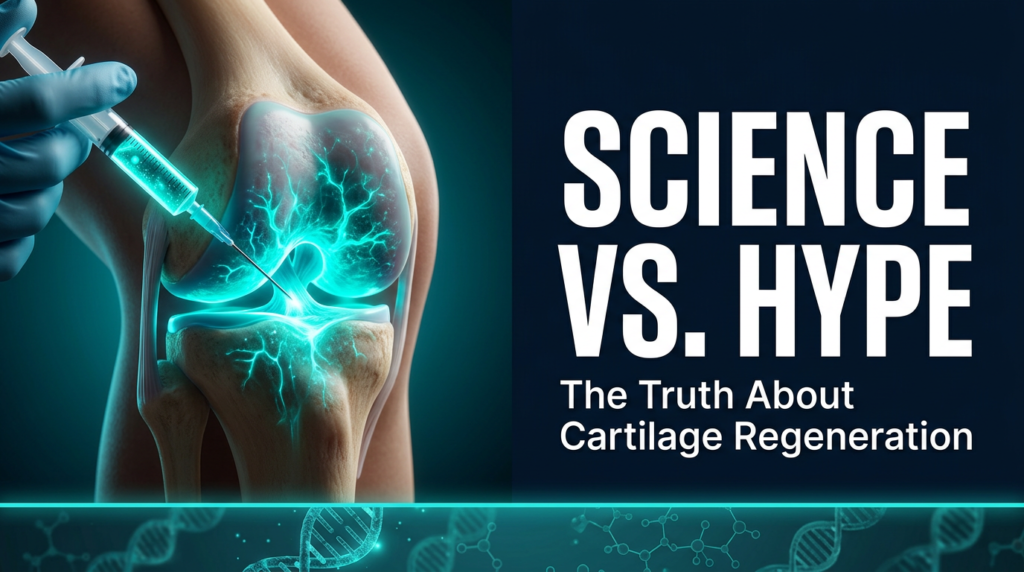
Social media says a “German miracle gel” will replace your knee replacement by 2026. The truth is more complicated — and more important.
The posts are everywhere. A sleek infographic, a shareable headline, a promise that sounds almost too good to be true: “German scientists have created an injectable gel that regrows cartilage in damaged joints — no surgery required.” Hundreds of thousands of people, many of them living with daily joint pain, liked, shared, and forwarded the claim across Facebook, LinkedIn, and Instagram throughout the second half of 2025.
Here’s the problem: it’s not quite true. Here’s the bigger truth: the science underneath the hype is real, it is advancing fast — and understanding the difference between the two matters enormously, both for your health and for a healthcare system already buckling under the weight of preventable costs.
Support Independent Local Journalism
TheTownHall.News is a non-profit reader-supported journalism. Just $5 helps us hire local reporters, investigate important issues, and hold public officials accountable across Alameda County. If you believe our community deserves strong, independent journalism, please consider donating $5 today to support our work.The Viral Story That Got Ahead of the Science
The social media wave appears to have originated from posts referencing ChondroFiller®, a collagen-based hydrogel scaffold manufactured by Meidrix Biomedicals in Stuttgart, Germany, developed in collaboration with the Fraunhofer Institute for Interfacial Engineering and Biotechnology. Fact-checkers at Snopes investigated the viral claims in August 2025 and rated them “Outdated” — because ChondroFiller® has been CE-marked and available in Europe since 2013. By that point, it had already treated more than 20,000 patients worldwide.
The viral posts claimed the gel requires no surgery, no rehabilitation, no risk of rejection, and is pending Europe-wide approval by 2026. Every one of those claims is either wrong or misleading. Meidrix’s own patient education materials confirm that the procedure requires arthroscopic or minimally invasive surgery, 48 hours of post-operative joint immobilization, and structured rehabilitation. The company also explicitly warns that hypersensitivity reactions to collagen can occur.
ChondroFiller® is a legitimate and useful treatment — but it is designed for small, focal cartilage defects of up to about 3 cm² in otherwise healthy joints. It is not a cure for widespread osteoarthritis, and it is not something you walk into a clinic and walk out of an hour later.
Viral health misinformation doesn’t just mislead patients — it erodes trust in the real science that could actually help them.

Why This Issue Matters Now
Osteoarthritis is one of the most significant and costly chronic conditions in the United States. According to Stanford Medicine, it affects approximately one in five adults — roughly 65 million Americans — and costs the healthcare system an estimated $65 billion in direct annual medical costs. The global joint replacement market was valued at over $20 billion in 2025 and is projected to reach $32 billion by 2035.
These are not abstract statistics. They represent real families — parents who can’t walk their kids to school, veterans with blown-out knees, former athletes watching their mobility erode in their fifties. They represent Medicare and Medicaid expenditures that taxpayers fund. Every joint replacement surgery costs tens of thousands of dollars, requires general anesthesia, carries real surgical risks, and demands months of intensive physical therapy.
If legitimate regenerative therapies can reduce the number of joint replacements performed each year, the downstream savings — for patients, for insurers, and for government programs — would be staggering. That’s precisely why this field deserves serious, honest coverage, not recycled miracle-cure clickbait.
The Real Breakthroughs Happening Right Now
Here’s what the viral posts got wrong by getting ahead of themselves: the actual science is far more exciting than the hype requires.
In November 2025, researchers at Stanford Medicine published a landmark study in the journal Science identifying a protein called 15-PGDH — dubbed a “gerozyme” because of its increasing prevalence as the body ages — as a master regulator of cartilage deterioration. When Stanford researchers injected old mice with a small molecule that blocks 15-PGDH activity, the thinning articular cartilage in their knee joints thickened measurably across the joint surface. More strikingly, human cartilage tissue removed from patients undergoing total knee replacement responded to the treatment by beginning to generate new, functional articular cartilage.
Support Independent Local Journalism
TheTownHall.News is a non-profit reader-supported journalism. Just $5 helps us hire local reporters, investigate important issues, and hold public officials accountable across Alameda County. If you believe our community deserves strong, independent journalism, please consider donating $5 today to support our work.“This is a new way of regenerating adult tissue, and it has significant clinical promise for treating arthritis due to aging or injury,” said Dr. Helen Blau, professor of microbiology and immunology at Stanford and director of the Baxter Laboratory for Stem Cell Biology.
An oral version of the same 15-PGDH inhibitor is already in Phase 1 clinical trials for age-related muscle weakness. The researchers have expressed strong hope that a similar trial targeting cartilage regeneration will follow. This is peer-reviewed, published in one of the world’s most prestigious scientific journals, and backed by the National Institutes of Health.
Separately, Northwestern University unveiled a bioactive scaffold material in 2024 that successfully regenerated high-quality cartilage in knee joints using nanoscale bioactive signals — also still in preclinical stages, but advancing. And a Nature Communications study from 2023 described a PTK hydrogel that demonstrated full-thickness cartilage regeneration in animal models.
The pipeline is real. The timeline is just honest.
What Critics Get Wrong About Medical Skepticism
Some will argue that raising questions about viral health claims is an attack on hope — that patients desperate for relief deserve to hear optimistic news. That argument, while emotionally understandable, gets the ethics backwards.
Patients with osteoarthritis deserve accurate information precisely because their need is real and urgent. When unverified claims circulate as fact, patients make poor medical decisions — delaying proven pain management, skipping physical therapy, pinning false hope on treatments that aren’t yet available. In some cases, bad actors exploit that hope to sell unproven or fraudulent products directly to suffering consumers.
Personal responsibility in healthcare begins with demanding honest information. A free press that holds viral medical misinformation to the same fact-checking standard as political claims is not being pessimistic — it is being responsible.
The regulatory pathway that new treatments must travel — animal studies, Phase 1 safety trials, Phase 2 efficacy trials, Phase 3 randomized controlled trials — exists precisely to protect patients from treatments that harm more than they help. That process is not “government overreach.” It is the hard-won institutional structure that separates medicine from snake oil. Trusting it, while holding it accountable for unnecessary slowness, is the rational position.
The Real Cost of False Hope
The economic stakes here are significant. The U.S. joint replacement market alone is valued at $7.1 billion in 2025, with Medicare bearing an enormous share of those costs for elderly patients. Every unnecessary surgery, every repeat procedure on a failed implant, every month of skilled nursing facility rehabilitation represents a direct fiscal burden on American taxpayers.
Regenerative therapies that actually work could, over time, meaningfully compress those costs. But that outcome depends on those therapies reaching the market with rigorous evidence behind them — not being rushed by social media buzz, not being prematurely dismissed due to association with viral misinformation, and not being blocked by regulatory timelines that have failed to keep pace with scientific innovation.
The goal is not just to replace surgeries with injections. It is to restore people’s lives — and to do it honestly.
Key Takeaway
The promise of injectable cartilage regeneration is not a myth — it is an emerging scientific reality grounded in peer-reviewed research from leading institutions. But the viral “German miracle gel” narrative that swept social media in 2025 misrepresented an existing product, inflated its capabilities, and crowded out the genuinely significant breakthroughs happening in labs right now. Stanford’s 15-PGDH research, Northwestern’s bioactive scaffold work, and advancing hydrogel technologies represent a genuine horizon for the roughly 65 million Americans living with osteoarthritis. Getting there requires honest reporting, patient advocates who demand real answers, and a healthcare system willing to reward innovation that reduces long-term costs.
Conclusion
The science of cartilage regeneration is one of the most exciting frontiers in modern medicine. The researchers advancing it deserve better than to have their work buried under a wave of recycled, exaggerated social media posts. And patients deserve better than false hope dressed up as a breakthrough.
We are not yet at the point where a single outpatient injection regrows a damaged knee. But if the science currently progressing through peer review and clinical trials continues its trajectory, that day may arrive sooner than skeptics expect — and when it does, it will have been built on rigor, honesty, and the kind of patient, methodical work that social media algorithms do not reward but patients’ lives depend on.
Stay informed. Demand accuracy from the health content you consume and share. And when the real breakthrough arrives — verified, peer-reviewed, and ready for patients — you’ll recognize it, because it will come with evidence, not just likes.
This article is based on verified reporting from Snopes, Stanford Medicine, Open Access Government, and peer-reviewed studies published in Science and Nature Communications.
If you found this article valuable, share it with someone who deserves the real story. Independent journalism that holds viral health misinformation accountable only survives when readers support and amplify it.