Chechen Fighters Declare Jihad as Iran War Escalates: What Every American Needs to Know
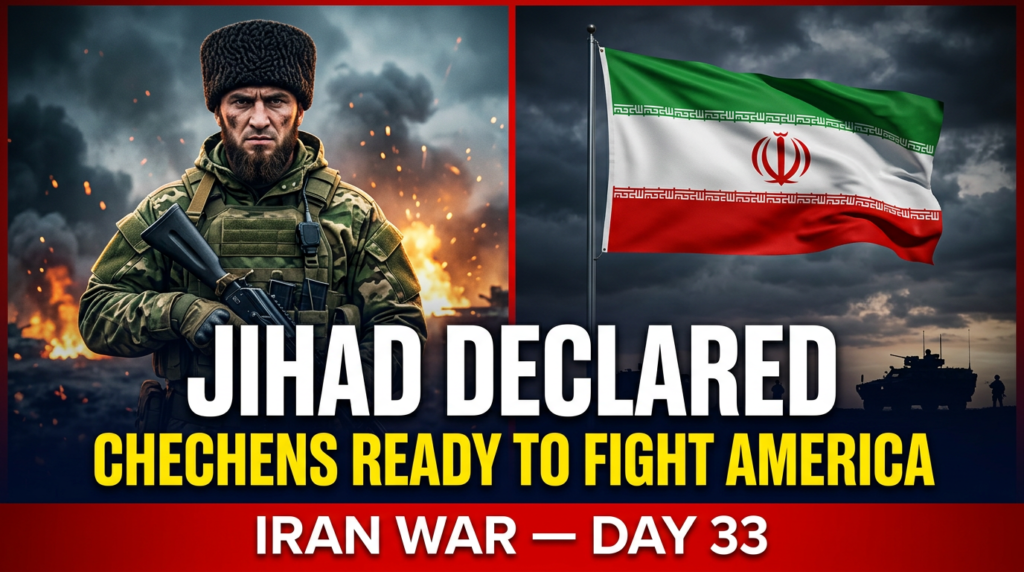
As the US-Iran conflict reaches Day 33, Russia-aligned Chechen militia commanders are threatening to deploy to Tehran — a development that should force every American to ask: how did we get here, and who is minding the strategic store?
The United States did not stumble into a war with Iran by accident. Decisions were made, signals were sent, and now the consequences are arriving — some of them from directions few in Washington appear to have anticipated. The latest: Chechen military commanders loyal to Russia’s Ramzan Kadyrov are publicly announcing their readiness to deploy to Iran and fight American troops if a ground invasion is launched — framing the potential intervention openly as a holy war against the United States.
This is not background noise. It is a warning siren. And whether you support the underlying military campaign or have deep reservations about it, every American deserves a clear-eyed account of what is happening on Day 33 of a conflict that is growing more complex — and more costly — by the hour.
Support Independent Local Journalism
TheTownHall.News is a non-profit reader-supported journalism. Just $5 helps us hire local reporters, investigate important issues, and hold public officials accountable across Alameda County. If you believe our community deserves strong, independent journalism, please consider donating $5 today to support our work.What the Chechen Commanders Actually Said
On March 31, 2026, Iranian state broadcaster Press TV reported that Chechen military units loyal to Kadyrov had formally declared readiness to deploy to Iran, contingent on approval from Russian leadership. The key figure is Lt. Gen. Apti Alaudinov, commander of the Akhmat force — Chechnya’s most battle-hardened units, veterans of the Ukraine war. In a video posted to his Telegram channel, Alaudinov said he was personally ready to fly to Iran, transfer weapons, and fight alongside Iranian forces.
The language was deliberately incendiary. He described a potential US ground invasion as the next move in a campaign of global aggression, called Trump the “Antichrist,” and stated that Russia itself would be Washington’s next target once Iran falls.
Kadyrov himself called the assassination of Iran’s Supreme Leader Khamenei — which triggered this war on February 28 — a “tragedy,” and accused the US and Israel of a “treacherous attack” conducted during the holy month of Ramadan.
The framing matters enormously: a Sunni Muslim militia is now prepared to cross centuries of sectarian division to stand alongside Shia Iran — united not by theology, but by opposition to American power.

Why This Is Not Just Propaganda to Dismiss
The first instinct of many analysts will be to wave this off as bluster from a Kremlin-friendly warlord amplified by Iranian state media. That instinct is understandable. But it is dangerously incomplete.
Kadyrov’s Chechen forces are not paper tigers. They have fought with documented effectiveness in Ukraine. Alaudinov’s units have real combat experience, real weapons, and a demonstrated willingness to deploy far from home in service of Russia’s geopolitical objectives. The caveat that Kremlin approval is required is significant — Putin has not authorized a move — but the fact that these statements are made publicly, without contradiction from Moscow, tells you something about the direction the Kremlin is leaning.
The broader geopolitical picture is also shifting fast. NATO allies Spain, France, and Italy have already restricted US military operations, closing airspace and denying base access. China and Pakistan have jointly proposed a five-point ceasefire plan. The Vatican has urged de-escalation. Iran’s Foreign Minister Abbas Araghchi stated this week that trust in Washington is “at zero.” Even Defense Secretary Pete Hegseth acknowledged the “coming days will be decisive.”
This is not a contained, manageable conflict. It is a war actively pulling in more players.
The Real Cost Being Paid by American Families
Lost in the geopolitical chess discussion is a number that deserves to be said plainly: more than 2,000 Iranians have been killed in 33 days of US-Israeli strikes, with hospitals, schools, pharmaceutical factories, and civilian infrastructure among the sites hit. US Senator Chris Coons stated this week that the war is already driving up the cost of groceries, utility bills, and mortgages for American families.
Support Independent Local Journalism
TheTownHall.News is a non-profit reader-supported journalism. Just $5 helps us hire local reporters, investigate important issues, and hold public officials accountable across Alameda County. If you believe our community deserves strong, independent journalism, please consider donating $5 today to support our work.Those are not abstract figures. Oil prices have surged. Global energy markets are in turmoil. The Strait of Hormuz remains a flashpoint. A desalination plant on Qeshm Island was knocked out this week. A passenger pier in Bandar Abbas was bombed. An “unknown projectile” damaged a tanker off Qatar.
Every one of those events has a downstream cost that lands in American wallets. Fiscal accountability requires that the architects of this conflict be asked directly: what is the exit strategy, and who is paying for it?
What the Administration’s Supporters Get Right — and Wrong
The case for strong action against Iran is not without foundation. Tehran has spent decades funding proxy militias, developing ballistic missiles, and pursuing nuclear ambitions that posed genuine threats to regional stability. Trump’s claim this week that the war “could end in two to three weeks” suggests a president who believes defined objectives are within reach. Hegseth’s posture — “negotiating with bombs” — resonates with Americans tired of adversaries exploiting Western hesitancy.
But there is a difference between strategic strength and strategic clarity. The Chechen threat is a reminder that wars expand beyond the boundaries their architects draw. The question is not whether America should project power. The question is whether this trajectory has a defined end state, a manageable cost, and an honest accounting of who the secondary adversaries might be.
Responsible governance demands those answers. Voters deserve them.
The Jihad Framing: A Strategic Weapon, Not Just Rhetoric
It would be a mistake to treat Alaudinov’s “holy war” language as mere theater. In the information environment of 2026 — where recruitment, morale, and international solidarity are fought on social media and Telegram channels — framing a conflict as a religious struggle has real operational value.
The Chechen units are Sunni Muslim. Iran is the world’s leading Shia state. The fact that these two branches of Islam — historically in deep theological tension — are being rhetorically united under the banner of anti-American jihad signals that opposition to US action has become a more powerful force than centuries of internal Islamic division.
When America’s adversaries are more willing to set aside their differences than our allies are willing to stand with us, that is a strategic problem no amount of air power alone can solve.
What Comes Next: The Ground Invasion Question
The central question is whether the US will launch a ground invasion. Multiple reports indicate American forces are actively preparing for that contingency, with additional Marines en route to the region.
Iran’s Foreign Minister said Wednesday he does not believe the US “would dare” launch a ground operation — possibly reflecting a genuine calculation about American public appetite for a land war in a country of 90 million people with mountain terrain, hardened infrastructure, and a now-declared pipeline of foreign fighters. The Iraqi armed group Kata’ib Sayyid al-Shuhada warned that using Kuwaiti territory for a ground push would trigger “all-out war.” Hezbollah has launched more than 40 rockets. Yemen has fired ballistic missiles. The region is not calming. It is escalating.
Key Takeaway
The Chechen deployment threat marks a genuine inflection point. It is no longer accurate to describe this as a bilateral US-Iran conflict. Russian-aligned forces are signaling entry. NATO allies are pulling back. American families are paying more at the pump and the grocery store.
A government that values fiscal discipline and limited power owes its citizens a clear accounting of the costs, risks, and endgame of the conflict being waged in their name. The Chechen commanders may or may not deploy. Putin may or may not give the order. But the fact that we are asking these questions on Day 33 tells you everything about where this war is headed if no one demands a course correction now.
Stay Informed. Stay Engaged.
This story is moving fast, and the stakes for every American family could not be higher. Share this article with someone who needs to understand the full picture — not just the headlines. Follow independent journalism that asks the hard questions, demands accountability from power, and trusts you to handle the truth.
Democracy works when citizens are informed. Be one of them.
Sources: Al Jazeera (Day 33 War Report, April 1, 2026); Palestine Chronicle; OC Media; India Today; WION News; Times of India; CBS News; Washington Post; Chatham House.