CJNG Phoenix Crackdown: Gun Dealer Charged With Terrorism, El Mencho Dead, and the Cartel War Inside America
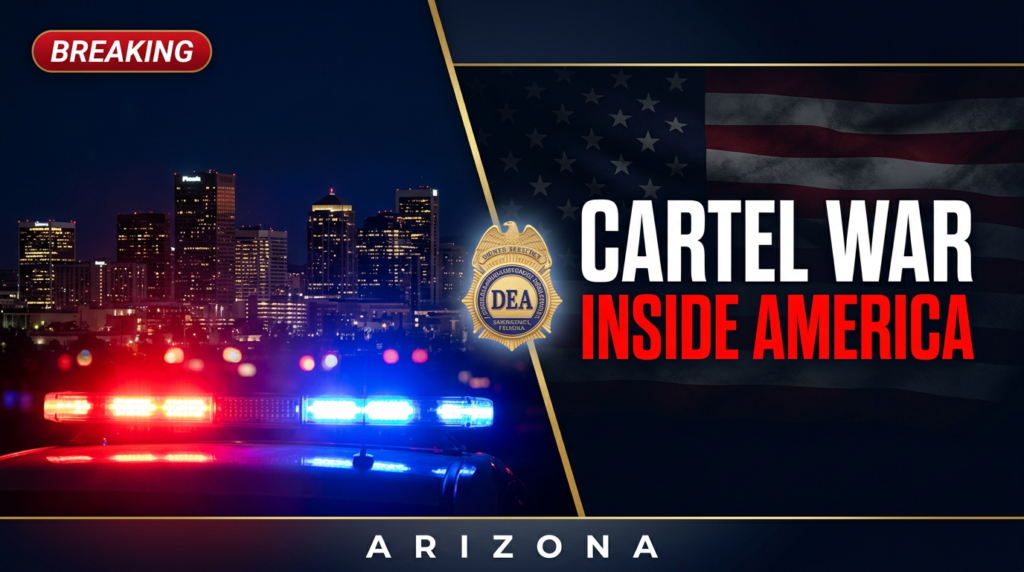
Federal indictments, DEA crackdowns, and the death of the world’s most wanted drug lord tell a single story: the cartels embedded themselves deep inside America — and it took years too long to respond.
The headlines out of Phoenix keep coming, and they aren’t subtle. A licensed gun dealer secretly arming two Mexican cartels. DEA agents shot at during a fentanyl sting in broad daylight. Hundreds of cartel-linked prosecutions filed every single week by the U.S. Attorney’s Office in Arizona. And looming over it all — the death in February of the most powerful drug lord on the planet.
Arizona is not a border abstraction. It is an active operational theater. And for the first time in years, the federal government is treating it that way.
Support Independent Local Journalism
TheTownHall.News is a non-profit reader-supported journalism. Just $5 helps us hire local reporters, investigate important issues, and hold public officials accountable across Alameda County. If you believe our community deserves strong, independent journalism, please consider donating $5 today to support our work.A Gun Store, Two Cartels, and a Terrorism Charge
On March 25, 2026, the U.S. Attorney’s Office for the District of Arizona announced the superseding indictment of Laurence Gray, 65 — the owner of Grips By Larry, a federally licensed firearms dealer based in Hereford, Arizona.
The charges are not minor. Gray now faces counts of attempting to provide material support to a designated foreign terrorist organization — specifically the Jalisco New Generation Cartel (CJNG) and the Sinaloa Cartel (CDS), both officially designated as Foreign Terrorist Organizations by the U.S. Secretary of State in February 2025.
According to the Department of Justice, Gray allegedly knowingly attempted to provide firearms to CJNG in May 2025, and conspired to supply weapons to both cartels during the same period. A second individual, Barrett Weinberger, 73, of Tucson, was also charged in the original 2025 indictment for related firearms trafficking offenses. Each terrorism support charge carries a maximum penalty of 20 years in federal prison.
Let that sink in. A federally licensed American gun dealer — someone entrusted with the legal authority to sell firearms — is accused of arming the same organizations responsible for flooding U.S. cities with fentanyl and killing tens of thousands of Americans every year. This isn’t just a crime. It is a betrayal.

The case is being prosecuted under Operation Take Back America, the DOJ’s nationwide initiative targeting cartel and transnational criminal organization networks. It signals something important: the federal government is no longer treating cartel infiltration as a foreign policy problem. It is a domestic law enforcement emergency.
The Man Behind the Cartel — and What His Death Means
To understand the urgency in Arizona, you have to understand who CJNG is — and what just happened to its founder.
On February 22, 2026, Mexican special forces — backed by U.S. intelligence — killed Nemesio “El Mencho” Oseguera Cervantes in Tapalpa, Jalisco. El Mencho was the single most wanted drug lord in the world, with a $10 million U.S. bounty on his head. He built CJNG from a regional criminal outfit into a military-grade transnational terrorist organization, with operations across the United States, Europe, and Asia.
His death is a genuine victory. But victories in the cartel world come with consequences.
Within hours of El Mencho’s killing, CJNG launched what analysts described as “destruction operations” across more than 20 Mexican states — burning vehicles, erecting roadblocks, and ambushing security forces. At least 25 Mexican National Guard troops were killed in Jalisco alone. The U.S. Embassy issued a shelter-in-place advisory for American citizens in affected regions.
Support Independent Local Journalism
TheTownHall.News is a non-profit reader-supported journalism. Just $5 helps us hire local reporters, investigate important issues, and hold public officials accountable across Alameda County. If you believe our community deserves strong, independent journalism, please consider donating $5 today to support our work.The cartels don’t dissolve when their leaders fall. They fracture, fight for territory, and frequently surge violence to prove they’re still relevant. Security analysts now warn of an expected spike in fentanyl shipments into the United States, as CJNG factions scramble to generate revenue amid internal succession battles. Arizona, as a primary smuggling corridor, sits directly in the crosshairs.
Phoenix Is Not the Border — It’s the Interior
Here is the detail that too many politicians and commentators still refuse to confront: the cartel problem in America is not a border problem. It is an interior problem.
Phoenix, 180 miles from the Mexican border, has functioned for years as a critical hub for CJNG and Sinaloa Cartel distribution networks. Stash houses, weapons caches, money laundering operations, and cartel-connected businesses have embedded themselves in ordinary American neighborhoods.
The DOJ’s own weekly enforcement data tells the story. In just the first four weeks of March 2026, U.S. prosecutors in the District of Arizona charged more than 860 individuals for immigration-related offenses — including human smuggling — as part of an unprecedented enforcement surge. On April 1, a man was indicted for the attempted murder of DEA agents after opening fire on federal officers during a Phoenix fentanyl sting the previous month.
These are not isolated incidents. They are the visible surface of a deeply embedded criminal infrastructure.
What Critics Get Wrong About Enforcement
Civil liberties advocates and immigration reform groups have raised concerns that the current enforcement surge disproportionately targets migrants rather than cartel leadership. It’s a perspective worth engaging honestly.
Not everyone swept up in border and immigration enforcement is a cartel operative. The vast majority of migrants crossing illegally are fleeing poverty or violence — and conflating them with CJNG enforcers is both inaccurate and unjust.
But here’s what that argument misses: the cartels exploit that ambiguity deliberately. CJNG and the Sinaloa Cartel profit from human smuggling. They use migrant corridors as operational cover. Every gap in enforcement is a business opportunity for organized crime.
The Grips By Larry indictment illustrates exactly how cartel networks operate inside America’s legal infrastructure — not through dramatic border crossings, but through licensed businesses, straw purchases, and corrupted individuals who exploit systems built on good faith. Dismantling that requires aggressive, systematic enforcement — not less of it.
The Real Cost of Inaction
For years, federal cartel enforcement in the U.S. interior was intermittent at best. DEA operations produced headlines and seizures, but structural penetration of American cities by transnational criminal organizations continued largely uninterrupted.
The cost of that inaction is measured in lives. Fentanyl — the primary product distributed by CJNG and Sinaloa networks — has driven drug overdose deaths to record levels in recent years, with Arizona among the hardest-hit states. It is also measured in eroded civic institutions. When cartel money flows into local economies through stash houses, laundered cash, and compromised businesses, it corrupts not just individuals, but communities.
The argument for sustained, serious enforcement isn’t about hostility to immigrants or militarizing neighborhoods. It is about the foundational obligation of government: protecting the people it serves from organized violence and predation.
The Momentum Is Real — But It Must Be Sustained
The convergence of events in early 2026 is significant. El Mencho is dead. An Arizona gun dealer faces terrorism charges for arming two cartels. The DOJ is prosecuting cartel-linked cases at scale under a dedicated national initiative. Federal agents are conducting active operations in Phoenix.
This is what serious enforcement looks like. The question is whether it will last.
Historically, crackdowns on cartel networks fade when political attention moves elsewhere. Sustaining the pressure requires more than operations — it requires legislative commitment to adequate resources for DEA, ATF, and federal prosecutors; coordination between federal and state law enforcement; and an honest public conversation about the scale of cartel penetration in American communities. Without hysteria, but without minimization either.
Arizona is ground zero. But the cartels don’t operate only in Arizona.
Key Takeaway
The CJNG raids, the Grips By Larry terrorism indictment, and the death of El Mencho are not separate stories. They are chapters in a single story about an organized criminal enterprise that treated American cities as operational territory — and a government that is finally, seriously, pushing back. The test now is staying power.
Stay informed. Share this story. Independent journalism that covers what matters — without fear and without favor — depends on readers who refuse to look away.