Cuba Blackouts Are Not America’s Fault — They’re Communism’s Final Bill
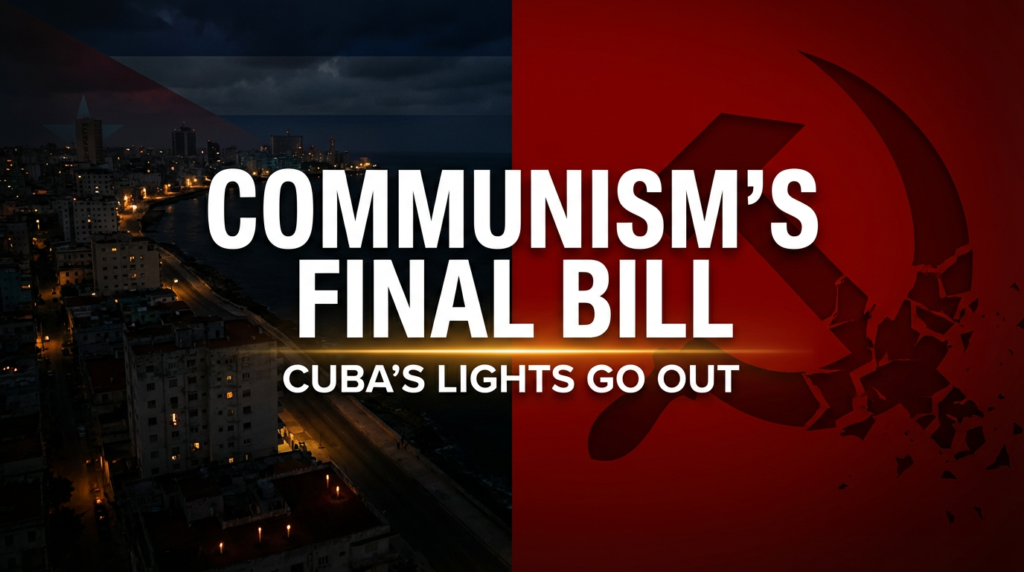
Darkness by Design: When Government Fails Its People
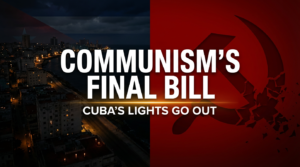
On the night of March 4, 2026, two-thirds of Cuba went dark. Hospitals strained to keep generators running. Families ate cold meals on street corners in Havana by candlelight. Millions of Cubans — roughly 7 million people — lost power in what became one of the island’s worst blackouts in recent memory. It lasted over 16 hours before the national grid was partially restored. And it wasn’t the first time. It won’t be the last.
The Cuban government was quick to point fingers at Washington. The state-run media blamed the U.S. oil blockade. Officials called it an act of economic aggression. And some corners of the international press dutifully echoed the narrative — framing Cuba as a helpless victim of American pressure.
But let’s be honest about what the lights going out in Cuba really illuminates: six and a half decades of communist mismanagement, broken promises, and a government that chose ideology over the basic welfare of its own citizens.
Support Independent Local Journalism
TheTownHall.News is reader-supported journalism. Just $5 helps us hire local reporters, investigate important issues, and hold public officials accountable across Alameda County. If you believe our community deserves strong, independent journalism, please consider donating $5 today to support our work.This is not primarily a story about sanctions. It is a story about what happens when government controls everything — and delivers nothing.
The Real Cause: 65 Years of Socialist Failure
Before a single American embargo was ever tightened, Cuba was already falling apart. The country’s power grid is ancient, underfunded, and crumbling. Cuba’s effective electrical generation capacity stands at just under 2,000 megawatts — a figure that hasn’t significantly grown in decades — while demand regularly outpaces supply. On the night of the March blackout, Cuba had roughly 590 megawatts online: less than 30% of normal capacity.
The trigger for this particular blackout was a broken boiler at the Antonio Guiteras thermoelectric plant, a key facility about 100 kilometers east of Havana. That’s not a geopolitical act. That’s an infrastructure failure — one that reflects years of deferred maintenance under a government that has consistently prioritized political control over capital investment.
Cuba’s GDP per capita, by multiple estimates, is lower today than it was before the communist revolution. In 1958 — the year before Fidel Castro seized power — Cuba was one of the most economically prosperous nations in Latin America. It was self-sufficient in beef, milk, tropical fruits, coffee, tobacco, and seafood. Today, the Cuban government cannot reliably keep the lights on. That collapse didn’t happen because of America. It happened because central planning, state ownership, and the suppression of free markets destroy economies. Every time. Without exception.
The Cato Institute has noted that Cuba’s crisis is, at its core, “self-induced” — the predictable result of a command economy where innovation is stifled, property rights are non-existent, and the state dictates every economic decision. That’s not conservative rhetoric. That’s economic history.
The Oil Problem — And Who Really Created It
Critics of U.S. policy are right about one thing: American pressure has tightened Cuba’s access to oil. When the Trump administration moved to cut off Venezuelan oil shipments to Cuba following the capture of Venezuelan President Nicolás Maduro, and then signed an executive order on January 29, 2026 threatening tariffs against any nation supplying oil to Cuba, the effect was significant. Mexico suspended planned oil shipments. The fuel pipeline dried up further.
But here is the question conservatives must ask: Why is Cuba entirely dependent on imported oil from authoritarian regimes in the first place?
Cuba sits in the Caribbean sun. It has year-round wind. It has geothermal potential. A government genuinely committed to its people’s well-being would have invested decades ago in diversified, domestic energy sources. Instead, Cuba spent those decades exporting its doctors as political pawns to prop up foreign socialist governments, funneling resources into military adventurism in Africa and Latin America, and building a surveillance state to silence dissent at home.
China has recently stepped in to help Cuba develop solar infrastructure. But that assistance is not born of charity — it is born of geopolitical calculation. Cuba’s dependency on foreign authoritarian regimes is not a feature forced upon it by America. It is the natural consequence of a government that refuses economic freedom while demanding political loyalty.
Accountability Starts at Home
There is a powerful conservative principle at stake here: personal and institutional accountability. When things go wrong, the first question should always be — who is responsible, and what decisions led to this outcome?
The Cuban government has held power for 65 years. It has controlled wages, prices, property, media, speech, and movement. There has been no free press to expose corruption. No independent judiciary to hold officials accountable. No free elections to remove failed leaders. No private sector to create jobs or build resilience. The Cuban people have had no vote, no voice, and no recourse.
When a government claims total control, it must accept total accountability. You cannot own everything, manage everything, and control everything — and then, when it all collapses, blame someone else.
That is not governance. That is tyranny with a scapegoat.
In March 2026, protests erupted in the darkness across Cuba. Thousands of ordinary Cubans — frustrated, exhausted, and cold — took to the streets. The Cuban government’s response, as always, has been to warn of repression. These are not the actions of a government that serves its people. These are the actions of a government that fears them.
What America’s Pressure Campaign Gets Right
The Trump administration’s Cuba strategy is, at its core, built on a conservative premise: governments that abuse their citizens, threaten regional stability, and align with America’s adversaries should face consequences — not comfort.
Secretary of State Marco Rubio, himself the son of Cuban immigrants, has led a diplomatic pressure campaign that seeks nothing less than genuine political and economic reform. The asks are not unreasonable: release political prisoners, guarantee freedom of expression and association, compensate American companies whose property was seized at the start of the revolution, and cease cooperation with U.S. adversaries like Russia and China.
These are the building blocks of a free and accountable society. They are also the conditions under which ordinary Cubans might one day enjoy the rights that Americans take for granted — the right to speak freely, to own property, to build a business, to raise their children without state indoctrination.
Senator Lindsey Graham has been direct: “Cuba’s next. They’re gonna fall. This communist dictatorship in Cuba — their days are numbered.” That is not warmongering. That is moral clarity about a regime that has imprisoned, tortured, and impoverished its people for over six decades.
Experts at the America First Policy Institute have noted that the Trump administration may be offering safe exile and legal protections for key power brokers in exchange for a peaceful transition. That is a pragmatic, proportionate approach — regime change through pressure and negotiation, not invasion.
The Stakes: Freedom, Order, and the Western Hemisphere
Cuba’s crisis is not just a humanitarian story. It is a strategic one. A Cuba free of communist rule would mean:
- An end to a state that has harbored terrorists and drug traffickers in exchange for political allegiance.
- A reduction in illegal migration across the Florida Straits, driven largely by economic desperation under socialism.
- A democratic neighbor 90 miles from American shores, capable of trade, partnership, and self-governance.
- A powerful message to every socialist government in the Western Hemisphere: failed ideologies have a final accounting.
Law, order, and regional security are conservative values — and a stable, free Cuba serves all three.
A Note on the Cuban People
None of this is about punishing ordinary Cubans. The men and women eating cold soup by candlelight on March 4th are not the architects of this crisis. They are its victims. They deserve better — and conservatives believe they deserve the same freedoms that make prosperity possible everywhere freedom is genuinely protected.
The goal of American pressure is not to starve a population. It is to collapse a system that has starved them for 65 years while blaming everyone else for the hunger.
Conclusion: The Bill Always Comes Due
Communism doesn’t work. It never has. Not in the Soviet Union. Not in Venezuela. Not in Cuba. The lights going out in Havana are not a mystery to be debated — they are a bill coming due. A bill written in decades of centralized control, crushed enterprise, silenced voices, and squandered potential.
The Cuban people deserve freedom. They deserve accountable government, economic opportunity, free speech, and the right to raise their families without fear of the state. These are not uniquely American values. They are universal ones — and they are precisely what 65 years of socialism have denied the people of Cuba.
The darkness in Cuba is real. But its source isn’t Washington. It’s the ideology that has governed that island since 1959.
Call to Action
Stay informed. Stay engaged. Share the truth.
The mainstream media will keep telling you Cuba’s blackouts are America’s fault. But you’ve now read the facts. Share this article with friends and family who want the full picture — not just the government’s talking points. Follow credible conservative outlets for ongoing coverage of Cuba’s unfolding crisis, and contact your representatives to voice your support for policies that champion freedom, accountability, and human dignity across the Western Hemisphere.
Because when the lights go out, the truth still matters.
Sources: Reuters, Al Jazeera, The Hill, Cato Institute, Forbes, BMJ, UN News, U.S. Congressional Research Service, America First Policy Institute, Atlantic Council.
The Town Hall is working to expand our coverage in Alameda County, but we need your help. We’re raising support to hire a dedicated local journalist who can report on the issues, decisions, and stories that impact our communities across the county. Your donation will directly support independent reporting that keeps residents informed and holds local leaders accountable. If you believe Alameda County deserves strong, fearless local journalism, please consider donating to help us bring a reporter on the ground.