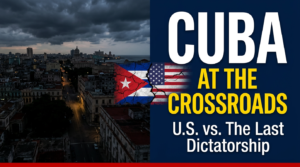
Cuba US Negotiations 2026: How American Resolve Brought a Dictatorship to Its Knees
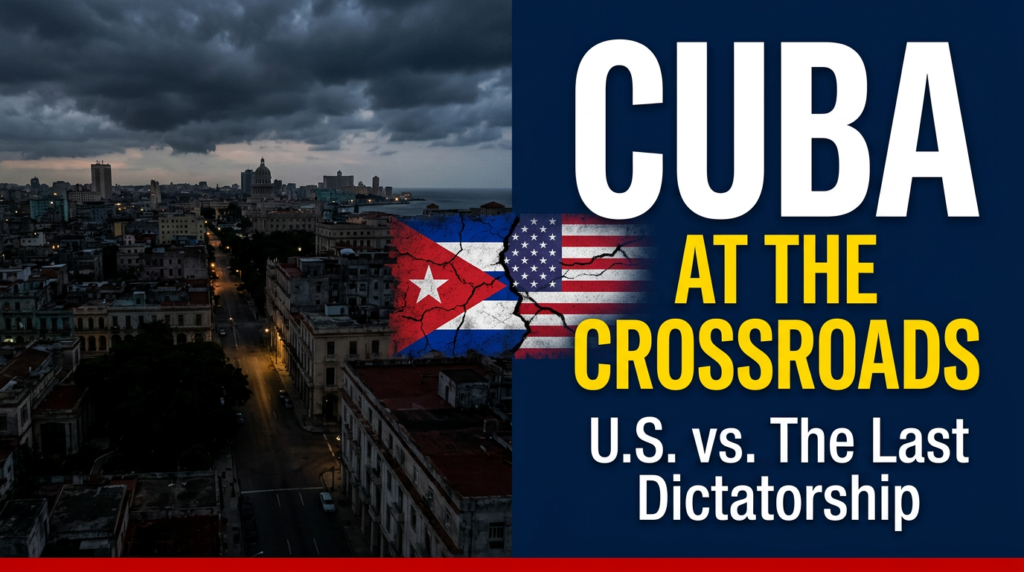
For 65 years, the Castro regime and its successors have defied every American president, outlasted every embargo, and mocked every olive branch extended their way. They jailed dissidents, crushed free speech, and told the world that communism in Cuba was permanent and untouchable.
Then came January 3, 2026.
On that date, the geopolitical ground shifted beneath Havana’s feet. Venezuelan dictator Nicolás Maduro — Cuba’s oil lifeline — was removed from power following a U.S.-backed intervention. Within weeks, Cuba’s lights began to go out. Literally.
Support Independent Local Journalism
TheTownHall.News is a non-profit reader-supported journalism. Just $5 helps us hire local reporters, investigate important issues, and hold public officials accountable across Alameda County. If you believe our community deserves strong, independent journalism, please consider donating $5 today to support our work.By early March, blackouts were hitting 63% of the island simultaneously. Hospitals ran on fumes. Schools and universities closed. Garbage trucks sat idle in Havana for want of fuel. And on March 13, 2026, Cuban President Miguel Díaz-Canel stood before the nation and confirmed what was once unthinkable: Cuba is in negotiations with the United States.
This is what principled, maximum-pressure diplomacy looks like when it works.
The Anatomy of a Regime in Crisis
Cuba does not produce enough of its own fuel to function. The island relies almost entirely on imported oil — historically from Venezuela, and secondarily from Mexico — to power its electrical grid, run its hospitals, harvest its crops, and fuel its transportation. That dependency was not an accident. It was the inevitable product of six decades of centrally planned socialist economics that prioritized ideological loyalty over productive efficiency.
When President Trump signed Executive Order 14380 on January 29, 2026 — invoking the International Emergency Economic Powers Act to threaten tariffs on any nation supplying oil to Cuba — the results were swift. Mexico’s Pemex suspended shipments. A fire at Havana’s Nico López refinery on February 13 compounded the damage. Cuba’s energy deficit ballooned to over 2,000 megawatts against a national demand of 3,050 MW — meaning the country could meet barely a third of its own power needs.
This is what happens when a government controls everything: when the system fails, there is no private-sector resilience to fall back on, no free market to absorb the shock. Only darkness.
Freedom Through Strength, Not Weakness
Critics argue the blockade causes humanitarian suffering among ordinary Cubans. It’s a concern worth taking seriously — and answering directly.
The suffering is real. But its author is Havana, not Washington. For six decades, the Cuban regime has maintained power through repression, not consent — imprisoning journalists, silencing opponents, and denying its citizens the basic freedoms of speech, assembly, and enterprise. When that system collapses under external pressure, the regime bears the moral responsibility, not the government applying it.
History is clear on this point. The Soviet Union did not fall because the West sent aid to Moscow. It fell because Ronald Reagan refused to normalize a system that was fundamentally illegitimate. Appeasement has never freed a single Cuban. Maximum pressure just might.
The Trump administration has also shown it can distinguish between the regime and the people. In February, the U.S. Treasury Department issued a specific license allowing companies to resell Venezuelan oil to Cuba’s private sector — supporting ordinary Cubans while keeping pressure on the state. That is not collective punishment. That is targeted statecraft.
Support Independent Local Journalism
TheTownHall.News is a non-profit reader-supported journalism. Just $5 helps us hire local reporters, investigate important issues, and hold public officials accountable across Alameda County. If you believe our community deserves strong, independent journalism, please consider donating $5 today to support our work.The Secret Backchannel: Bypassing the Bureaucrats
Perhaps the most revealing detail of these negotiations is how they are being conducted.
According to reporting confirmed by multiple sources, Secretary of State Marco Rubio has been holding secret talks not with Díaz-Canel — the nominal head of state — but with Raúl Guillermo Rodríguez Castro, the 41-year-old grandson of Raúl Castro, known as “El Cangrejo.” The message is deliberate: the United States is dealing with those who actually hold power, while signaling that Díaz-Canel is expendable.
A senior administration official was unambiguous: “The position of the U.S. government is that the regime has to go.”
This is regime change through leverage, not invasion — the kind conservatives have long argued is both more effective and more principled. The goal is Cuban freedom, achieved through economic strength and a negotiated transition that avoids bloodshed.
The reported deal framework includes a negotiated exit for Díaz-Canel, eased sanctions in energy, ports, and tourism, expanded American travel rights to Cuba, and Cuban access agreements over its nickel and cobalt reserves — strategic minerals Washington badly wants. Cuba has also released 51 political prisoners as a goodwill gesture through Vatican diplomatic channels — a sign the regime grasps the gravity of its position.
What Conservative Principles Demand of This Moment
The Cuba situation is not just a foreign policy story. It is a case study in conservative principles applied consistently and courageously.
Limited government is not just an American ideal — it is the universal condition for human flourishing. Cuba is the most vivid proof of what unlimited government produces: food shortages, darkness, and a population that cannot freely leave. Every Cuban who has risked death on a raft is a living argument for the founding principles of this republic.
Law and order demands that the world stop pretending one-party dictatorships deserve the courtesies of legitimate governments. Díaz-Canel’s regime has jailed hundreds of political prisoners — including peaceful protesters from the historic July 11, 2021 uprising — for nothing more than demanding the freedoms Americans take for granted. Accountability is not aggression. It is justice.
Personal responsibility applies to nations as much as individuals. Cuba’s government chose Soviet alignment, nationalized private property, silenced dissent, and made itself dependent on hostile foreign patrons. Now it faces the consequences of those choices. That is not cruelty. That is how the world is supposed to work.
A Historic Moment — With Caution Still Required
Díaz-Canel’s confirmation of talks is a beginning, not an end. He warned that negotiations are “long processes” that “take time.” The Castro family still holds real power and is reportedly positioning to survive any transition — not surrender to it.
The path from “we are talking” to “Cuba is free” is long and uncertain. There will be attempts to slow-walk the process, extract concessions without delivering freedom, and engineer a cosmetic transition that changes faces without changing systems. A deal that lets Díaz-Canel exit comfortably while the one-party state limps on under new branding is not a victory. It is capitulation in a suit. The standard must be genuine democratic transition — free elections, freed political prisoners, a free press, and the rule of law.
The Bottom Line
For the first time in six decades, a Cuban government is sitting across from American negotiators not as equals, but as a regime under existential pressure. That pressure didn’t come from appeasement or from the fantasy that trade and tourism would naturally liberalize a totalitarian state.
It came from strength. From sanctions. From an American administration willing to say plainly that a dictatorship 90 miles from Florida is unacceptable — and to back those words with action.
The Cuban people deserve freedom. They have always deserved it. America has the leverage. The question is whether it will use it wisely — and whether the American public will demand it does.
📢 Take Action: Your Voice Matters
Cuba’s potential liberation is unfolding right now — and the outcome depends on whether free citizens demand their governments hold firm.
- Stay informed. Don’t let this story fade. Cuba’s freedom movement needs sustained attention.
- Share this article. The more Americans understand what’s at stake, the stronger the political will to see it through.
- Contact your representatives. Urge them to hold firm and reject any deal that falls short of genuine democratic transition.
- Support Cuban dissidents. Their courage deserves our solidarity.
Freedom is not free — not in America, and not in Cuba. But on March 13, 2026, it got a little closer.