Democrats’ Political Stunt Threatens Critical Homeland Security Functions Over ICE Restrictions
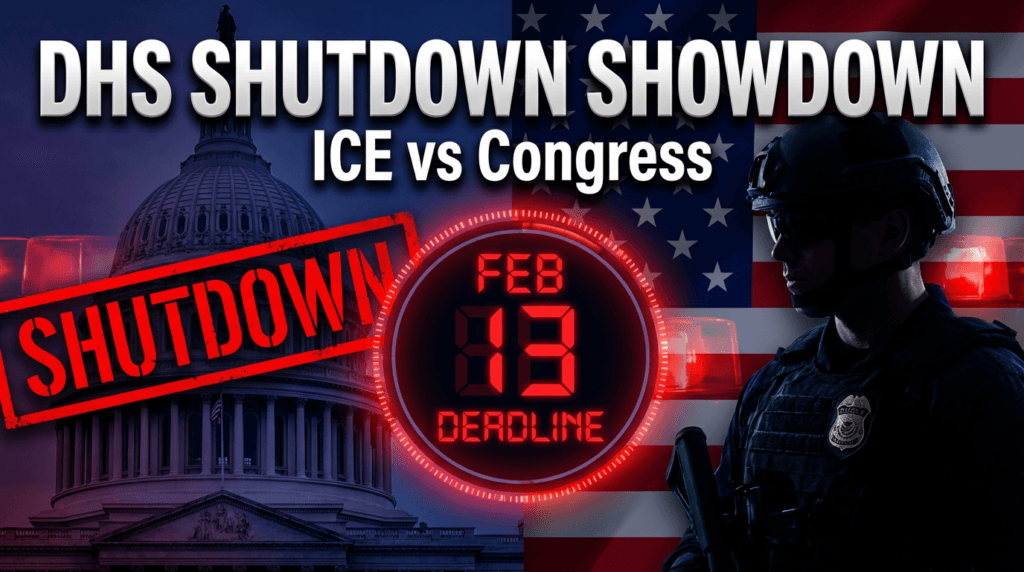
With a February 13 deadline looming, Congressional Democrats are threatening to shut down the Department of Homeland Security unless Republicans accept sweeping restrictions on Immigration and Customs Enforcement operations. The standoff, triggered by two controversial shootings in Minneapolis, reveals a troubling willingness to sacrifice essential government functions—from FEMA disaster response to TSA airport security—for political theater that undermines law enforcement and border security.
This isn’t about reasonable reform. It’s about handcuffing federal agents trying to enforce immigration law while violent crime concerns remain front and center for American families.
The Manufactured Crisis: Two Tragic Incidents Become Political Ammunition
On January 7, 2026, ICE agents fatally shot Renee Good during an enforcement operation in Minneapolis. Seventeen days later, Alex Pretti, a protester, was killed in a shooting involving federal immigration officers. Both deaths are tragic, and both warrant thorough investigation to ensure accountability and proper procedures.
Support Independent Local Journalism
TheTownHall.News is a non-profit reader-supported journalism. Just $5 helps us hire local reporters, investigate important issues, and hold public officials accountable across Alameda County. If you believe our community deserves strong, independent journalism, please consider donating $5 today to support our work.But Democrats immediately seized on these incidents—before investigations concluded—to demand radical restrictions that would fundamentally hamstring immigration enforcement nationwide. House Minority Leader Hakeem Jeffries and Senate Minority Leader Chuck Schumer laid out ten demands, including requirements for judicial warrants before agents can enter private property, bans on face masks for agents, mandatory body cameras, and the removal of DHS Secretary Kristi Noem.
The problem? These sweeping demands apply to all ICE operations across the country, not just Minneapolis. They’re using two incidents to justify nationwide policy changes that would make it exponentially harder to enforce immigration law everywhere—exactly the outcome open-borders advocates have sought for years.
The Fiscal Absurdity: ICE Already Has $75 Billion
Here’s what makes this shutdown threat particularly cynical: ICE doesn’t need the appropriations bill Democrats are blocking. The agency received $75 billion over the next decade through the “One Big Beautiful Bill” passed earlier this year. ICE operations will continue regardless of whether DHS gets its annual funding.
So what would a DHS shutdown actually affect? FEMA operations as communities recover from winter storms. TSA screening at airports. Coast Guard maritime security operations. Secret Service protective details. In other words, Democrats are threatening to shut down critical homeland security functions that have nothing to do with immigration enforcement, while ICE—the supposed target of their ire—keeps operating with its massive funding windfall.

As Speaker Mike Johnson correctly noted, “What they’ll be shutting down is FEMA operations, as we’re cleaning up from the winter storm. They’ll be shutting down TSA, which is obviously necessary to keep the country moving through our airports. Coast Guard operations… so many important functions in the Department of Homeland Security is what will be adversely affected by these partisan games.”
This is fiscal irresponsibility masquerading as principle. Democrats know ICE won’t be defunded, but they’re willing to disrupt genuinely essential services to score political points.
The Law and Order Problem: Undermining Federal Enforcement
Let’s examine Democrats’ specific demands and their practical implications for law enforcement:
Judicial Warrants for Private Property: Democrats want to require judicial warrants on top of the immigration judge warrants ICE already uses. This sounds reasonable until you understand the reality: immigration enforcement often requires time-sensitive action. Adding another layer of judicial process creates delays that allow targets to flee. As Speaker Johnson noted, time constraints make this demand impractical.
Banning Face Masks: In an era when federal agents are being doxed and their families threatened, Democrats want to prohibit agents from protecting their identities during operations. This isn’t about transparency—it’s about making agents vulnerable to intimidation and retaliation. Johnson rightly rejected this demand, noting that “when you have people doxing them and targeting them, of course, we don’t want their personal identification out there on the streets.”
Support Independent Local Journalism
TheTownHall.News is a non-profit reader-supported journalism. Just $5 helps us hire local reporters, investigate important issues, and hold public officials accountable across Alameda County. If you believe our community deserves strong, independent journalism, please consider donating $5 today to support our work.Mandatory Body Cameras: This is the only Democratic demand that has merit and bipartisan support. Body cameras increase accountability and protect both agents and the public. Republicans have signaled willingness to compromise on this issue. But Democrats aren’t interested in compromise on the one reasonable proposal—they want all ten demands or they’ll shut down DHS.
Removing Secretary Noem: This demand reveals the political nature of the entire exercise. Democrats don’t just want policy changes; they want to force personnel decisions and weaken the administration’s ability to enforce immigration law.
The Public Safety Stakes: Who Pays the Price?
While Democrats grandstand about ICE restrictions, they’re ignoring the fundamental question: What happens when immigration enforcement is weakened?
According to DHS data from mid-2025, violent crime fell significantly in cities where ICE removed criminal aliens: gun assaults down 21%, aggravated assault down 10%, sexual assault down 10%, and carjacking down 24%. These aren’t abstract statistics—they represent real victims who were spared violence because federal agents could do their jobs.
ICE data also shows that at the beginning of 2025, 87% of arrests were immigrants with either a prior conviction or a criminal charge pending. These aren’t families seeking a better life; they’re individuals who have already broken additional laws beyond illegal entry.
Democrats’ proposed restrictions would make it harder to remove exactly these dangerous individuals. The judicial warrant requirement would create opportunities for flight. The mask ban would discourage agents from working in hostile environments. The cumulative effect would be fewer removals of criminal aliens and more Americans victimized by preventable crimes.
The Accountability Question: Reform vs. Restriction
Conservatives should absolutely support accountability measures that improve law enforcement while maintaining effectiveness. Body cameras are a proven tool that protects both officers and civilians. Clear use-of-force standards and proper training are essential. Transparency in operations builds public trust.
But there’s a crucial difference between accountability and restriction. Accountability measures help law enforcement do their jobs better. Restrictions prevent them from doing their jobs at all.
Democrats aren’t proposing accountability—they’re proposing restrictions designed to make immigration enforcement nearly impossible. That’s why Senator Katie Britt, leading Republican negotiations, called Democrats’ demands “a ridiculous Christmas list” that’s “NOT negotiating in good faith.”
The polling Democrats cite—showing 62% of Americans believe ICE efforts “go too far”—is misleading. That poll was conducted immediately after the Minneapolis shootings, during maximum media coverage of two isolated incidents. It doesn’t reflect sustained public opinion about immigration enforcement generally, and it certainly doesn’t justify nationwide restrictions based on two cases still under investigation.
The Constitutional Duty: Enforcing Immigration Law
Here’s what often gets lost in these debates: enforcing immigration law isn’t optional. It’s a constitutional duty of the federal government. Congress passed immigration laws, and the executive branch is obligated to enforce them. When Democrats demand restrictions that make enforcement impractical, they’re effectively asking the administration to abdicate its constitutional responsibility.
This is particularly troubling given the broader context. Many of the jurisdictions where Democrats want the most restrictions are “sanctuary cities” that refuse to cooperate with federal immigration enforcement. They won’t allow local police to honor ICE detainers or notify federal agents when criminal aliens are released from custody.
So federal agents must work in actively hostile environments, without local cooperation, to enforce federal law—and now Democrats want to add even more restrictions that make an already difficult job nearly impossible. At some point, this stops being about accountability and becomes about obstruction.
The Negotiation Reality: Democrats Aren’t Serious
Perhaps most telling is that Democrats haven’t actually drafted legislative text for their demands. Neither have Republicans proposed alternative language. With the February 13 deadline approaching, neither party has put specific proposals on paper.
This suggests Democrats aren’t actually interested in negotiating reforms. If they were, they’d be working on specific language that addresses legitimate concerns while maintaining enforcement capability. Instead, they’re making sweeping demands, refusing compromise, and threatening shutdown.
Jeffries declared he’s a “hard no” on a continuing resolution that would simply extend current funding. “We need to resolve this issue by Feb. 13,” he said, adding dramatic rhetoric about “American citizens being killed in the streets” and “children being kidnapped”—inflammatory language not supported by the facts of the Minneapolis cases.
This is political theater, not serious legislating.
The Conservative Position: Accountability With Enforcement
Conservatives should stake out a clear position that supports both accountability and effective enforcement:
Support Body Cameras: This is common-sense reform that protects everyone involved. Republicans should embrace it enthusiastically.
Maintain Enforcement Authority: Reject restrictions designed to make immigration enforcement impractical. Federal agents need the tools to do their jobs.
Demand Fiscal Responsibility: Don’t shut down FEMA, TSA, and Coast Guard over immigration policy disputes. These are separate issues that shouldn’t be held hostage.
Insist on Local Cooperation: If Democrats want to restrict federal enforcement, they should first require sanctuary cities to cooperate with ICE. You can’t refuse cooperation and then demand restrictions.
Focus on Results: The data shows immigration enforcement reduces violent crime. Policy should be driven by outcomes, not isolated incidents exploited for political advantage.
Conclusion: Principle Over Politics
The DHS funding fight reveals a fundamental divide about law and order in America. Do we enforce immigration law or don’t we? If we do, then federal agents need the authority and tools to do their jobs safely and effectively. If we don’t, then Congress should change the law—not tie agents’ hands with restrictions that make enforcement impossible while leaving the laws on the books.
Two tragic deaths in Minneapolis deserve thorough investigation and appropriate accountability. But they don’t justify nationwide restrictions that would hamstring immigration enforcement everywhere, especially when those restrictions are attached to a funding bill that would shut down essential homeland security functions having nothing to do with ICE.
Democrats are playing a dangerous game, threatening critical services to score political points on immigration. They’re not interested in reform—they’re interested in restriction. They’re not seeking accountability—they’re seeking obstruction.
Conservatives should call this what it is: a political stunt that puts ideology above public safety, partisan advantage above fiscal responsibility, and theater above governance.
Call to Action
The February 13 deadline is approaching fast, and the outcome will shape immigration enforcement for years to come. Here’s how you can make your voice heard:
Contact your representatives in Congress. Tell them you support accountability measures like body cameras, but oppose restrictions designed to prevent immigration enforcement. Demand they fund DHS without shutting down FEMA, TSA, and other critical services.
Stay informed about the negotiations. Follow the specific proposals being discussed, not just the rhetoric. The details matter enormously in determining whether reforms enhance accountability or simply obstruct enforcement.
Support law enforcement. Federal agents doing difficult, dangerous work deserve our backing, not political scapegoating based on isolated incidents. Accountability and support aren’t mutually exclusive.
Share this article with others who care about border security, law and order, and fiscal responsibility. The mainstream media will frame this as Republicans blocking “common-sense reforms.” The truth is more complicated, and voters deserve to understand what’s really at stake.
The rule of law depends on our willingness to enforce it. Democrats’ shutdown threat over ICE restrictions is a test of whether we’re serious about immigration enforcement or whether we’ll let political pressure and isolated tragedies dictate policy that affects the entire nation.
The choice is clear: accountability with enforcement, not restriction without it.