Deporting Fraudsters Act Passes House: Illegal Immigrants Who Commit Welfare Fraud Face Automatic Deportation
The House of Representatives just passed a landmark bill making welfare fraud a deportable offense — a move that could reshape how America protects taxpayer dollars and enforces the rule of law.
Every year, between $233 billion and $521 billion in federal funds is lost to fraud, according to estimates from the White House Office of Management and Budget. By some estimates, up to $42 billion in public benefits annually flows to households containing illegal immigrants. For millions of hardworking Americans who pay their taxes, follow the rules, and depend on programs like Social Security and Medicaid, that number is not just a statistic — it is a direct insult to their contributions.
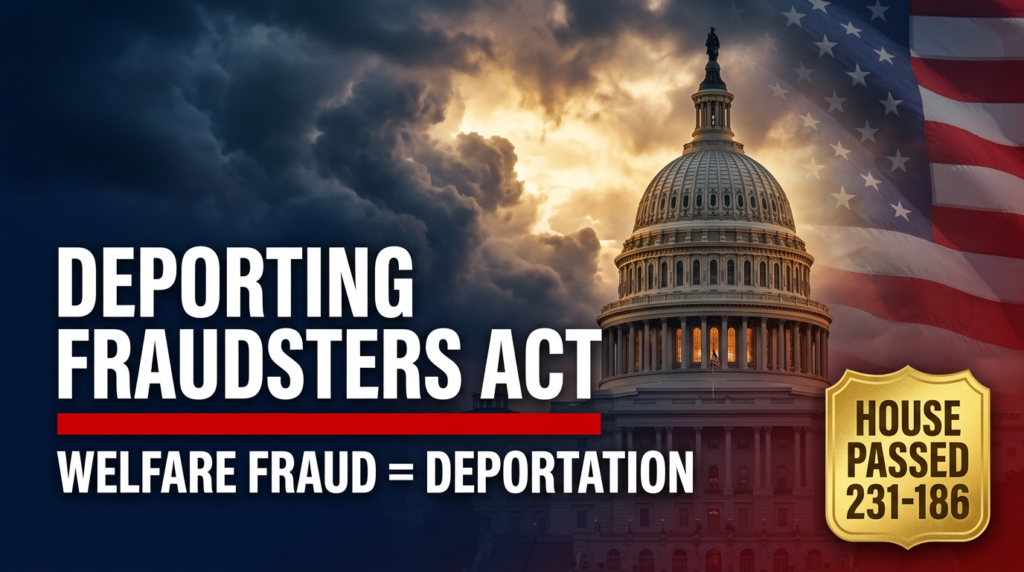
Now, the House of Representatives is fighting back. On March 18, 2026, Congress passed the Deporting Fraudsters Act of 2026 (H.R. 1958), sponsored by Rep. Dave Taylor (R-OH), by a vote of 231–186. The bill makes the act of defrauding the U.S. government of taxpayer-funded public benefits — including SNAP, Social Security, and Medicaid — an explicit deportable offense for non-citizens. It is a common-sense measure that closes a glaring loophole, and its passage is long overdue.
Support Independent Local Journalism
TheTownHall.News is a non-profit reader-supported journalism. Just $5 helps us hire local reporters, investigate important issues, and hold public officials accountable across Alameda County. If you believe our community deserves strong, independent journalism, please consider donating $5 today to support our work.What the Deporting Fraudsters Act Actually Does
The legislation is surgical in its design. Current federal immigration law contains a long list of deportable offenses — but fraudulently obtaining welfare benefits was not explicitly among them. The Deporting Fraudsters Act changes that directly.
Under H.R. 1958, any non-citizen who defrauds the U.S. government or steals taxpayer-funded benefits can be deported and permanently barred from re-entering the United States. Crucially, deportation can be triggered not only by a formal criminal conviction but also by an admission of guilt — meaning the system doesn’t have to wait years for the courts to act while a fraudster continues drawing benefits.
The bill also bars any alien who commits such fraud from being eligible to receive any further benefits, closing a secondary loophole that allowed some individuals to continue accessing programs even after being caught. As Rep. Taylor stated following the vote: “Ohioans work too hard to have their tax dollars and benefits stolen by illegal aliens who shouldn’t even be here in the first place.”
Why This Issue Matters Right Now
The timing of this legislation is no accident. A series of high-profile fraud scandals has made the systemic vulnerability of America’s welfare programs impossible to ignore.

In Minnesota, state and federal investigators found that over half of the $18 billion allocated to social services — including Medicaid — had been stolen in what amounts to one of the largest public benefit fraud cases in U.S. history. In California, $181 million was lost to EBT card fraud. In New York, a $120 million Medicare and Medicaid scheme was uncovered and prosecuted.
These are not isolated incidents. They are symptoms of a system that, for too long, lacked the enforcement teeth to deter fraud — particularly by individuals who entered the country illegally and face minimal accountability when exploiting federal programs.
As Rep. Anna Paulina Luna (FL-13), a co-sponsor of the bill, put it: “The Deporting Fraudsters Act closes a dangerous loophole by making benefit fraud and the theft of public funds a deportable offense. In light of the abuses that have come to light in Minnesota, this legislation is vital to protecting taxpayers.”
The Fiscal Reality: Who Pays the Price?
America’s federal welfare system costs taxpayers over $1 trillion annually, according to the White House Office of Management and Budget. That money is intended to serve American citizens and legal residents in genuine need — the elderly, disabled Americans, low-income families, and veterans.
When illegal immigrants fraudulently access these programs, they do not just take money from the government. They drain resources from the very people those programs were designed to protect. Every fraudulent SNAP claim is a meal taken from an American child in poverty. Every stolen Medicaid dollar is a medical service denied to an elderly American on a fixed income.
Support Independent Local Journalism
TheTownHall.News is a non-profit reader-supported journalism. Just $5 helps us hire local reporters, investigate important issues, and hold public officials accountable across Alameda County. If you believe our community deserves strong, independent journalism, please consider donating $5 today to support our work.Fiscal accountability is not cruelty. It is stewardship. And for decades, the absence of clear legal consequences for welfare fraud by non-citizens has made a mockery of that stewardship.
If you are in the country illegally and you steal from the American taxpayer, there should be a consequence. The Deporting Fraudsters Act makes that consequence real.
What Critics Get Wrong
Opponents of the bill — all 186 of whom were Democrats — argue that existing laws already address fraud and that the legislation is therefore redundant or politically motivated. That argument collapses under basic scrutiny.
If existing laws were sufficient, Minnesota would not have seen billions stolen. California would not have lost $181 million in EBT fraud. New York would not have prosecuted a $120 million healthcare fraud scheme. The legal gaps are documented, real, and costly.
Democrats also raise concerns about due process, arguing that deportation based on an admission — rather than a conviction — is overly punitive. But the bill does not invent a new legal standard. Immigration proceedings already operate differently from criminal trials, and the admission standard is a reasonable tool to prevent years of delay while a fraudster continues to live and benefit at taxpayer expense.
House Judiciary Committee Chairman Jim Jordan put it plainly: “Congressman Taylor’s Deporting Fraudsters Act will ensure that foreign nationals defrauding American taxpayers and the country’s immigration system are held accountable.”
Senate Companion Bill and the Path Forward
The Deporting Fraudsters Act does not stop at the House. Senators Ted Cruz (R-TX), John Cornyn (R-TX), and Mike Lee (R-UT) introduced a Senate companion bill on November 7, 2025 (S. 3113). Their support gives the legislation real momentum in the upper chamber.
That said, the Senate’s 60-vote threshold to overcome a filibuster remains a significant obstacle. With Democrats largely unified in opposition, the bill faces a difficult road to final passage without broader legislative maneuvering. But the politics matter as much as the procedural math. Every Senate Democrat who votes to block this bill will have to answer one question to their constituents: Why did you vote to protect people who stole from American taxpayers?
Senator Cruz framed the stakes clearly: “Americans who meet eligibility requirements should be the only ones to receive taxpayer-funded benefits. I urge my colleagues in the Senate to do the same and send it to the President to become law.”
A Clear Takeaway for American Taxpayers
The Deporting Fraudsters Act is not a culture war bill. It is not an exercise in cruelty or xenophobia. It is a straightforward enforcement measure that says: if you are in this country illegally and you steal from the American people, you will be removed.
That principle — personal responsibility, rule of law, protection of public resources — is one that the vast majority of Americans across the political spectrum can endorse. The 231 House members who voted yes understood that. The 186 who voted no will need to explain themselves.
The bill now moves to the Senate. Whether it becomes law will depend on whether enough senators are willing to stand with American taxpayers — or continue shielding a system that rewards fraud with benefits and impunity.
Stay Informed and Make Your Voice Heard
This story is far from over. The Senate vote will be decisive, and public pressure matters. Here is what you can do right now:
- Contact your Senator and ask where they stand on the Deporting Fraudsters Act (S. 3113).
- Share this article so your friends and family understand what is at stake.
- Stay informed — independent journalism depends on readers like you staying engaged and holding elected officials accountable.
- Subscribe to The Town Hall News for continuing coverage of this bill and the broader fight to protect American taxpayers.
The House has spoken. Now it is the Senate’s turn.