Epstein Files Chain of Custody Missing: The Critical Question No One’s Asking About Evidence Integrity
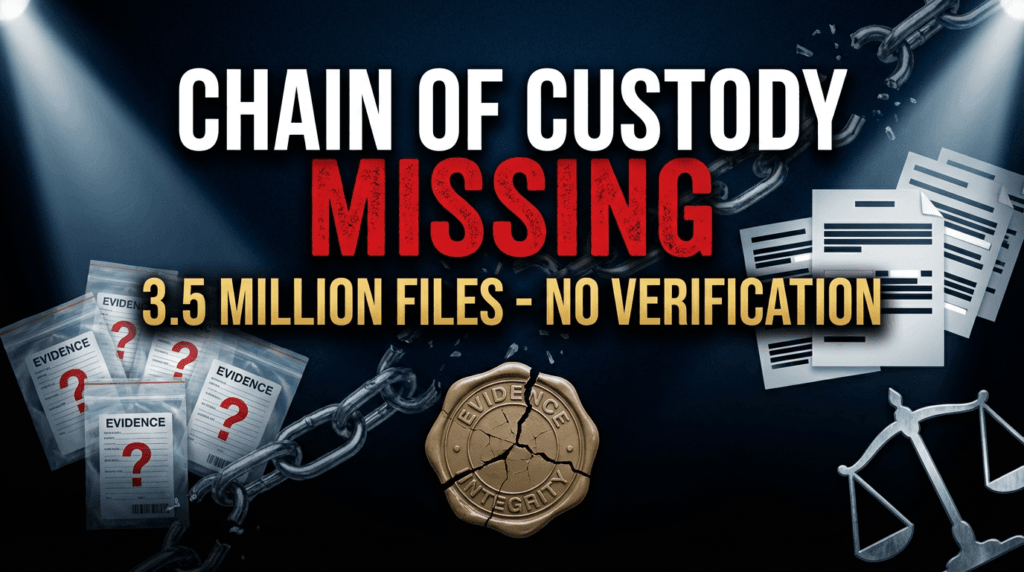
The headlines scream about princes, billionaires, and private islands. Media outlets breathlessly report on emails and photographs from the 3.5 million pages of Jeffrey Epstein files released by the Department of Justice on January 30, 2026. But while Americans focus on salacious details about elite connections, they’re missing the most important question of all: How do we know these files haven’t been tampered with?
The answer is troubling. We don’t.
Senate Democrats Adam Schiff and Dick Durbin requested an audit of chain of custody forms in December 2025, specifically to address concerns about “contamination, tampering, or concealment” of the Epstein files. Their request was prompted by reports that approximately 1,000 FBI personnel reviewed the documents, Attorney General Pam Bondi personally ordered FBI Director Kash Patel to deliver files to her office, and the White House demonstrated its intention to be involved in the public release.
Support Independent Local Journalism
TheTownHall.News is a non-profit reader-supported journalism. Just $5 helps us hire local reporters, investigate important issues, and hold public officials accountable across Alameda County. If you believe our community deserves strong, independent journalism, please consider donating $5 today to support our work.Without verified chain of custody documentation—the fundamental requirement for evidence integrity in any legitimate investigation—the American people are being asked to trust a system that has already failed spectacularly in the Epstein case. That’s not transparency. That’s a press release masquerading as accountability.
What Chain of Custody Means—and Why It Matters
Chain of custody is not a technicality. It’s the bedrock principle that ensures evidence remains untainted from the moment it’s collected until it’s presented in court or released to the public. These forms document five critical facts:
- Who had custody of specific evidence
- When the individual had control or possession
- When and to whom evidence was transferred
- Any analysis or testing performed on the evidence
- The storage and disposition of the evidence
As Senators Schiff and Durbin wrote in their December letter to the DOJ Inspector General: “The purpose of chain of custody documentation is to show in detail who had control of evidence so that questions concerning contamination, tampering, or concealment do not arise.”
Without these forms, we cannot verify that the documents released on January 30 are identical to those originally collected by law enforcement. We cannot confirm that nothing was removed, altered, or “lost.” We cannot ensure that the files showing elite connections to a convicted sex offender represent the complete picture.

For conservatives who champion the rule of law and institutional accountability, this should be unacceptable. The principle of equal justice under law demands that evidence handling meet the same rigorous standards regardless of who might be implicated.
The Timeline Raises Red Flags
The Epstein Files Transparency Act, signed by President Trump on November 19, 2025, gave the DOJ 30 days to release all unclassified records related to Epstein. The legislation passed the House 427-1—a rare moment of bipartisan agreement that reflected overwhelming public demand for transparency.
But between the law’s passage and the January 30 release, several concerning developments occurred:
March 2025: Attorney General Bondi ordered FBI Director Patel to deliver Epstein files to her office, according to Democratic lawmakers’ December letter.
Throughout 2025: Internal FBI emails released through FOIA requests revealed that approximately 1,000 FBI personnel worked in 24-hour shifts reviewing the massive trove of evidence. Personnel were specifically directed to identify any mentions of President Trump.
Support Independent Local Journalism
TheTownHall.News is a non-profit reader-supported journalism. Just $5 helps us hire local reporters, investigate important issues, and hold public officials accountable across Alameda County. If you believe our community deserves strong, independent journalism, please consider donating $5 today to support our work.December 2025: Senators Schiff and Durbin sent their letter requesting a chain of custody audit, citing “political interference in the review and release of the files” and the need to “reassure the American public that any files released have not been tampered with or concealed.”
January 30, 2026: The DOJ released 3.5 million pages, 2,000 videos, and 180,000 images—but only about half of the 6 million potentially responsive pages they identified. No chain of custody documentation was included.
The DOJ claims full compliance with the law, citing the need to protect victims’ identifying information. But as victim representatives told CBS News, they want a third-party review to determine if documents have been “scrubbed, softened, or quietly removed before the public sees it.”
A History of Institutional Failure
The conservative principle of limited government exists precisely because power corrupts and institutions protect themselves. The Epstein case exemplifies why Americans have lost faith in federal agencies.
In 2008, federal prosecutors in Florida under U.S. Attorney Alex Acosta prepared a draft indictment with 30 criminal counts against Epstein, including conspiracy, sex trafficking, and enticement of minors. The case was never tried. Instead, Acosta’s office negotiated a sweetheart plea deal that let Epstein serve just 13 months in county jail with work-release privileges for crimes involving multiple underage victims.
A 2020 Justice Department internal review found Acosta exercised “poor judgment”—bureaucratic language for a catastrophic failure of justice that allowed a serial predator to continue operating for another decade.
When Epstein was finally arrested on federal sex-trafficking charges in 2019, he died in a Manhattan jail cell under circumstances that remain disputed. His accomplice, Ghislaine Maxwell, was convicted and sentenced to 20 years—but questions about who else enabled, participated in, or benefited from the trafficking operation have never been fully answered.
Now, Americans are told to trust that the same institutions that failed to prosecute Epstein in 2008, failed to prevent his suspicious death in 2019, and resisted transparency for years have suddenly delivered complete, untampered evidence. Without chain of custody verification, that’s blind faith, not accountability.
What the Files Show—If They’re Complete
The released documents do reveal troubling patterns of elite behavior, assuming they represent the full picture:
Prince Andrew invited Epstein to Buckingham Palace after his 2008 conviction, directly contradicting his 2019 claims that he ended the friendship. Emails show Andrew asking if it was “good to be free” from house arrest and accepting Epstein’s offer to arrange dinner with a young Russian woman.
Peter Mandelson, UK ambassador to the United States until September 2025, maintained contact with Epstein post-conviction. Files show Epstein sent £10,000 to Mandelson’s husband for an osteopathy course in 2009.
Elon Musk asked Epstein in 2012: “What day/night will be the wildest party on your island?” Multiple emails suggest visits or planned visits between 2012 and 2014.
Commerce Secretary Howard Lutnick and his family spent time on Epstein’s island in 2012, despite Lutnick claiming in October 2025 that he cut ties with Epstein in 2005.
These revelations matter. They expose a culture where a conviction for abusing a 14-year-old girl wasn’t disqualifying for the wealthy and connected. But they also raise an obvious question: If these embarrassing details made it through the review process, what didn’t?
The Half-Truth Problem
The DOJ identified over 6 million potentially responsive pages but released only 3.5 million. Deputy Attorney General Todd Blanche stated that over 500 reviewers worked nights, holidays, and weekends to process documents, and that the department has “met its legal obligations.”
But meeting legal obligations and providing complete transparency are not the same thing. The Epstein Files Transparency Act allows withholding information that would “jeopardize an active federal investigation or ongoing prosecution”—a provision that could be weaponized to keep politically sensitive material hidden indefinitely.
House Judiciary Committee Democrats sent a letter noting that “DOJ itself claims to have identified over 6 million potentially responsive pages, but after releasing only about half of them—including over 200,000 pages that DOJ redacted or withheld—says strangely that it has fully complied with the law.”
Conservative principles demand we question this. Limited government requires informed citizens. Accountability demands complete information. When agencies claim compliance while withholding half the evidence, Americans have every right to be skeptical.
The Audit That Should Happen
Senators Schiff and Durbin requested that the DOJ Inspector General’s audit address four specific questions by January 19, 2026:
- Are there any irregularities in the chain of custody forms for evidence released under the Epstein Files Transparency Act?
- Did the FBI and other agencies create and maintain chain of custody forms in every required instance?
- Since January 20, 2025, how many individuals obtained custody over material covered under the Act?
- Since January 20, 2025, how many agencies obtained custody of material covered under the Act?
As of this writing, no such audit results have been made public. The DOJ Inspector General’s office has not responded to the request. The January 19 deadline passed without the transparency Senators requested.
This is not a partisan issue. Republican Representative Thomas Massie and Democratic Representative Ro Khanna co-sponsored the Epstein Files Transparency Act. Both parties voted overwhelmingly for its passage. The principle of evidence integrity transcends politics.
What Real Accountability Looks Like
Conservatives understand that trust must be earned, not demanded. After the DOJ’s documented failures in the Epstein case—the sweetheart plea deal, the suspicious death, the years of resistance to transparency—Americans deserve more than a document dump and assurances that everything is fine.
Real accountability would include:
Complete chain of custody documentation for every piece of evidence, showing exactly who handled what and when, with no gaps or irregularities.
Independent third-party verification that released documents match original evidence, as victim representatives requested.
Full disclosure of why 2.5 million identified pages were withheld, with specific legal justifications for each category of redaction.
Congressional access to unredacted files, as Massie and Khanna requested in their January letter to Deputy Attorney General Blanche.
Reforms to prevent future sweetheart deals for wealthy predators, including mandatory review of plea agreements in cases involving minors.
The Epstein case should unite Americans across the political spectrum in demanding better. When institutions fail this catastrophically, when evidence integrity cannot be verified, when half the story remains hidden, we don’t have transparency—we have theater.
Conclusion: Sunlight Requires More Than Headlines
The conservative commitment to the rule of law means demanding that justice apply equally to everyone. It means insisting on verified evidence, not trusting bureaucratic assurances. It means recognizing that real transparency requires documentation, not just document releases.
The Epstein files release represents progress, but incomplete progress. Without chain of custody verification, without independent review, without full disclosure of what’s being withheld and why, Americans are being asked to trust the same institutions that protected Epstein for decades.
That’s not how accountability works. That’s not how evidence integrity works. And that’s not how we restore faith in equal justice under law.
The files are out, but the questions remain. Who handled this evidence? When were transfers made? Were there any irregularities? What’s in the 2.5 million pages still hidden? These aren’t conspiracy theories—they’re basic evidentiary questions that any legitimate investigation would answer.
Until the DOJ provides complete chain of custody documentation and explains what it’s still withholding, the American people should remain skeptical. Trust is earned through transparency, not demanded through press conferences.
Call to Action
Demand the audit. Contact your senators and representatives and demand they press the DOJ Inspector General to complete the chain of custody audit requested by Senators Schiff and Durbin. Evidence integrity is not optional.
Question the narrative. Don’t just read headlines about elite connections—ask why half the identified documents remain unreleased and how we can verify the integrity of what was released.
Support transparency legislation. The Epstein Files Transparency Act was a good start, but we need stronger provisions requiring chain of custody documentation and independent verification for major evidence releases.
Stay informed. The DOJ’s Epstein repository is at justice.gov/epstein. Review the documents yourself, but remember: what you’re seeing is only half the story, and we have no verified chain of custody proving it’s untampered.
Share this article. While mainstream media focuses on sensational details, the bigger story is about evidence integrity and institutional accountability. Help spread the word about why verification matters.
The Epstein case is a test of whether America still believes in equal justice under law and evidence-based accountability. The files are out, but without chain of custody verification, we don’t know if we’re seeing the truth, a partial truth, or a carefully curated version of events.
That’s not transparency. That’s not justice. And Americans who value the rule of law should demand better.