F-15E Rescue in Iran: How U.S. Special Forces Brought Both Crew Members Home From Enemy Territory
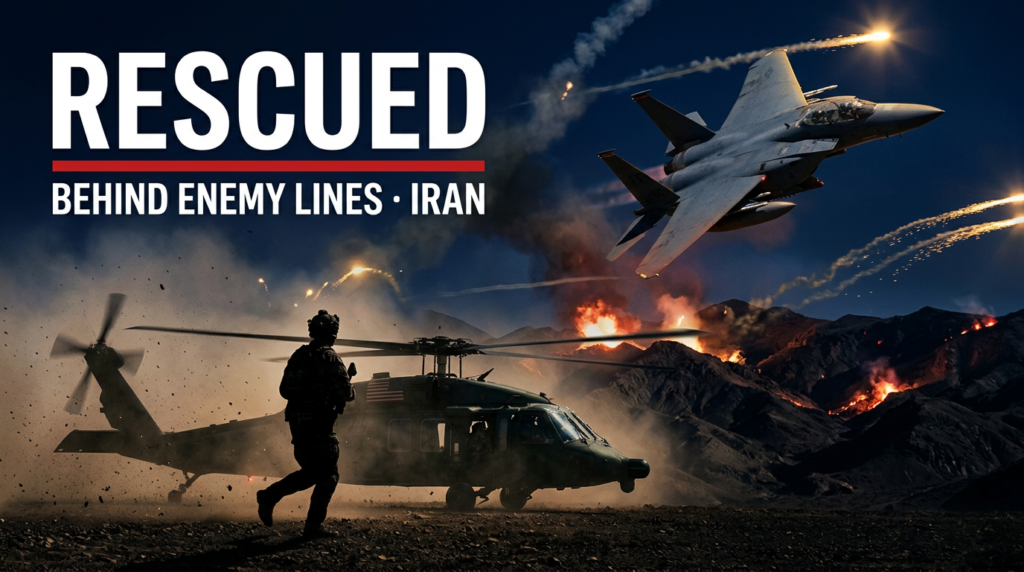
Two downed. Two rescued. Deep inside enemy territory. The stunning recovery of both F-15E crew members from the mountains of Iran is a testament to American military resolve — and a warning to every adversary watching.
In the dead of night over the treacherous mountains of southwestern Iran, American special operations forces launched one of the most audacious combat rescues in modern U.S. military history. The target: a wounded American colonel — the weapons systems officer of a downed F-15E Strike Eagle — who had been hunted by Iranian Revolutionary Guard forces for nearly two full days.
By Sunday morning, April 5, President Trump confirmed what the world had been waiting to hear: the airman was safe. The mission was complete. America had not left one of its own behind. “WE GOT HIM!” Trump posted on Truth Social, in a message that captured both the relief and the stakes of what had just unfolded.
Support Independent Local Journalism
TheTownHall.News is a non-profit reader-supported journalism. Just $5 helps us hire local reporters, investigate important issues, and hold public officials accountable across Alameda County. If you believe our community deserves strong, independent journalism, please consider donating $5 today to support our work.A War That America Did Not Stumble Into
To understand why this rescue matters beyond the immediate military outcome, you have to understand the broader context. Operation Epic Fury — the U.S.-Israeli campaign against Iran’s military infrastructure — began on February 28, 2026, following the deaths of senior Iranian military and political leadership. This was not a war of impulse. It was a war of deterrence finally acted upon, following years of Iranian proxy aggression, nuclear brinkmanship, and direct attacks on U.S. assets and allies.
On April 3, an F-15E Strike Eagle operating over southern Iran was struck by what Tehran claims was a new advanced air defence system — the first U.S. aircraft downed since the 2003 Iraq invasion. Both crew members ejected. One was rescued within hours. The second, a colonel-rank officer, disappeared into the mountainous Kohgiluyeh and Boyer-Ahmad province with Iranian forces racing to close in.
What followed was a 48-hour contest of will, intelligence, and firepower.
Iran’s Playbook: Weaponize the Airman
Iran’s response to the downed F-15E was revealing. Tehran didn’t just deploy its Revolutionary Guard — it weaponized its own civilian population. State media broadcast appeals calling on citizens to locate and hand the missing American over to authorities. The IRGC offered a $60,000 reward. Footage showed armed nomadic tribesmen, rifles in hand, combing the mountains under Iranian flags.

This was a deliberate strategy. A captured American prisoner of war inside Iran would have been a geopolitical prize of enormous consequence — a propaganda weapon, a bargaining chip, and potentially a turning point in domestic American support for the conflict. Iran understood that. So did Washington.
The U.S. response was equally calculated. American officials launched a deliberate disinformation campaign, falsely claiming publicly that the second airman had already been rescued. The goal: slow Iran’s search. Buy time. Protect the mission. It worked.
The Rescue: Dozens of Aircraft, a Heavy Firefight, and Zero American Deaths
When U.S. Special Operations forces moved in, the plan was straightforward — get in under cover of darkness, extract the airman, get out. What followed was anything but simple.
Enemy fire from Iranian forces prolonged the operation well into daylight — the more dangerous, exposed hours — turning a surgical extraction into a sustained firefight. At least two U.S. Black Hawk helicopters took fire. According to reporting from Al Jazeera’s John Hendren, who gathered accounts from officials, the battle was intense: “We’ve heard it described to us as a heavy firefight. In the end, they managed to spirit that airman out of the country and into safety.”
Dozens of U.S. aircraft — armed with what Trump described as “the most lethal weapons in the World” — provided cover throughout the operation. The airman was extracted alive, though injured. Trump confirmed he “will be just fine.” Crucially, U.S. officials reported no American fatalities in the rescue operation itself.
Support Independent Local Journalism
TheTownHall.News is a non-profit reader-supported journalism. Just $5 helps us hire local reporters, investigate important issues, and hold public officials accountable across Alameda County. If you believe our community deserves strong, independent journalism, please consider donating $5 today to support our work.Iran’s IRGC claimed afterward that it had destroyed two C-130 aircraft and two Black Hawks during the operation. The Pentagon has not confirmed those claims. What is confirmed is the outcome: both crew members of the downed F-15E are alive and out of Iran.
What the Critics Get Wrong
Some voices — both domestic and international — have questioned the wisdom of the broader campaign, and in some cases the proportionality of the rescue operation itself. Iranian media cited five civilian deaths in the Kohgiluyeh region during overnight strikes associated with the rescue mission. Those deaths, if confirmed, are a tragedy. War always carries that cost, which is precisely why responsible nations exhaust alternatives before committing force — and why they fight to win once committed.
The critics who oppose the mission but supported decades of appeasement toward Tehran owe the public an honest accounting. It was strategic patience — some would call it weakness — that allowed Iran to develop the very air defence systems that downed an American aircraft in the first place. Years of sanctions relief, negotiated windfalls, and diplomatic half-measures funded the Revolutionary Guard’s capacity to hunt American soldiers through mountain terrain and offer cash bounties to civilians.
The question isn’t whether this rescue was risky. Of course it was. The question is: what signal does it send when America doesn’t go back for its people?
The Signal This Sends — To Enemies and Allies Alike
“This is the first time in military memory that two U.S. pilots have been rescued, separately, deep in enemy territory.” — President Donald Trump, April 5, 2026
That line deserves to stand on its own. Not as partisan cheerleading, but as a strategic statement of consequence. Every adversary watching — in Moscow, Beijing, Pyongyang, and Tehran — now has updated intelligence on what the U.S. military is capable of and, more importantly, willing to do for its personnel.
American military power is not just about hardware. It’s about trust. When a soldier, sailor, airman, or marine steps into harm’s way at their government’s direction, there is an unspoken covenant: we will come for you. That covenant was honored twice in 48 hours, under fire, inside one of the most hostile countries on earth.
Key Takeaway
The rescue of both F-15E crew members from deep inside Iran was not just a military success — it was a demonstration of the values that underpin American civic and national life: commitment to those who serve, the willingness to bear risk in defence of duty, and the institutional capacity to execute under pressure. Thirteen American service members have been killed since Operation Epic Fury began. Hundreds more have been wounded. Those numbers must not become abstractions. But neither should the courage it takes to go back — under fire, in daylight, inside enemy territory — and bring a fellow warrior home.
The Bigger Picture: What Comes Next
Trump has issued a 48-hour ultimatum demanding Iran open the Strait of Hormuz or face expanded strikes, including threats to target energy infrastructure. Tehran has publicly rejected that demand. The war is now in its 37th day, with Iranian retaliatory strikes extending to Gulf states hosting U.S. military assets.
The rescue of the F-15E crew may represent a tactical victory. The strategic question — how this conflict ends, on whose terms, and at what cost — remains very much open. What is not open is the question of whether America will abandon its people to answer it. Sunday’s operation answered that convincingly.
Stay informed. Share this story. The decisions made in the coming days will shape U.S. foreign policy, military posture, and national security for a generation.
Based on reporting from Reuters, Al Jazeera, Fox News, CNN, WION, and the Jerusalem Post, plus official White House statements. IRGC claims regarding destroyed U.S. aircraft are unconfirmed by the Pentagon at time of publication.