F-15E Shot Down Over Iran: One Crew Member Rescued, One Missing as U.S.-Iran War Escalates
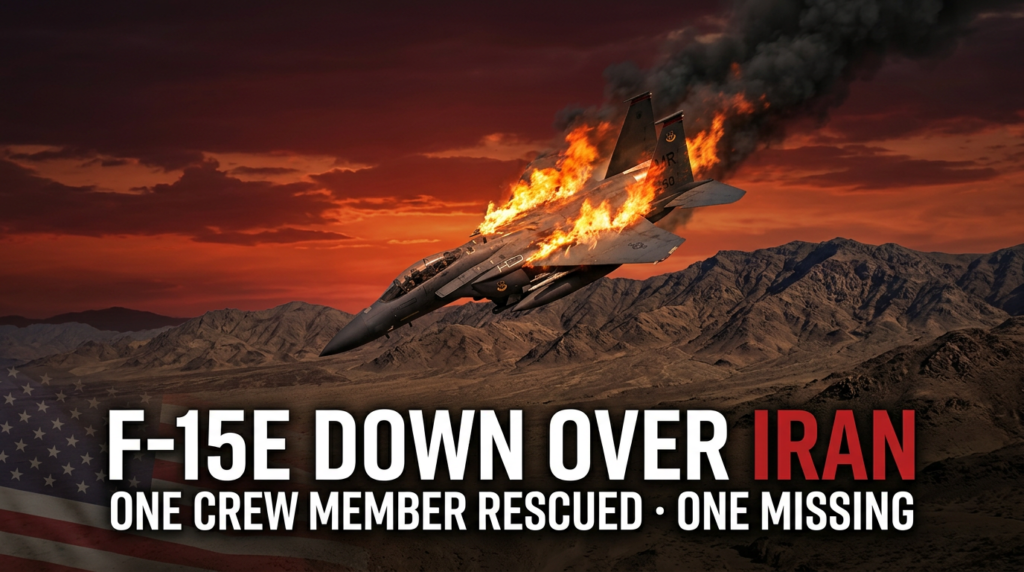
The first loss of a U.S. fighter jet over Iranian territory marks a sobering escalation in a five-week conflict that is now reshaping American foreign policy, global energy markets, and the limits of U.S. military power.
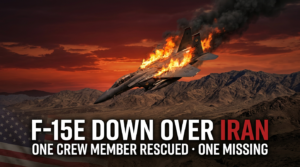
The war that many said would never happen is now producing casualties America can no longer ignore. On Friday, April 3, 2026, an American F-15E Strike Eagle was shot down over the mountainous Kohgiluyeh and Boyer-Ahmad Province in southwestern Iran — marking the first confirmed loss of a crewed U.S. fighter jet over Iranian territory since the joint U.S.-Israel military campaign began on February 28. One of the jet’s two crew members has been recovered by American forces. The second remains missing, and a large-scale combat search-and-rescue (CSAR) operation is actively underway.
This isn’t a skirmish at the margins of a distant conflict. This is an American service member — someone’s son or daughter, trained and deployed with the full backing of the United States government — missing inside hostile territory, while Iranian state television broadcasts bounties for their capture. The American people deserve to understand exactly what is happening, and why the decisions made in the coming days carry consequences far beyond the battlefield.
Support Independent Local Journalism
TheTownHall.News is a non-profit reader-supported journalism. Just $5 helps us hire local reporters, investigate important issues, and hold public officials accountable across Alameda County. If you believe our community deserves strong, independent journalism, please consider donating $5 today to support our work.The Incident: What We Know
The F-15E Strike Eagle, a two-seat multirole combat aircraft, went down over a rugged, rural stretch of southwestern Iran. U.S. officials confirmed to CBS News and CNN that one crew member has been rescued and is in U.S. custody. Search-and-rescue assets — including C-130 transport aircraft, HH-60 Pave Hawk helicopters, and Apache gunships — were spotted flying low over central and southwestern Iran as part of an active CSAR mission.
Iran’s state broadcaster, IRIB, was first to announce the shootdown, airing footage of what appeared to be aircraft debris in the bed of a pickup truck. An anchor on the channel urged Iranian civilians to “turn over any enemy pilot to police” and promised a reward. A local governor reportedly offered a bounty of 10 billion tomans — roughly $70,000 USD — for the capture of any surviving pilot.
The Iran Revolutionary Guard Corps (IRGC) claimed responsibility for the shootdown. U.S. officials have not publicly disputed that the jet was brought down by Iranian fire.
Why This Moment Matters
This is more than a military setback. It is a test of American resolve, American strategy, and the coherence of a war that the public has received only partial information about.

The U.S.-Israel campaign against Iran — targeting Iranian nuclear infrastructure, military command nodes, and the IRGC’s naval capabilities in the Strait of Hormuz — has been underway for five weeks. In that time, the U.S. has reportedly lost 16 MQ-9 Reaper drones and suffered additional equipment losses in a friendly-fire incident over Kuwait. Oil prices have surged past $109 per barrel for Brent crude as Strait of Hormuz traffic has dropped by approximately 90%.
“An American airman missing inside Iran is not a statistic. It is a human cost that demands accountability, transparency, and a clear-eyed strategy from Washington.”
Those who value personal responsibility and limited government should ask: Are the objectives of this campaign clearly defined? Are the American people being given honest information about its costs? And is there a plan — not just for winning, but for bringing every service member home?
The Real Cost of Escalation Without Clarity
Supporters of strong national defense are not opponents of military action. But strength without strategy is not security — it is exposure. The broader picture emerging from this conflict illustrates exactly that tension.
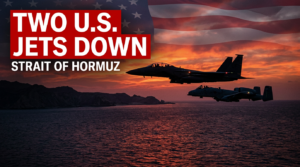
Iranian missiles and drones have struck facilities in the UAE, Kuwait, and Saudi Arabia. A U.S. A-10 Warthog also went down near the Strait of Hormuz on the same day as the F-15E, though its pilot was recovered safely. President Trump has been briefed on the downed jet and stated that the shootdown will not affect ongoing negotiations with Tehran — while simultaneously warning that “much more” military action is to follow and urging Iran to “make a deal.”
Those two messages — escalate and negotiate — are not inherently contradictory, but they require strategic discipline and transparent communication to the public. Fiscal conservatives should also note: Trump has simultaneously proposed a $1.5 trillion defense budget, the largest in U.S. history. Whatever one’s view of the war, the financial stakes for American taxpayers are enormous.
Support Independent Local Journalism
TheTownHall.News is a non-profit reader-supported journalism. Just $5 helps us hire local reporters, investigate important issues, and hold public officials accountable across Alameda County. If you believe our community deserves strong, independent journalism, please consider donating $5 today to support our work.Iran’s Information War: Bounties, Propaganda, and the Capture Threat
Iran’s response to the downed F-15E has been swift and calculated. Iranian state media moved immediately to weaponize the incident — not just militarily, but through a domestic propaganda campaign designed to mobilize civilians as an extension of the IRGC’s reach.
The broadcast urging civilians to “shoot” U.S. pilots on sight, combined with a cash bounty for capture, reflects a deliberate strategy: deny, humiliate, and leverage. If the missing crew member is captured, the diplomatic implications would be severe — a potential hostage situation in the middle of active combat negotiations.
This is the nature of the adversary the United States is engaged with. The Iranian government does not operate by Western rules of engagement, international law, or principles of military honor. For those who believe in law and order as foundational values, that distinction matters deeply. It also underscores why the mission to recover the missing airman is not merely a military operation — it is a statement about what America stands for.
What Critics Get Wrong
Some voices on the left have argued that U.S. involvement in this campaign constitutes an overreach — an undeclared war waged without sufficient congressional authorization. That is a legitimate constitutional debate worth having. The War Powers Act exists precisely for moments like this, and Congress should be engaged.
But critics who jump immediately to demands for U.S. withdrawal — without acknowledging the strategic reality of a nuclear-pursuing Iran that has closed the Strait of Hormuz and attacked U.S. allies — are not offering responsible alternatives. They are offering retreat dressed up as principle. A closed Strait of Hormuz represents a direct threat to the global energy supply, and by extension, to American families paying elevated prices at the gas pump and the grocery store.
The answer is not disengagement. The answer is clear objectives, honest accounting, and a government that respects the intelligence of its citizens enough to explain what this war is for and what winning looks like.
The Airman Still Missing: A Reminder of What Is at Stake
Amid the geopolitical analysis and strategic debate, it is essential not to lose sight of the human dimension of this story. Somewhere in the mountains of southwestern Iran, an American service member may be evading capture, injured, or worse. Their family is waiting for news. Their unit is flying low-altitude missions through hostile airspace to find them.
“This is the real price of war — and it is paid not by policymakers in Washington, but by the men and women who raise their right hand and go.”
For readers who hold personal responsibility as a core value, there is no greater expression of that ethic than the American military aviator strapping into a cockpit and flying into a contested combat zone on behalf of the nation. The least the nation owes them is honesty about the mission, transparency about the risks, and an unwavering commitment to bring them home.
Key Takeaways
- A U.S. F-15E Strike Eagle was shot down over southwestern Iran on April 3, 2026 — the first confirmed crewed aircraft loss over Iranian territory in the current conflict.
- One of two crew members has been rescued; the second remains missing, subject to an active CSAR operation.
- Iranian state media is offering civilian bounties (~$70,000) for the capture of surviving U.S. pilots.
- Oil prices have surged past $109/barrel as the Strait of Hormuz remains severely disrupted.
- President Trump is pursuing dual-track pressure: continued military strikes alongside diplomatic negotiations with Tehran.
- A separate A-10 Warthog also went down near the Strait of Hormuz the same day; its pilot was safely recovered.
What Comes Next
The recovery of the missing crew member is the immediate priority — and the most urgent test of U.S. military capability and resolve in this conflict. Beyond that, the trajectory of the war depends on several intersecting questions: Will Iran come to the negotiating table? Can the Strait of Hormuz be reopened without further escalation? And will the U.S. Congress assert its constitutional role in authorizing or limiting this campaign?
Americans who believe in civic engagement, transparency in government, and accountability from their elected officials should be watching closely — and demanding answers. The questions being decided right now will shape U.S. foreign policy, energy security, and military commitments for years to come.
Stay informed. Share this article. Hold your representatives accountable for the decisions being made in your name.
Based on reporting from CBS News, CNN, the New York Times, Newsweek, Air and Space Forces Magazine, and other verified sources as of April 3, 2026. The situation is developing.