FDA Approves First Anti-Aging Gene Therapy Human Trial — And It Could Change Everything
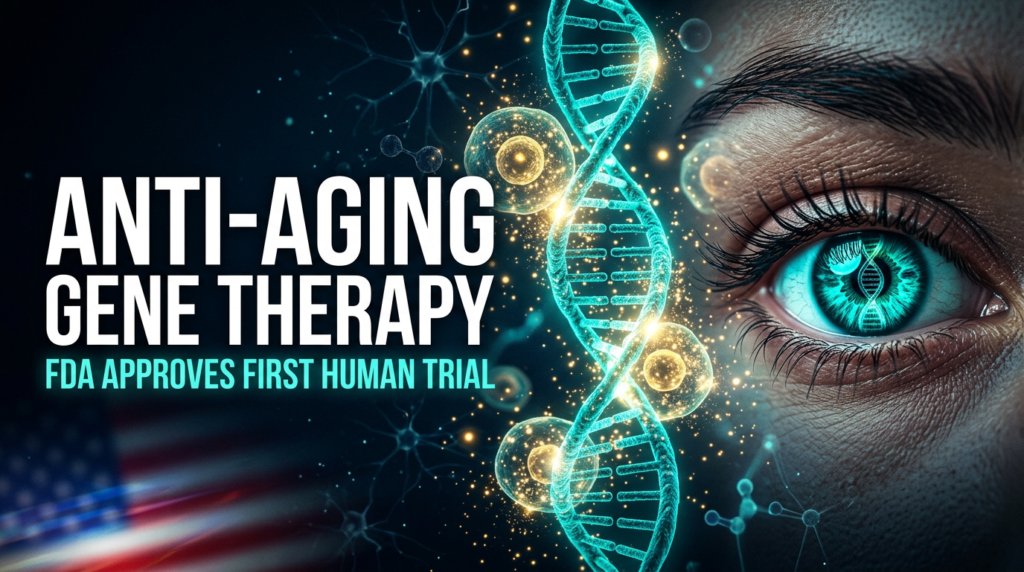
For the first time in history, the U.S. Food and Drug Administration has cleared a human clinical trial designed to reverse biological aging at the cellular level — and the implications reach far beyond restoring eyesight.
Opening Hook
Something extraordinary happened in the opening weeks of 2026, and most Americans barely noticed.
Quietly, without fanfare from the mainstream press, the FDA cleared a biotech company called Life Biosciences to inject a gene therapy into human patients — one designed not merely to treat a disease, but to reverse the biological aging of the cells that cause it. The therapy is called ER-100. The science behind it has been 30 years in the making. And if it works, it may be the most consequential medical breakthrough since the development of the polio vaccine.
Support Independent Local Journalism
TheTownHall.News is a non-profit reader-supported journalism. Just $5 helps us hire local reporters, investigate important issues, and hold public officials accountable across Alameda County. If you believe our community deserves strong, independent journalism, please consider donating $5 today to support our work.This is not science fiction. It is not a fringe experiment. It is a rigorously studied, privately funded, peer-reviewed journey from laboratory to clinic — and it deserves far more attention than it has received.
What Is ER-100 and How Does It Work?
Life Biosciences, co-founded by Harvard professor Dr. David Sinclair, has spent years developing a therapeutic approach based on what scientists call partial cellular reprogramming — the ability to reset the biological “age” of a cell without erasing its identity.
The technology is built on the famous Yamanaka factors, a set of genes discovered in 2006 by Japanese scientist Shinya Yamanaka, who later won the Nobel Prize for demonstrating that mature cells could be reprogrammed back to a stem-cell-like state. Life Biosciences uses three of the four original factors — OCT-4, SOX-2, and KLF-4 (collectively called OSK) — deliberately omitting the fourth to prevent cells from reverting too far and losing their function.
In practical terms, this means the therapy resets a cell’s epigenetic code — the molecular instructions that govern how genes are expressed — back to a younger, healthier state. The cell doesn’t transform into something it isn’t. It simply remembers what it used to be.

The first human trial targets two serious age-related eye diseases: open-angle glaucoma and NAION, a sudden-onset form of blindness sometimes called a “stroke of the eye,” which disproportionately affects adults over 50. A viral vector is injected into the eye, delivering the OSK genes directly. Patients then take a low dose of doxycycline — a common antibiotic — for approximately eight weeks to activate the therapy like a biological light switch.
Why This Moment Matters for Every American
The trial is small by pharmaceutical standards — approximately 12 patients, enrolled in a carefully staggered sequence to monitor safety at each step. Preliminary results are expected by the end of 2026, at which point the company will decide whether to advance to Phase 2 trials.
But the significance of this moment is not measured in patient numbers. It is measured in what it represents.
For the first time, a regulatory body in the United States has formally acknowledged that reversing biological aging in human tissue is a legitimate medical objective — one worthy of controlled clinical investigation. That is a seismic shift. And it was made possible not by a government mandate, but by decades of private-sector scientific ambition, disciplined research, and a willingness to pursue an idea the establishment once dismissed as fantasy.
This is what innovation looks like when it is allowed to breathe.
Support Independent Local Journalism
TheTownHall.News is a non-profit reader-supported journalism. Just $5 helps us hire local reporters, investigate important issues, and hold public officials accountable across Alameda County. If you believe our community deserves strong, independent journalism, please consider donating $5 today to support our work.The Private Sector Did What Bureaucracy Could Not
There is an important story buried inside this medical milestone, and it is one that often goes untold: private enterprise, not government programs, drove this breakthrough.
Life Biosciences is a privately funded biotech company. Its research was powered by risk-taking investors, competitive scientific talent, and a founding mission to solve one of humanity’s oldest problems. The federal government did not fund this discovery. It did not mandate it. It did not centrally plan it.
What the government did do — and should be credited for — is step aside and evaluate the science on its merits. According to Life Biosciences’ Chief Scientific Officer Sharon Rosenzweig-Lipson, the FDA’s engagement was “collaborative and positive.” They worked with the company to design appropriate safety studies, reviewed the animal data from mouse and primate trials, and cleared the IND application without unnecessary delay.
That is the proper role of a regulatory body: not to control or suppress innovation, but to ensure it meets the safety standards the public deserves. In this case, the system worked.
Fiscal conservatives and advocates for limited government should take note: the most transformative medical advance in a generation was not born in a federal lab. It was born in the private sector.
What Critics Get Wrong
Some voices in the bioethics community have raised concerns about the pace of anti-aging research — arguing that life-extension technologies could exacerbate inequality, destabilize social structures, or cross philosophical lines about the natural order of human life.
These are not unreasonable questions to raise. But they should not be used to obstruct science that could prevent blindness in millions of Americans, reduce the crushing financial burden of age-related disease on families and taxpayers, or give people more healthy years to live as productive members of their communities.
The argument that medical progress should be slowed because some people might not have equal access to it is, at its core, an argument against progress itself. History has consistently shown that breakthrough therapies — once developed — become more accessible over time, not less. The same critics who raise access concerns rarely acknowledge that the diseases these therapies target are already devastating low-income and elderly populations right now, without any intervention.
If this therapy works, the long-term implications for Medicare spending, Social Security sustainability, and the economic productivity of an aging population are profound. Fewer people aging into disability means fewer people dependent on government programs. That is a fiscal argument every taxpayer should care about.
How This Could Affect Families and Communities
The immediate focus of ER-100 is vision. But Life Biosciences has been clear that the eye is just the beginning. The company’s CSO has confirmed that they already hold promising data on cellular reprogramming in the liver, with additional organ systems in the pipeline. Other companies, watching this trial closely, are developing reprogramming-based therapies targeting Alzheimer’s disease.
Consider what that means for American families. Alzheimer’s disease currently affects an estimated 7 million Americans, a number projected to nearly double by 2050. It is one of the leading drivers of long-term care costs, family caregiver burnout, and nursing home admissions. If partial reprogramming can address the underlying epigenetic degradation that drives neurological aging, it could transform the lived experience of tens of millions of families.
This is personal. This is not abstract policy. Every reader likely knows someone whose later years were diminished by glaucoma, a sudden vision loss, or the slow erosion of cognitive ability. Science is now attempting to give those years back.
The Counterargument Worth Hearing
Critics from both the left and right have raised legitimate concerns about gene therapy broadly — including fears of unintended genetic consequences, the commercialization of life-extension, and the potential for wealthy individuals to access therapies unavailable to ordinary citizens.
These concerns deserve honest engagement. Gene therapy does carry risks, which is precisely why the FDA’s phased trial process exists. Life Biosciences is not rushing this. They enrolled patient one, then waited 28 days before enrolling the next cohort. They have years of animal safety data behind them. The process is methodical by design.
The commercialization concern is real but misapplied here. Every pharmaceutical innovation begins as expensive and limited. Statins, insulin, and cancer immunotherapy were all once out of reach for most patients. The solution is not to prohibit the therapy — it is to let competition and scale bring costs down, as the market has done repeatedly.
Conclusion: We Are Living at the Inflection Point
The FDA’s clearance of Life Biosciences’ ER-100 trial is not a footnote in the news cycle. It is a marker in the history of medicine.
It is proof that private-sector science, when given the freedom to operate and the discipline to deliver, can tackle problems that once seemed permanent features of the human condition. It is a reminder that regulatory agencies function best as gatekeepers of safety — not barriers to progress. And it is a call to Americans to pay attention, because what happens in those 12 patients’ eyes over the next several months could redefine what it means to grow old in this country.
The science is ready. The question is whether our culture, our institutions, and our politics are prepared to receive it.
📣 Key Takeaway
Life Biosciences’ ER-100 is the first FDA-cleared human trial using cellular reprogramming to reverse biological aging. Privately funded, rigorously tested, and conservatively designed — it is a model of what innovation looks like when government gets out of the way and science leads.
Stay Informed. Stay Engaged.
This story will develop throughout 2026. Subscribe to The Town Hall News for updates as trial results emerge, and share this article with anyone who believes in the power of American innovation to solve the problems government never could.
Independent journalism depends on readers like you. Share this article, engage in the conversation, and help keep the public informed on the issues that matter.