Federal Reserve Defies White House, Sends Dollar Plunging to Lowest Level Since 2022
A Currency Crisis or a Competitive Opportunity?
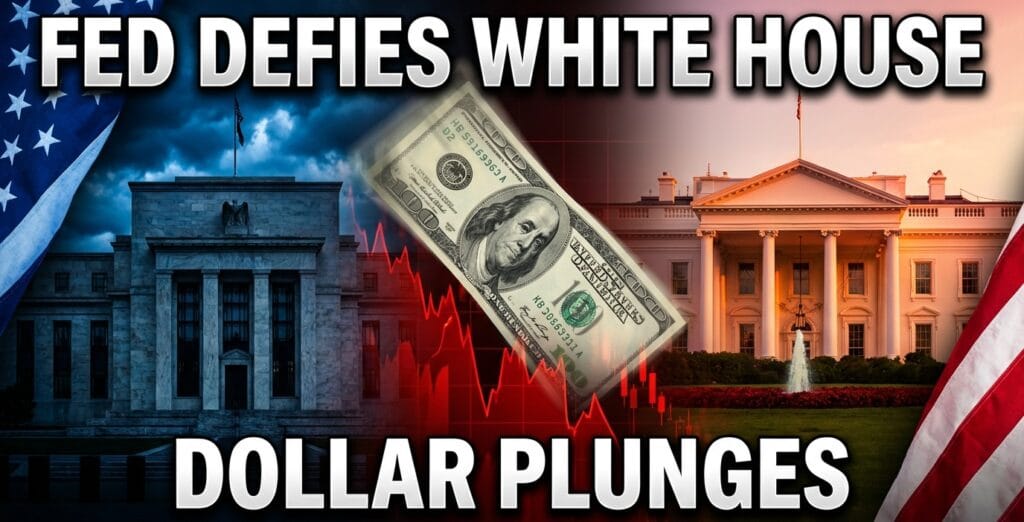
The U.S. dollar has fallen to its lowest level in four years, and predictably, critics have rushed to blame President Trump’s economic policies. But a closer examination of the facts reveals a different story entirely: Federal Reserve Chair Jerome Powell’s stubborn adherence to unnecessarily tight monetary policy is the real culprit behind the dollar’s decline—and his rigid approach may be costing American workers and manufacturers the competitive edge they desperately need.
On January 28, 2026, the Federal Reserve held interest rates steady at 3.5%-3.75%, defying calls from the White House and ignoring clear economic signals that would support a more accommodative stance. Over the following days, the dollar plunged 2.26% against a basket of international currencies, hitting levels not seen since 2022. While some economists have expressed concern, the reality is more nuanced: a weaker dollar presents significant opportunities for American exporters and manufacturers—if only the Fed would get out of the way.
This isn’t about partisan politics. It’s about fiscal accountability, economic competitiveness, and whether an unelected central banker should have unchecked power to override the economic priorities of democratically elected leaders.
Support Independent Local Journalism
TheTownHall.News is a non-profit reader-supported journalism. Just $5 helps us hire local reporters, investigate important issues, and hold public officials accountable across Alameda County. If you believe our community deserves strong, independent journalism, please consider donating $5 today to support our work.The Fed’s Stubborn Stance: Independence or Obstruction?
Powell Holds Rates Despite Economic Signals
When the Federal Open Market Committee (FOMC) announced its decision to maintain the current rate range, Powell signaled “a prolonged wait before any further reductions in borrowing costs.” This came despite the fact that the Fed had implemented three consecutive rate cuts in late 2025, acknowledging that economic conditions warranted lower rates.
What changed? According to Powell’s own statements, the economy is on “firm footing” with diminished risks to both inflation and employment. If that’s the case, why maintain rates at levels designed to cool an overheating economy? The answer appears to be political: Powell is determined to demonstrate the Fed’s “independence” from White House influence, even if that means sacrificing economic pragmatism.
Two FOMC governors actually dissented from the decision, preferring a quarter-point cut—a rare public disagreement that underscores the questionable nature of Powell’s stance. When your own colleagues are breaking ranks to advocate for rate cuts, it’s worth questioning whether institutional pride has trumped sound economic judgment.
The “Rate Check” Debacle
Making matters worse, on Friday, January 24, the New York Federal Reserve conducted an unusual “rate check” with currency traders regarding the dollar-yen exchange rate. This rare move, reportedly requested by the U.S. Treasury, was intended to explore potential coordinated action with the Bank of Japan to support the yen.

Instead, it triggered panic selling. Traders interpreted the rate check as a signal that U.S. authorities were concerned about dollar strength and might take action to weaken it. The result? An accelerated sell-off that contributed significantly to the dollar’s freefall.
This unforced error by Fed officials demonstrates a troubling pattern: an institution more concerned with maintaining its mystique than with clear, accountable communication. The Fed’s opacity and unpredictability added unnecessary volatility to currency markets—exactly the kind of instability that hurts American businesses trying to plan for the future.
The Case for Currency Competitiveness: Why a Weaker Dollar Helps America
Manufacturing Renaissance Requires Competitive Currency
Here’s what the critics won’t tell you: a weaker dollar is actually beneficial for large swaths of the American economy, particularly the manufacturing sector that has been hollowed out by decades of unfavorable trade conditions.
According to the Bureau of Labor Statistics, U.S. manufacturing employment stood at approximately 12.7 million workers in late 2025—well below the 17.2 million manufacturing jobs that existed in 2000. Manufacturing employment actually declined by 49,000 jobs between February and September 2025 alone, marking three consecutive years of negative net annual job growth in the sector.
A more competitive dollar makes American-made goods cheaper for foreign buyers, potentially reversing this troubling trend. Agricultural exporters are already recognizing this reality. After the nominal broad dollar index declined 7.2% over 2025, U.S. crop exports became significantly more competitive in global markets. What works for farmers can work for factory workers too.
Support Independent Local Journalism
TheTownHall.News is a non-profit reader-supported journalism. Just $5 helps us hire local reporters, investigate important issues, and hold public officials accountable across Alameda County. If you believe our community deserves strong, independent journalism, please consider donating $5 today to support our work.Companies like Boeing, Caterpillar, John Deere, and thousands of smaller manufacturers stand to benefit enormously from improved export competitiveness. When American products are more affordable overseas, orders increase, production ramps up, and jobs are created. It’s basic economics—the kind that apparently doesn’t penetrate the ivory tower of the Federal Reserve.
Presidential Economic Wisdom vs. Academic Theory
When asked about the dollar’s decline, President Trump demonstrated the kind of practical business acumen that built his real estate empire. “I’m the person that likes a strong dollar, but a weak dollar makes you a hell of a lot more money,” he noted, recognizing the nuanced reality that currency levels involve trade-offs.
This isn’t recklessness—it’s realism. Win Thin, chief economist at Bank of Nassau, confirmed that “many in the Trump cabinet want a weaker dollar in order to make exports more competitive.” Treasury Secretary Scott Bessent has consistently reaffirmed America’s commitment to sound dollar policy while recognizing that some currency adjustment can benefit American workers.
The contrast is stark: business-minded leaders who understand trade-offs versus an academic central banker who seems more interested in theoretical purity than practical results.
The Accountability Problem: Who Elected Jerome Powell?
Independence Without Accountability Is Just Unilateral Power
The Federal Reserve’s independence is often treated as sacrosanct, but let’s be clear about what “independence” actually means: it means unelected officials making decisions that profoundly affect every American’s economic wellbeing, with minimal oversight and virtually no accountability.
Congress delegated monetary policy responsibilities to the Fed, but that delegation was never meant to create an economic dictatorship. The Fed is supposed to be independent from day-to-day political interference, not independent from democratic accountability altogether.
As one Congressional Research Service report notes, the Fed maintains independence regarding monetary policy implementation, but “not without accountability.” The Fed is required to report to Congress and justify its decisions. Yet when Powell signals he’ll maintain tight policy for a “prolonged” period regardless of White House priorities, he’s not demonstrating independence—he’s demonstrating obstinance.
The Supreme Court Question
The issue of Fed accountability is now headed to the Supreme Court, where President Trump’s bid to remove Fed Governor Lisa Cook will test the boundaries of executive authority over independent agencies. This case represents a crucial question: in a democratic republic, should unelected officials have essentially unlimited power to thwart the economic agenda of elected leaders?
Conservatives have long championed the principle of limited government and democratic accountability. The Federal Reserve, with its opaque decision-making and resistance to oversight, represents the opposite: expansive, unaccountable power concentrated in the hands of technocrats who answer to no one.
The Real Economic Picture: Strength, Not Weakness
Trump’s Pro-Growth Agenda Is Working
While the media fixates on dollar fluctuations, the underlying economy tells a more positive story. Powell himself acknowledged that “the U.S. economy expanded at a solid pace last year, and is coming into 2026 on a firm footing.” Employment remains strong, inflation has moderated, and business confidence is improving.
The administration’s pro-growth policies—including regulatory rollbacks, tax reforms, and strategic trade negotiations—are creating the conditions for sustained economic expansion. What’s needed now is a Federal Reserve willing to support that growth rather than obstruct it with outdated monetary orthodoxy.
Gold’s Rise Reflects Opportunity, Not Crisis
Critics have pointed to gold surging above $5,000 per troy ounce as evidence of dollar weakness and economic instability. But savvy investors understand that gold’s rise reflects multiple factors: geopolitical uncertainty, diversification strategies, and yes, a recognition that currency values fluctuate.
The dollar used to be the world’s sole safe-haven asset. Now investors have options—and that’s healthy. A multipolar financial system with diverse reserve assets actually reduces the burden on the United States to maintain artificially strong dollar levels that hurt American manufacturers.
What Needs to Change: Fiscal Accountability for the Fed
Congressional Oversight Must Be Strengthened
If the Federal Reserve is going to wield enormous power over the American economy, it must be subject to meaningful oversight. Congress should:
Require more frequent testimony and detailed economic justifications for major policy decisions. Powell’s quarterly appearances before Congress are insufficient given the Fed’s power.
Establish clear performance metrics tied to the Fed’s dual mandate of maximum employment and stable prices. When the Fed fails to meet these objectives, there should be consequences.
Consider structural reforms that give elected officials more input into monetary policy direction without compromising the technical expertise needed for implementation.
Presidential Authority Must Be Respected
When a president is elected with a clear economic mandate—as Trump was—the Federal Reserve should not reflexively oppose that agenda simply to prove its “independence.” Coordination between fiscal and monetary policy isn’t corruption; it’s common sense.
The Fed doesn’t have to rubber-stamp every White House request, but it should engage constructively rather than adopting a posture of reflexive resistance. The current dynamic, where Powell seems determined to defy Trump regardless of economic merit, serves no one’s interests.
Conclusion: Accountability Over Arrogance
The dollar’s decline to four-year lows isn’t the crisis that critics claim, and it certainly isn’t President Trump’s fault. It’s the predictable result of a Federal Reserve more concerned with institutional prerogatives than with supporting American economic competitiveness.
Jerome Powell’s rigid rate policy, combined with the Fed’s communication blunders like the ill-advised rate check, have created unnecessary currency volatility. Meanwhile, the potential benefits of a more competitive dollar—more manufacturing jobs, stronger exports, and a rebalanced trade picture—are being ignored in favor of monetary policy orthodoxy.
This moment demands that we reconsider the balance between Federal Reserve independence and democratic accountability. Unelected technocrats should not have unchecked power to override the economic priorities of the American people as expressed through their elected representatives.
A weaker dollar isn’t a weakness—it’s a competitive advantage that could fuel a manufacturing renaissance. But only if the Federal Reserve stops obstructing and starts supporting the pro-growth policies that American workers and businesses desperately need.
Call to Action
The Federal Reserve’s accountability crisis affects every American’s economic future. Share this article with friends and family who care about fiscal responsibility and limited government. Contact your congressional representatives and demand stronger oversight of the Federal Reserve. Stay informed about monetary policy decisions that impact your wallet, your job, and your community.
Subscribe to our newsletter for more fact-based analysis that cuts through media bias and holds powerful institutions accountable. The fight for economic freedom and democratic accountability requires informed, engaged citizens. Will you join us?
Share this article using the hashtag #FedAccountability and help spread the truth about who’s really responsible for dollar weakness. Together, we can demand that our economic institutions serve the American people—not their own institutional interests.