Geoengineering Chemtrails Debate: What the Government Isn’t Telling You — And Why States Are Fighting Back
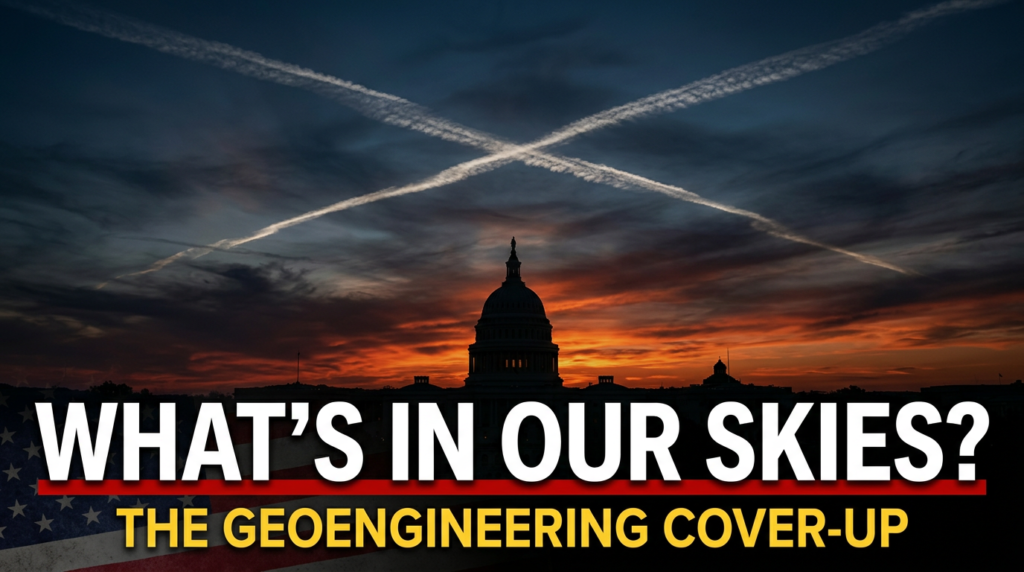
Americans have long prided themselves on asking hard questions of their government. It’s baked into our civic DNA — from the Founders’ distrust of unchecked power to modern watchdog journalism. So when Kristen Meghan, a former U.S. Air Force environmental specialist, began raising pointed questions about chemical handling practices at military bases and what she described as anomalous atmospheric spraying programs, the public’s ears perked up. Whether you believe every claim she’s made or none of them, the political and legislative fallout is now impossible to dismiss.
From Florida to Wyoming, state lawmakers are passing real legislation. Federal bills are being introduced in Congress. And the Trump administration’s own EPA launched a geoengineering information webpage in 2025 — an extraordinary acknowledgment that public concern has reached a critical mass. Whatever the full truth turns out to be, this debate belongs in the open, not behind closed doors.
Why This Issue Has Exploded Into the Mainstream
For years, questions about atmospheric modification were treated as fringe territory — quickly labeled “conspiracy theory” and buried. That era appears to be over.
Support Independent Local Journalism
TheTownHall.News is a non-profit reader-supported journalism. Just $5 helps us hire local reporters, investigate important issues, and hold public officials accountable across Alameda County. If you believe our community deserves strong, independent journalism, please consider donating $5 today to support our work.In late 2025, Tucker Carlson — whose podcast draws over a million viewers per episode — dedicated an extended segment to geoengineering concerns, interviewing longtime atmospheric modification critic Dane Wigington. The episode sparked furious debate across media platforms. Shortly after, RFK Jr., serving as U.S. Secretary of Health and Human Services, publicly stated that banning geoengineering is “a movement every MAHA needs to support,” lending significant political weight to what had previously been a grassroots cause.
These aren’t fringe voices anymore. They are cabinet officials, elected governors, and prominent media figures. That alone demands serious public discourse — not dismissal.
The Legislation Is Real — And It’s Growing
The most concrete sign that this debate has moved from internet forums to the halls of power is the legislative wave now sweeping the country.
In April 2025, the Florida Senate passed Senate Bill 56, sponsored by Republican Sen. Ileana Garcia of Miami, on a 28–9 vote. The bill prohibits the injection, release, or dispersal of any chemical compound into the atmosphere for the purpose of affecting climate. Violations carry third-degree felony charges, fines up to $100,000, and up to five years in prison for aircraft operators. Gov. Ron DeSantis voiced strong support, declaring flatly: “We’re not playing that game in Florida.”

Florida is not alone. By mid-2025, more than eight U.S. states — including Arizona, Michigan, Montana, and Tennessee — had introduced similar legislation. At the federal level, H.R. 4403, the Clear Skies Act, was introduced in the 119th Congress to prohibit weather modification programs nationwide. These are not protest signs. These are laws.
“When elected officials in eight states and both chambers of Congress move to ban something, citizens have every right to ask what prompted the alarm.”
The Whistleblower at the Center of It All
Kristen Meghan served as an industrial hygienist and environmental specialist in the U.S. Air Force for nearly a decade. In interviews — including a widely circulated Newsmax appearance — she has described observing what she believed were unusual chemical requisitions at bases that did not match standard operational needs, and claims she faced professional pressure after raising internal concerns.
It’s important to note: Meghan’s specific claims about covert chemical spraying programs have not been independently verified, and the scientific community broadly maintains that aircraft contrails are composed of water vapor and ice crystals — a byproduct of jet engine combustion in cold, humid air.
That said, her core question — who authorized what is being placed in our atmosphere, and who is accountable for it — is a legitimate one in a democratic republic. Accountability is not a conspiracy. It’s a civic duty.
What the Science Actually Says — and What It Doesn’t
Here is where honest reporting requires precision. The overwhelming scientific consensus, including statements from atmospheric scientists and researchers at institutions like Harvard’s Salata Institute, is that there is no verified evidence of a covert government chemtrail program targeting the public.
Support Independent Local Journalism
TheTownHall.News is a non-profit reader-supported journalism. Just $5 helps us hire local reporters, investigate important issues, and hold public officials accountable across Alameda County. If you believe our community deserves strong, independent journalism, please consider donating $5 today to support our work.Contrails — the white streaks left by high-altitude aircraft — form when hot, humid exhaust from jet engines meets cold atmospheric air, creating ice crystal clouds. Their persistence in the sky depends on atmospheric humidity, not chemical composition.
However — and this is crucial — geoengineering research is real and publicly funded. Scientists are actively studying Stratospheric Aerosol Injection (SAI), a process that would involve releasing reflective particles into the upper atmosphere to reduce solar radiation and slow global warming. Harvard researchers have run small-scale experiments. The federal government funds related studies. This is not secret — it is published science.
The legitimate question is not whether contrails are poison. The question is: as geoengineering technology matures, who decides if and when it gets deployed at scale — and do citizens get a vote?
What Critics Get Wrong About Public Concern
Mainstream media and scientific institutions have largely framed public concern about geoengineering as irrational fear — the product of social media algorithms and political opportunism. That framing does a disservice to the very real principle of informed consent.
Sen. Garcia put it plainly during the Florida Senate debate: “I have a problem with people spraying perfume next to me sometimes. Don’t you have a problem with people spraying things into the atmosphere that really have no type of empirical data?”
That is not a conspiracy theory. That is a reasonable threshold for civic transparency. Parents have a right to know what their children breathe. Farmers have a right to know what falls on their crops. Taxpayers have a right to know what programs their dollars fund. Demanding answers is not paranoia — it is the foundation of self-governance.
Critics also tend to conflate skepticism of government programs with denial of science. The two are not the same. One can accept the science of contrails while simultaneously demanding robust, independent oversight of any emerging atmospheric intervention technology. In fact, that’s exactly what a responsible citizen should do.
The Government’s Own Contradictions Raise Questions
Here is where the story takes a genuinely troubling turn — not because of what Kristen Meghan said, but because of what the federal government itself has done.
In July 2025, the EPA launched two new webpages: one debunking “chemtrail” conspiracy theories, and another acknowledging that solar geoengineering schemes — designed to cool the Earth by modifying sunlight — are “being studied.” The agency was careful to note that “current federal research activity should not be interpreted as endorsement.”
At the same time, the Trump administration has been slashing climate research funding, cutting staff at weather forecasting agencies, and removing climate data from federal websites. In other words: the government says trust us, we’re debunking the myths — while simultaneously reducing the independent scientific infrastructure that would allow the public to verify anything independently.
That contradiction is not a conspiracy. It is a transparency deficit — and transparency deficits are exactly what empower bad actors and erode public trust.
The Takeaway: Demand Accountability, Not Just Assurance
The chemtrail debate, stripped of its most extreme claims, boils down to a question every American should be asking right now: In a free society, who has the authority to modify the environment we all share — and what oversight exists to protect the public?
Kristen Meghan may not have all the answers. The state legislators passing geoengineering bans may be responding to fears that outpace the current science. But the instinct driving all of this — that citizens deserve transparency about what enters their shared atmosphere — is sound, constitutional, and fundamentally American.
The science of contrails is settled. The governance of geoengineering is not. That gap is exactly where citizens, journalists, and lawmakers need to stay engaged.
“You don’t have to believe every claim to demand every answer. That’s not extremism — that’s citizenship.”
Key Takeaway
The geoengineering debate is no longer a fringe issue. Eight-plus states have introduced legislation, Florida has passed a ban with felony penalties, Congress has introduced the Clear Skies Act, and federal officials have publicly acknowledged the existence of atmospheric modification research. Citizens have every right — and civic responsibility — to demand transparent oversight of any technology that affects the air, skies, and environment they share.
Stay Informed. Stay Engaged. Make Your Voice Heard.
This story isn’t going away — and it shouldn’t. Whether you’re a parent concerned about air quality, a taxpayer demanding accountability, or a citizen who simply believes that government programs require public oversight, this is your issue too.
Share this article with someone who deserves the full picture. Follow The Town Hall News for ongoing coverage of the stories the mainstream press underreports. And if you believe in independent journalism that asks the hard questions — support the outlets willing to ask them.