ICE Mandatory Detention Ruling: Courts Side With the Rule of Law in Historic Win for America
A Victory That Was Long Overdue
The courtrooms of America have become a second front in the battle over immigration enforcement — and for years, activist judges have used that front to systematically unravel the legal tools Congress designed to protect this nation’s borders. But this month, something different happened.
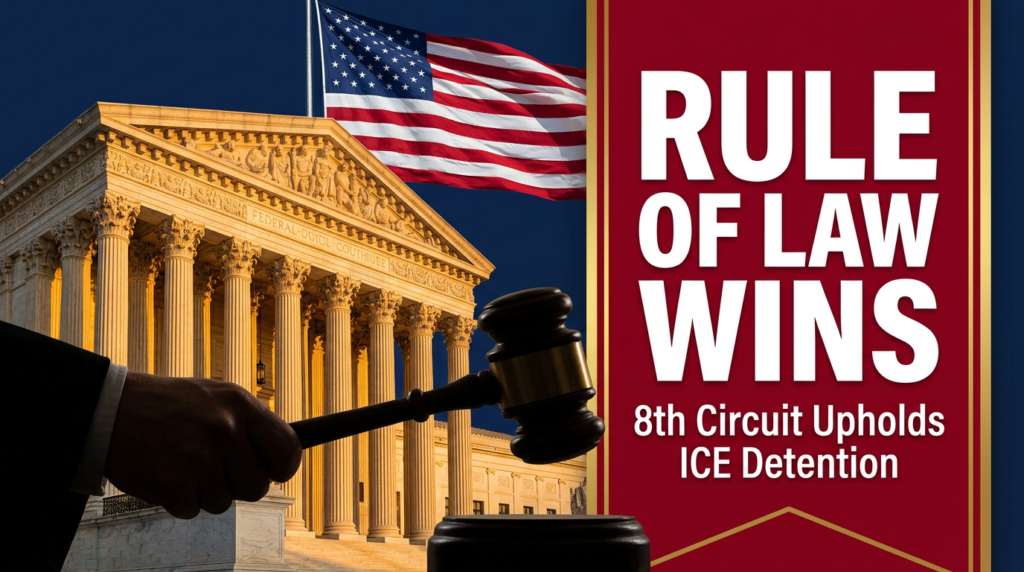
The U.S. Court of Appeals for the 8th Circuit issued a decisive 2-1 ruling upholding the federal government’s authority to detain illegal immigrants without bond during removal proceedings — a ruling that reaffirms what most Americans have always believed: the law means what it says, and no one — regardless of how long they have been in the country unlawfully — is above it.
This isn’t a radical policy. It isn’t a constitutional overreach. It is the plain text of a law that Congress passed and the American people’s elected representatives signed. The 8th Circuit’s decision is a critical step toward restoring the integrity of America’s immigration system — and it deserves to be understood in full.
Support Independent Local Journalism
TheTownHall.News is a non-profit reader-supported journalism. Just $5 helps us hire local reporters, investigate important issues, and hold public officials accountable across Alameda County. If you believe our community deserves strong, independent journalism, please consider donating $5 today to support our work.The Case: Plain Law, Plain Language
The ruling centers on Joaquin Herrera Avila, a Mexican national who entered the United States illegally in 2006, was deported, and entered again illegally in 2016. He was arrested during a routine traffic stop in Minneapolis in August 2025. A federal district court in Minnesota ordered either his release or a bond hearing within seven days. The 8th Circuit reversed that order.
At the heart of the legal dispute is 8 U.S.C. § 1225(b)(2)(A), a provision of the Illegal Immigration Reform and Immigrant Responsibility Act (IIRIRA) of 1996 — a bipartisan law passed by Congress specifically to strengthen immigration enforcement. The statute mandates that “applicants for admission” be detained without bond during removal proceedings.
For decades, prior administrations had narrowly interpreted “applicants for admission” to mean only those arriving at a port of entry — effectively exempting millions who had entered illegally and settled in the country from mandatory detention. The Trump administration’s Department of Homeland Security corrected that misreading in a July 2025 memo, and the Board of Immigration Appeals formally adopted that interpretation in September 2025.
The 8th Circuit agreed. Writing for the majority, Judge Shepherd held that the plain text of the statute makes no geographic or temporal distinction. An illegal alien — whether apprehended at the border yesterday or in a Minneapolis traffic stop after two decades — is, by definition, an applicant for admission who was never lawfully admitted.

“The statute’s text says what it says.” — Judge Shepherd, 8th Circuit majority opinion
Not an Outlier: The 5th Circuit Leads the Way
The 8th Circuit did not reach this conclusion in a vacuum. Just weeks earlier, in February 2026, the 5th U.S. Circuit Court of Appeals issued the same determination in Buenrostro-Mendez v. Bondi — becoming the first appellate court to uphold the policy. Writing for the 5th Circuit majority, Judge Edith Jones stated clearly that the administration’s re-interpretation of the 1996 law was correct.
“The text says what it says, regardless of the decisions of prior administrations,” Judge Jones wrote.
The alignment of two appellate circuits marks a major turning point. For months, over 300 lower-court federal judges had ruled the policy unlawful, creating confusion and loopholes that allowed illegal immigrants to avoid detention during removal proceedings. With two circuit courts now affirming the policy, the legal landscape is fundamentally shifting.
Why This Matters: Law, Order, and the Social Contract
The argument against mandatory detention is often framed in humanitarian terms — that immigrants who have lived here for years should not be detained without a bond hearing. That argument has emotional appeal. But it fundamentally misunderstands both the law and the principle at stake.
The rule of law is not a cafeteria. You do not get to select which statutes apply to you based on how long you have chosen to ignore them. A person who enters this country illegally in 2006 and remains unlawfully for twenty years has not earned legal status through the passage of time. They have spent those years outside the protections and obligations of lawful residency — and outside the legal framework that every immigrant who follows the rules must navigate.
Support Independent Local Journalism
TheTownHall.News is a non-profit reader-supported journalism. Just $5 helps us hire local reporters, investigate important issues, and hold public officials accountable across Alameda County. If you believe our community deserves strong, independent journalism, please consider donating $5 today to support our work.America’s legal immigration system is one of the most generous in the world. Over one million people gain lawful permanent residence each year. They wait. They comply. They contribute. The mandatory detention policy is not an attack on immigrants — it is a defense of the system those immigrants trusted when they chose to follow the rules.
When courts allow illegal immigrants to remain at large during multi-year removal proceedings, they send a message that the legal pathway is optional. That is not a humane policy. It is an incentive structure that fuels illegal crossings and undermines every lawful immigrant who played by the rules.
Accountability and the Limits of Judicial Activism
Perhaps the most significant dimension of these rulings is what they say about the proper role of the courts. Over the past several years, a troubling pattern has emerged: individual district court judges — often in jurisdictions chosen specifically for their perceived favorability — have issued nationwide injunctions blocking federal immigration enforcement. More than 300 judges ruled against mandatory detention alone.
This is not the judiciary functioning as a check on executive overreach. This is the judiciary functioning as a veto on duly enacted law, interpreted by the executive branch in a manner directly consistent with the statute’s text. The 5th and 8th Circuits have now said clearly that the administration is on the right side of the law.
Attorney General Pam Bondi called the 5th Circuit ruling “a significant blow against activist judges who have been undermining our efforts to make America safe again at every turn.” She is right. The judiciary has a vital constitutional role — but that role does not include rewriting immigration statutes because individual judges find the law’s results unpalatable.
The Road Ahead: The Supreme Court Awaits
The legal battle is not over. Other circuit courts — including the notoriously liberal 9th Circuit — are expected to rule on the same question in coming weeks. A circuit split could emerge, making Supreme Court intervention both necessary and likely.
For now, the 5th and 8th Circuits have built a strong foundation. The Trump administration’s interpretation of the 1996 law is legally sound, textually grounded, and practically necessary. Two federal appellate courts, reviewing the same statute and the same facts, have reached the same conclusion: Congress meant what it wrote in 1996, and the executive branch is entitled — indeed, obligated — to enforce it.
A Nation of Laws, Not of Loopholes
America’s greatness has always rested on a simple but profound premise: the law applies to everyone. The 8th Circuit’s ruling is not a victory for cruelty. It is a victory for clarity — for the idea that words in a statute carry meaning, that Congress’s will cannot be nullified by a single sympathetic judge, and that a nation serious about its own sovereignty must be willing to enforce the rules it has set.
The American people want secure borders, lawful immigration, and a system that rewards those who follow the rules. These rulings bring us one step closer to that goal. Now it is up to the Supreme Court — and the American people — to ensure that step is not the last.
“The rule of law is not self-enforcing. It requires citizens who care enough to defend it.”
📢 Call to Action
The fight to restore the rule of law in America’s immigration system is far from over — but victories like this one matter. Stay informed. Share this article with friends and family who believe in legal immigration, limited government, and the sanctity of law. Follow the upcoming Supreme Court developments closely — they will define immigration enforcement for a generation. And if you believe in a nation where the law applies equally to all, make your voice heard — at the ballot box, in your community, and in the national conversation.