ICE Shootings Spark National Debate: When Law Enforcement Meets Lawlessness
A Nation at a Crossroads
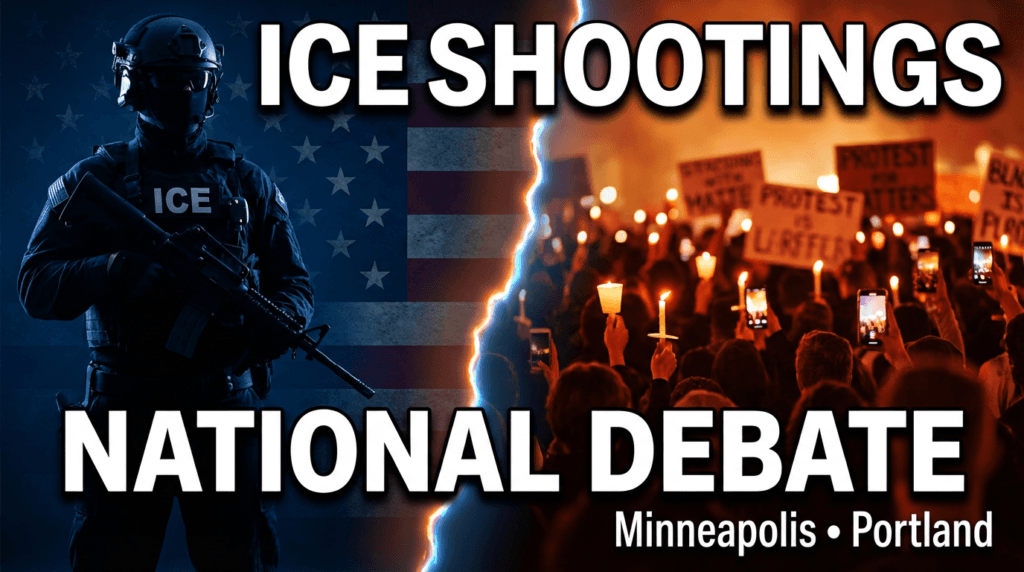
The fatal shooting of Renee Nicole Good by an ICE agent in Minneapolis and the wounding of two suspected Venezuelan gang members by Border Patrol in Portland have ignited a firestorm of controversy across America. More than 1,000 vigils and rallies planned nationwide this weekend demonstrate the raw emotions surrounding immigration enforcement—but beneath the protests lies a more complex reality that demands honest examination.
These incidents force Americans to confront uncomfortable questions: How do we balance compassionate immigration policies with the rule of law? When does legitimate law enforcement become excessive force? And most critically, who bears responsibility when enforcement operations turn deadly?
The answers require moving beyond reflexive partisan reactions toward a principled framework rooted in constitutional governance, public safety, and the foundational belief that laws apply equally to everyone—including those tasked with enforcing them.
Support Independent Local Journalism
TheTownHall.News is a non-profit reader-supported journalism. Just $5 helps us hire local reporters, investigate important issues, and hold public officials accountable across Alameda County. If you believe our community deserves strong, independent journalism, please consider donating $5 today to support our work.The Minneapolis Incident: Tragedy Demanding Transparency
Renee Nicole Good, a 37-year-old U.S. citizen and mother of three, was shot three times by ICE agent Jonathan Ross during an immigration enforcement operation in south Minneapolis on January 7. Video footage from multiple angles shows ICE officers aggressively approaching Good’s SUV, which appeared to be stopped in the street. An officer can be heard shouting profanities while attempting to forcibly open her vehicle door.
According to footage released by authorities, Good was shot as she attempted to drive away from the confrontation. The Department of Homeland Security claims the shooting was justified self-defense, with officials suggesting Good’s vehicle posed a threat to officers. However, video reconstruction by multiple news organizations indicates the vehicle was moving away from—not toward—the officer when shots were fired.
The conservative principle at stake here is straightforward: law enforcement officers deserve our support and the benefit of doubt when facing genuine threats, but they are not above the law. The same constitutional protections that shield citizens from government overreach must apply to federal agents’ use of deadly force.
Several concerning elements demand investigation. First, ICE deportation officers lack authority to conduct routine traffic stops or detain U.S. citizens absent specific immigration-related justifications. What legal basis existed for the initial confrontation? Second, DHS use-of-force policy explicitly prohibits shooting at drivers of moving vehicles except in cases of imminent death or serious injury—and specifically bars lethal force against fleeing suspects who pose no immediate threat.
Third, and perhaps most troubling, the FBI has limited cooperation with state investigators, potentially shielding the incident from impartial review. This contradicts conservative principles of accountability and limited government. Federal law enforcement should not operate as an untouchable class immune from the scrutiny we rightfully demand of local police.
The Portland Case: A Different Calculus
The Portland shooting presents markedly different circumstances. On January 8, Border Patrol agents attempted to arrest Luis David Nino-Moncada and Yorlenys Betzabeth Zambrano-Contreras, both Venezuelan nationals with alleged ties to Tren de Aragua—a transnational criminal organization involved in human trafficking, prostitution, and violent crime.
According to DHS, both individuals illegally entered the United States during the Biden administration and were released into American communities. Zambrano-Contreras allegedly participated in a Tren de Aragua prostitution ring and was connected to a prior Portland shooting. Nino-Moncada had been arrested for DUI and unauthorized vehicle use, with a final removal order outstanding.
During the attempted arrest, agents report the suspects weaponized their vehicle against officers, prompting defensive gunfire. Both sustained non-fatal injuries. Portland Police Chief subsequently confirmed the individuals have “some involvement” with Tren de Aragua.
This incident underscores the real-world consequences of failed border security and selective immigration enforcement. When federal authorities release illegal immigrants with criminal histories or gang affiliations into American communities, they create precisely the dangerous confrontations that endanger both law enforcement and civilians.
Support Independent Local Journalism
TheTownHall.News is a non-profit reader-supported journalism. Just $5 helps us hire local reporters, investigate important issues, and hold public officials accountable across Alameda County. If you believe our community deserves strong, independent journalism, please consider donating $5 today to support our work.The Portland shooting also highlights an often-ignored reality: ICE and Border Patrol agents face extraordinary dangers. According to DHS, officers are experiencing a 1,300% increase in assaults, a 3,200% increase in vehicular attacks, and an 8,000% increase in death threats under the current administration’s immigration crackdown.
Law and Order: Principles, Not Politics
Conservatives have long championed law enforcement, and rightly so. Police officers, border agents, and federal law enforcement personnel stand between ordered society and chaos. They deserve our respect, adequate resources, and legal protections when acting lawfully.
But supporting law enforcement does not mean granting blanket immunity from accountability. True law and order requires that laws bind everyone equally—including those who enforce them. When officers abuse their authority or use excessive force, conservatives should be the first to demand accountability, not the last to excuse it.
The Minneapolis incident appears to raise serious questions about whether proper protocols were followed. If ICE agents lacked legal justification for the initial stop, if they failed to employ de-escalation techniques, or if the shooting violated DHS use-of-force policy, consequences must follow. Otherwise, we abandon the constitutional principles that distinguish America from authoritarian regimes where state agents operate with impunity.
Conversely, the Portland incident demonstrates why robust immigration enforcement matters. Tren de Aragua has terrorized communities across the United States, engaging in sex trafficking, violent crime, and drug distribution. When the previous administration released suspected gang members into American cities—individuals with final removal orders—they prioritized ideology over public safety.
Border Patrol agents attempting to arrest dangerous criminals should receive full support. If suspects weaponize vehicles against officers, defensive force is not only justified but necessary.
The Protest Movement: Missing the Mark
The nationwide “ICE Out for Good” protests conflate these distinct incidents into a single narrative: that immigration enforcement itself constitutes violence requiring abolition. This perspective fundamentally misunderstands both the rule of law and the proper role of government.
Every sovereign nation has the right—indeed, the obligation—to control its borders and enforce immigration laws. The alternative is not compassion but chaos: communities overrun by criminal organizations, labor markets distorted by illegal competition, and public resources strained beyond capacity.
The protesters’ demands for abolishing ICE ignore that the agency serves essential functions: removing criminal aliens, combating human trafficking, and enforcing court-ordered deportations. The problem isn’t ICE’s existence but ensuring its agents operate within constitutional constraints and proper use-of-force guidelines.
Moreover, the protest narrative erases crucial distinctions. Renee Good was a U.S. citizen whose death raises serious accountability questions. The Portland suspects were illegal immigrants with alleged gang ties and criminal histories facing lawful arrest. Treating these situations identically serves political theater, not justice.
A Path Forward: Accountability and Enforcement
Conservatives can and should advocate for both robust immigration enforcement and genuine law enforcement accountability. These principles are complementary, not contradictory.
First, demand transparency. The FBI’s investigation into the Minneapolis shooting must be thorough and impartial, with findings made public. If Agent Ross violated DHS policy or acted without legal justification, he should face appropriate consequences—including criminal prosecution if warranted. Federal law enforcement officers cannot operate above the law.
Second, support proper immigration enforcement. Border Patrol agents arresting dangerous criminals like suspected Tren de Aragua members deserve full backing. Congress should provide ICE and Border Patrol with resources needed for safe, effective operations while maintaining clear use-of-force standards.
Third, reject false choices. America can maintain secure borders, enforce immigration laws, remove criminal aliens, and still hold law enforcement accountable when they exceed their authority. These goals are mutually reinforcing, not mutually exclusive.
Fourth, remember fiscal responsibility. Every illegal immigrant released into American communities imposes costs: law enforcement resources, emergency services, court proceedings, and incarceration when they commit crimes. Effective border security and prompt deportations reduce these expenditures while enhancing public safety.
Conclusion: Principles Over Partisanship
The Minneapolis and Portland shootings expose the consequences of years of failed immigration policy and inconsistent law enforcement standards. When borders remain porous, criminal organizations flourish. When federal agents lack clear guidelines and accountability, tragedies occur.
Conservatives must resist the temptation toward tribal loyalty that excuses all law enforcement actions while progressives reflexively condemn them. Instead, we should apply consistent principles: support lawful enforcement, demand accountability for misconduct, secure borders, and ensure laws apply equally to everyone.
Renee Good’s death deserves thorough investigation and, if warranted, prosecution. The Portland agents defending themselves against suspected gang members deserve our support. These positions are not contradictory—they reflect a coherent philosophy of limited government, constitutional rights, and the rule of law.
The choice before America isn’t between compassion and security, or between supporting police and demanding accountability. It’s between a nation governed by laws applied fairly and consistently, or one where political expedience determines which rules matter and who must follow them.
The conservative answer is clear: We stand for law and order—real law and order—where everyone, from illegal immigrants to federal agents, lives under the same constitutional framework. That’s not just good policy. It’s the American way.
Call to Action
The events unfolding this weekend will shape immigration and law enforcement policy for years to come. Don’t let the loudest voices monopolize the conversation.
Stay informed: Follow developments in both investigations through reliable sources. Demand transparency from federal authorities and local prosecutors.
Get involved: Contact your congressional representatives. Insist they support both effective immigration enforcement and accountability mechanisms for federal law enforcement.
Share this article: The mainstream media narrative ignores crucial distinctions between these incidents. Help spread fact-based analysis that applies consistent principles rather than partisan reflexes.
Support law enforcement: Let your local police, border agents, and ICE officers know you appreciate their service—while also making clear you expect them to uphold constitutional standards.
America’s future depends on citizens willing to think critically, apply principles consistently, and resist simplistic narratives that serve political agendas rather than truth. The Minneapolis and Portland shootings demand nothing less than our most careful, principled attention.
The rule of law isn’t a partisan issue. It’s the foundation of American liberty. Let’s defend it—for everyone.