Iran Oil Infrastructure Strikes Are Coming for Your Wallet — And Washington Needs to Own It
The Fire Is Burning — and So Is Your Budget
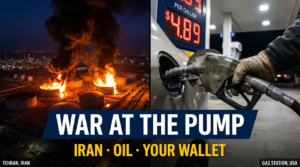
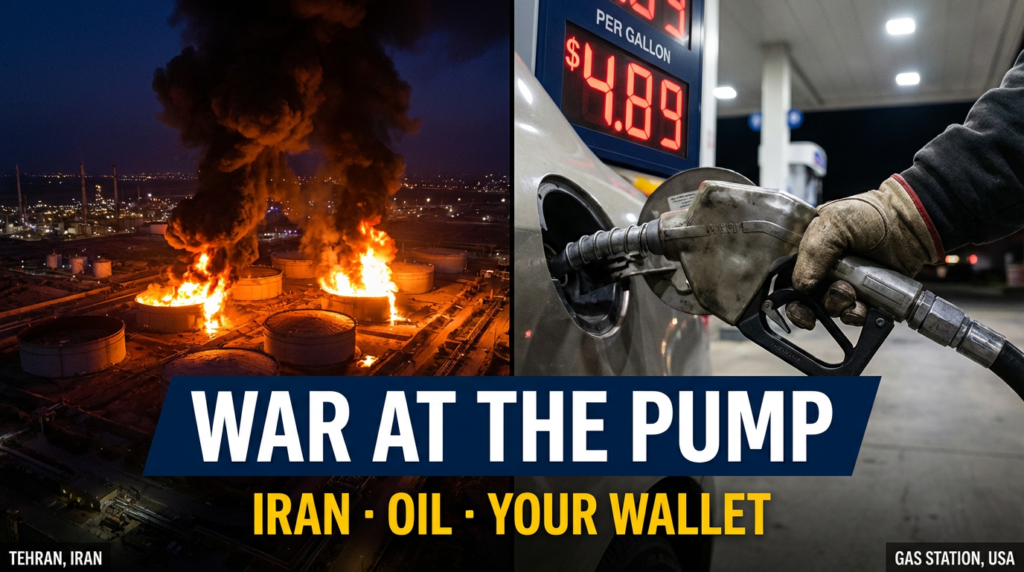
Massive fireballs lit up the Tehran skyline last Saturday night. Israeli jets had just struck several of Iran’s fuel storage terminals — towering depots that feed the Islamic Republic’s military machine. The footage was dramatic, even satisfying to some. But while the fires burned in Iran, something else began to ignite closer to home: the price of gasoline.
In the space of one week — from February 28 to March 7, 2026 — the average cost of a gallon of regular unleaded gasoline in the United States jumped 34 cents to $3.32, according to AAA. Oil is trading at nearly $93 a barrel. Qatar’s energy minister has warned the world could see $150-per-barrel crude “within days” if hostilities continue — more than double pre-war levels, and a figure that would put US pump prices squarely above $5 a gallon, matching the painful peak Americans endured after Russia’s invasion of Ukraine in 2022.
This is not fearmongering. This is arithmetic. And every American who fills a gas tank, books a flight, or puts groceries on the table deserves a clear-eyed accounting of what is happening — and who is responsible.
Support Independent Local Journalism
TheTownHall.News is reader-supported journalism. Just $5 helps us hire local reporters, investigate important issues, and hold public officials accountable across Alameda County. If you believe our community deserves strong, independent journalism, please consider donating $5 today to support our work.What Is Actually Being Struck — and Why It Matters
Operation Epic Fury, now in its eighth day, has seen the United States and Israel confirm strikes on more than 2,000 targets inside Iran. The campaign has escalated from military installations to economic infrastructure. Israel has struck fuel storage complexes in Tehran that Iran uses to power its military operations — a strategically logical step in the effort to degrade the regime’s war-fighting capability.
Iran has responded in kind. Iranian drones and missiles have targeted energy infrastructure across the Gulf — hitting facilities in Saudi Arabia, Qatar, and Bahrain. The crown jewel of this economic warfare, however, is the Strait of Hormuz.
The Strait — a narrow waterway along Iran’s southern coast — is the world’s single most critical oil chokepoint. It handles approximately 25% of the world’s maritime oil trade and 20% of global liquefied natural gas shipments, according to Axios. An IRGC commander has declared the strait effectively “closed,” warning that any vessel attempting passage would be set “ablaze.” Marine traffic data confirms it: tanker movements through the strait have ground to a halt.
The economic consequences extend far beyond gas. Some 33% of the world’s fertilizers — including sulfur and ammonia — move through the strait, per trade analysis firm Kpler. Economists warn that US farmers growing corn, soy, wheat, and cotton face sharply higher input costs. Nearly 30% of global ammonia production is either “involved or at risk” in this conflict, according to the Fertilizer Institute. If the strait remains closed for a month or more, analysts at investment firm Neuberger Berman warn that crude could surge “well into triple digits” and European natural gas prices could approach the crisis levels of 2022.
The cascading damage doesn’t stop at the pump or the farm. United Airlines CEO Scott Kirby has already warned that airfares are heading up. Shipping costs will rise — meaning the price of electronics, clothing, cookware, and medical equipment will too.
The Principle of Accountability: Who Pays, Who Decides?
Conservatives have long held a foundational belief: decisions have consequences, and those who make decisions must be accountable for their outcomes. That principle applies in the boardroom, the household, and — especially — in the halls of power.
President Trump launched Operation Epic Fury. He has pressed forward with it aggressively, demanding Iran’s “unconditional surrender” and warning of further strikes. He is acting from a position of strength, which many Americans respect. The Iranian regime is dangerous, destabilising, and long overdue for serious reckoning. Few serious people dispute that.
But fiscal accountability — a bedrock conservative value — demands honesty about costs. Every sustained one-cent increase in the price of a gallon of gasoline costs American consumers nearly $1.4 billion over the course of a year, according to Moody’s chief economist Mark Zandi. A 34-cent increase in one week, with more on the way, is not a rounding error. It is a transfer of wealth out of working Americans’ pockets.
“It’s particularly hard on lower-income households that spend a higher share of their budget on gas,” Zandi said. “That’s the group that’s already under a lot of financial pressure.”
This matters politically too. Republicans staked their 2026 midterm platform heavily on lowering the cost of living. That promise becomes significantly harder to keep when the national average gas price is approaching $5.
Energy Independence Was the Insurance Policy — Have We Cashed It In?
There is a silver lining that conservatives should understand and articulate clearly. The United States is now the world’s largest oil producer. That is not an accident — it is the direct result of policies that prioritised domestic energy development, reduced regulatory burdens, and trusted the market. The US is far less dependent on Middle Eastern oil than it was during the 1979 Iran crisis, which caused widespread fuel shortages and economic chaos across America.
This is not the 1970s. American energy independence has provided real insulation from geopolitical shocks — and that insulation is doing real work right now. The Trump administration’s moves to stabilise markets — offering political risk insurance for Gulf tankers, exploring military escorts through the Strait of Hormuz, and granting India a 30-day waiver on Russian oil restrictions — reflect an understanding that market confidence matters alongside military power.
But that insulation is being tested. Analysts at investment research firm Macquarie have warned plainly: “The timeline for an extremely large oil price move is very short. A few weeks of Hormuz closure will create a domino effect of events that could push crude to $150 or higher.”
The moral of the story is that energy independence must be relentlessly defended, expanded, and never taken for granted. Domestic production is national security. It is also economic security for every American who drives to work, heats their home, or runs a small business. Any future policy that restricts domestic energy development — whether in the name of climate ideology or regulatory overreach — should be viewed through this lens. The cost of dependence is now visible in real time.
A Clear-Eyed View of What Comes Next
The Iranian regime has shown itself willing to attack civilian energy infrastructure across the Gulf, threaten global shipping lanes, and proxy-launch drones as far as Cyprus and the UAE. The case for confronting Iran’s regional aggression is serious and legitimate. Americans support the defense of their country and their allies — but they also expect their leaders to be straight with them about the price.
Here is what fiscal conservatism and honest governance demand of this moment:
First, the administration must communicate clearly and regularly about the economic trajectory of this conflict. Americans can handle hard truths. What erodes trust is the sense that costs are being minimised or concealed.
Second, every policy lever that increases domestic energy production should be pulled — now. Expanded drilling approvals, pipeline permitting, LNG export authorisations. The current crisis is a live demonstration of why energy sovereignty matters.
Third, the exit strategy matters as much as the military strategy. “Unconditional surrender” may be the right goal, but the path to that goal must account for the economic clock ticking in living rooms and at gas stations across America. Markets are pricing in uncertainty — and the longer the uncertainty continues, the more ordinary Americans pay.
The Bottom Line
Holding Iran accountable is right. Targeting the infrastructure that powers a terrorist-sponsoring regime is a defensible military strategy. But conservative governance is not just about strength — it is about wisdom, accountability, and honesty with the people bearing the cost.
The fires in Tehran are real. So is the 34-cent jump at your local gas station. Both deserve to be talked about in the same breath.
America has the energy resources, the economic strength, and the military capability to navigate this moment — but only if its leaders are as transparent about the bill as they are bold about the mission.
Stay Informed. Stay Engaged.
The decisions being made in Washington this week will affect your gas bill, your grocery costs, and your country’s economic trajectory for months to come. Share this article with someone who needs the full picture. Follow The Town Hall News for continuing coverage of the Iran conflict, energy markets, and what it all means for your wallet. And make your voice heard — contact your representatives and demand both strength and accountability from the leaders who serve you.
Sources: AAA, CNBC, Washington Post, Axios, Bloomberg, Moody’s Analytics, Fertilizer Institute, Neuberger Berman, Macquarie, Argus Media.