Iran Strikes Dimona: The Nuclear Wake-Up Call the West Can No Longer Ignore
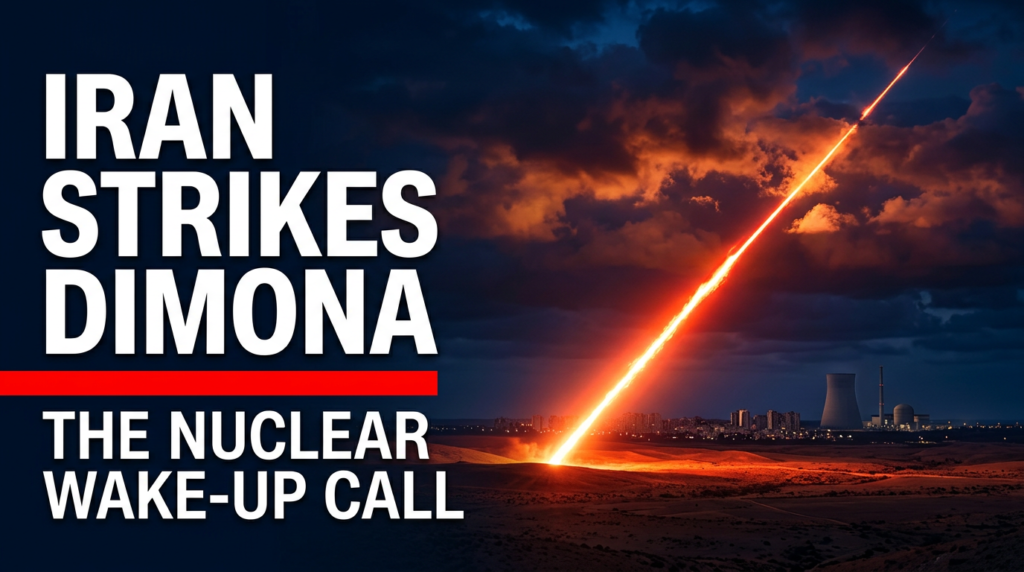
The missiles came without warning, and the air defenses failed.
On the evening of Saturday, March 22, 2026, two Iranian ballistic missiles punched through Israel’s vaunted multi-layered air defense umbrella and detonated in the residential neighborhoods of Dimona and Arad — two southern Israeli towns nestled in the Negev Desert, mere kilometers from the Shimon Peres Negev Nuclear Research Center, the most sensitive military installation in the Middle East. The result: nearly 200 civilians wounded, apartment buildings reduced to rubble, a 10-year-old girl pulled bleeding from the wreckage, and a 10-year-old boy listed in serious condition in a Dimona hospital.
No one died — but as Israeli Prime Minister Benjamin Netanyahu said bluntly the following morning, standing in the rubble of Arad: “That’s due to luck, not their intention. Their intention is to murder civilians.”
Support Independent Local Journalism
TheTownHall.News is a non-profit reader-supported journalism. Just $5 helps us hire local reporters, investigate important issues, and hold public officials accountable across Alameda County. If you believe our community deserves strong, independent journalism, please consider donating $5 today to support our work.This was not an accident. This was not a miscalculation. This was Iran, with deliberate intent, targeting the heart of Israeli civilization — and the world must respond accordingly.
The Strike That Changed Everything
The attack on Dimona and Arad represents a dangerous and unmistakable escalation — the first time since the current war began on February 28, 2026, that Iran has directly targeted areas adjacent to Israel’s nuclear research complex. Iranian state media stated plainly that the strikes were aimed at the nuclear facility, framed as retaliation for an earlier strike on Iran’s Natanz uranium enrichment site.
The facts are stark. Iran has fired over 400 missiles at Israel since February 28. Israel’s military says 92% were intercepted. But 8% were not — and on Saturday night, two of those failures struck in the worst possible place. “In both Dimona and Arad, interceptors were launched that failed to hit the threats, resulting in two direct hits by ballistic missiles with warheads weighing hundreds of kilograms,” Israeli firefighters confirmed.
The International Atomic Energy Agency (IAEA) confirmed no damage to the nuclear research center itself and no abnormal radiation levels — but the margin was terrifyingly thin. The research center sits just 10 kilometers from downtown Dimona. Had either missile veered slightly off course — or had Iran deployed a larger payload — the outcome could have been catastrophic not just for Israel, but for the entire region.

This is the reality that appeasement, strategic ambiguity, and hollow diplomatic frameworks have produced.
A Failure of Deterrence — and of Political Will
The American taxpayer has invested billions in Israel’s layered missile defense systems: Iron Dome, David’s Sling, Arrow, and most recently the US-made Terminal High Altitude Area Defense (THAAD) system. The THAAD system, designed specifically to intercept ballistic missiles at high altitude, faced pointed questions after Saturday’s failures.
The Israeli Air Force attempted to frame the interception failures as coincidental and non-systemic. But this explanation strains credulity when two missiles, fired hours apart at the same region, both breached the same defense architecture. Iran’s Parliament Speaker Mohammad Bagher Ghalibaf seemed to recognize the significance immediately: “If the Israeli regime is unable to intercept missiles in the heavily protected Dimona area, it is, operationally, a sign of entering a new phase of the battle.”
Conservatives have long held that peace through strength is not a bumper sticker — it is the only foreign policy doctrine that actually works. When adversaries like Iran detect genuine weakness, whether in air defenses, diplomatic resolve, or strategic clarity, they exploit it without hesitation. The question every American taxpayer and policymaker must now confront is this: have decades of half-measures, nuclear deal negotiations, sanctions waivers, and diplomatic hedging emboldened Tehran to the point where it now openly targets nuclear sites and civilian populations with ballistic missiles?
The answer, written in the rubble of Dimona, appears to be yes.
Support Independent Local Journalism
TheTownHall.News is a non-profit reader-supported journalism. Just $5 helps us hire local reporters, investigate important issues, and hold public officials accountable across Alameda County. If you believe our community deserves strong, independent journalism, please consider donating $5 today to support our work.Iran’s Long War Against Civilization
This is not a spontaneous act of desperation from a cornered regime. Iran’s Islamic Revolutionary Guard Corps has spent decades — and billions of dollars — building a missile arsenal explicitly designed to threaten Israel, US military assets in the Gulf, and Western interests across the Middle East. Tehran funds, arms, and directs Hezbollah, Hamas, the Houthis, and Shia militias across Iraq and Syria. The missiles that struck Dimona were not manufactured last week. They were built patiently, over years, while Western governments debated, negotiated, and equivocated.
The Natanz nuclear facility had already been struck during the June 2025 war and again by US forces. Yet Iran pressed forward. The IAEA estimates that the bulk of Iran’s stockpile of near-weapons-grade enriched uranium remains buried underground at its Isfahan facility. The Trump administration has been actively developing options to secure or extract those materials before they can be weaponized. The clock is ticking.
Conservatism has always held that the primary obligation of government — its most irreducible duty — is the protection of its citizens and its allies from physical harm. This is not an ideological preference. It is the foundational contract of ordered liberty. When governments fail this obligation through naivety, negligence, or political cowardice, ordinary people — children in Dimona, families in Arad — pay the price with their safety, their homes, and sometimes their lives.
The Stakes: Order vs. Chaos on a Nuclear Precipice
The men and women of Dimona went to sleep on Saturday night believing their proximity to a heavily guarded nuclear site made them safer. “We thought we were safe,” said Galit Amir, a 50-year-old resident. “Dimona is the most safe place in Israel.” By Sunday morning, her neighborhood was a field of shattered concrete and broken glass. A kindergarten near the impact zone was devastated.
This is what deterrence collapse looks like — not in a grand cinematic moment, but in apartment buildings with their outer walls sheared away, in a 10-year-old boy’s hospital chart, in a paramedic trying to coax a blood-soaked child into an ambulance while her parents were still being pulled from the rubble.
America’s conservative tradition has always understood that strength, clarity, and resolve — not diplomatic ambiguity and endless negotiation — are what preserve civilization from those who seek to destroy it. Ronald Reagan did not negotiate with the Soviet Union from weakness. He rebuilt American military power, named the enemy for what it was, and stood firm. The result was the peaceful dismantling of the most dangerous empire of the 20th century. That same clarity of purpose is required now.
What Must Be Done
The United States and its allies cannot afford to treat Iran’s nuclear ambitions as a perpetual diplomatic project. Several things are now clear and non-negotiable:
Accountability must be total. The Trump administration’s work to neutralize Iran’s nuclear program must be prosecuted with resolve and without apology. The goal must be the permanent, verifiable elimination of Iran’s capacity to develop nuclear weapons.
Air defense investment must be accelerated. Saturday’s failures are a warning that the current architecture is insufficient. American defense cooperation with Israel must be intensified, and both nations must demand answers — and results — from systems that failed.
The international community must be honest. The IAEA must have full and unconditional access to Iran’s remaining nuclear sites. Iran’s threats to close the Strait of Hormuz — a critical artery of global trade — must be met with an unambiguous declaration that such an act is an act of war.
Allies must step up. Netanyahu’s call for world leaders to join the effort against Iran is not warmongering. It is a recognition that civilized nations share a common stake in preventing a nuclear-armed theocracy from reshaping the Middle East through force and terror.
A Wake-Up Call We Cannot Snooze
The rubble in Dimona is not just an Israeli problem. It is a warning to every democracy that believes it can manage rather than confront evil. History is relentless in its lesson: regimes that openly declare their intent to destroy their neighbors — and then systematically build the weapons to do it — must be taken at their word.
The families of Dimona and Arad did not choose to live on the front line of a civilizational conflict. They simply wanted to live their lives, raise their children, and trust that the wall of deterrence would hold. On Saturday night, it didn’t.
Luck is not a strategy. Deterrence must be rebuilt — with strength, clarity, and the unwavering conviction that civilization is worth defending.
📢 Call to Action: Don’t let this story fade from the headlines. Share this article, subscribe to The Town Hall News for daily fact-based conservative commentary, and contact your representatives to demand a clear, decisive US policy on Iran’s nuclear program. The time for half-measures is over.