Iran Strikes Kuwait Airport: Why America Cannot Afford to Back Down Now
A Fire Over Kuwait — and a Message to the Free World
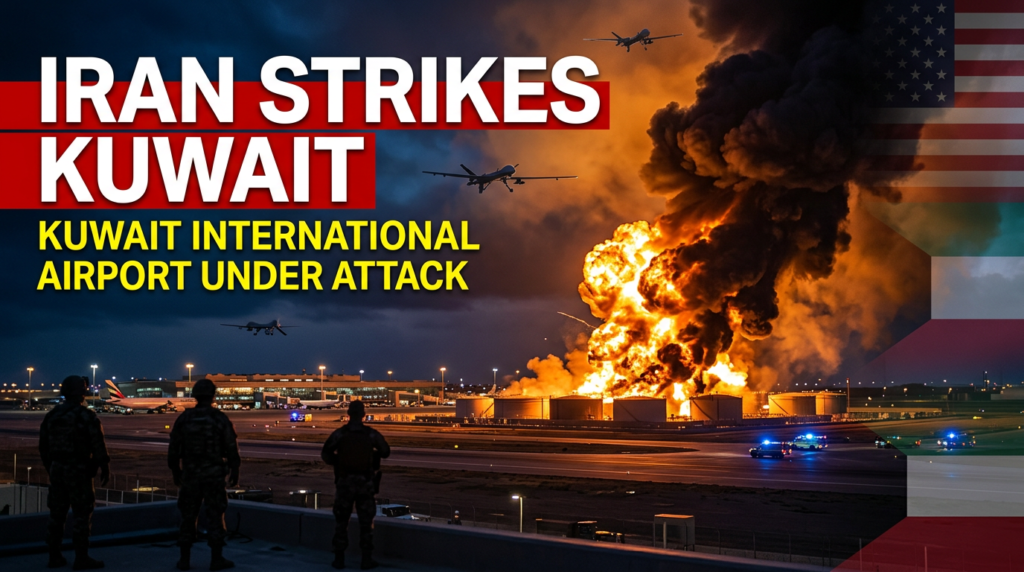
On March 25, 2026, a drone launched by Iran’s Islamic Revolutionary Guard Corps pierced Kuwait’s air defenses and slammed into a fuel tank at Kuwait International Airport. The explosion sent thick black smoke billowing into the sky — visible for miles. Kuwaiti authorities intercepted multiple other drones, but one got through. One was enough to send the message Iran intended: no one in the Gulf is safe.
This was not an isolated act. It was the latest strike in a systematic, weeks-long Iranian campaign of terror targeting one of America’s closest allies in the Middle East. Since February 28, 2026 — the day the United States and Israel launched Operation Epic Fury — Iran has retaliated with a relentless barrage of missiles and drones aimed at Kuwaiti airports, military bases, oil refineries, ports, and civilian infrastructure. The toll is real: seven American soldiers killed, dozens wounded, four Kuwaiti servicemen dead, 32 civilians injured, and critical energy infrastructure repeatedly targeted.
Make no mistake — this is not just a regional conflict. It is a direct challenge to American strength, Gulf stability, and the international rules-based order that keeps energy markets, global commerce, and allied nations functioning. The question before the American people and their elected leaders is not whether to be involved. We already are. The question is whether we will finish what we started — or flinch at the decisive moment.
Support Independent Local Journalism
TheTownHall.News is a non-profit reader-supported journalism. Just $5 helps us hire local reporters, investigate important issues, and hold public officials accountable across Alameda County. If you believe our community deserves strong, independent journalism, please consider donating $5 today to support our work.The Stakes: Why Kuwait Matters to Every American
Some will ask why a drone strike in the Gulf should concern an American in Iowa or Georgia. The answer is simple: energy, security, and credibility.
Kuwait sits astride the Persian Gulf, one of the most strategically vital waterways on earth. Roughly 20% of the world’s oil supply flows through the Strait of Hormuz — just south of Kuwait’s coastline. Iran has already struck the Mina al-Ahmadi refinery — Kuwait’s largest — twice in recent weeks. It has targeted Kuwaiti ports. It has fired on the airport that serves as a commercial and logistics hub for the entire region.
When Iranian drones hit Gulf energy infrastructure, oil prices spike. When oil prices spike, American families pay more at the pump, more to heat their homes, and more for every product that moves by truck or plane. The economic security of ordinary Americans is directly tied to stability in the Persian Gulf. Fiscal responsibility begins with energy security — and energy security requires deterrence.
Beyond economics, the United States has approximately 13,000 service members stationed in Kuwait. These are sons, daughters, fathers, and mothers who volunteered to serve and protect American interests abroad. Six of them were killed on March 1 when an Iranian missile struck a U.S. operations center at Port Shuaiba. They deserve a government that has their backs — with a clear strategy, robust rules of engagement, and the unwavering resolve to protect them.

Operation Epic Fury: The Right Call, Needing the Right Follow-Through
On February 28, 2026, President Donald Trump authorized Operation Epic Fury alongside Israeli Prime Minister Benjamin Netanyahu. The stated U.S. objectives were unambiguous: eliminate Iran’s ballistic missile capacity, destroy its drone production infrastructure, neutralize its naval threat in the Gulf, and dismantle the terror proxy networks Iran has funded for decades — from Hezbollah to the Houthis.
These are not hawkish ambitions for their own sake. They are long-overdue responses to decades of Iranian aggression that previous administrations — of both parties — failed to confront decisively. Iran assassinated a U.S. general on Iraqi soil in 2020. It funded militias that killed hundreds of American soldiers in Iraq. It supplied drones to Russia used against Ukrainian civilians. And for years, it inched steadily toward a nuclear weapon while the international community argued about the wording of diplomatic letters.
Two-thirds of Iran’s missile and drone production capacity has now been damaged or destroyed, according to available intelligence assessments. Iran’s Supreme Leader Ali Khamenei is dead. The regime is operating under a transitional council. For the first time in nearly half a century, the Islamic Republic is on the back foot.
This is not the moment to retreat. This is the moment to hold the line.
Iran’s Defiance: What Rejection of the Ceasefire Tells Us
On March 25, 2026 — the same day drones struck Kuwait’s airport — Iran publicly dismissed a U.S.-proposed ceasefire plan. Foreign Minister Abbas Araghchi stated bluntly that Iran has not engaged in any talks and “does not plan on any negotiations.” Iran issued its own five-point counter-demand, including a claim of sovereignty over the Strait of Hormuz — an international waterway through which the entire world’s energy supply flows.
Support Independent Local Journalism
TheTownHall.News is a non-profit reader-supported journalism. Just $5 helps us hire local reporters, investigate important issues, and hold public officials accountable across Alameda County. If you believe our community deserves strong, independent journalism, please consider donating $5 today to support our work.Read that again: Iran is demanding sovereignty over one of the world’s most critical shipping lanes as a condition for peace. This is not the posture of a government seeking an honorable exit. This is a regime that continues to launch drones at civilian airports while publicly refusing diplomacy and issuing maximalist demands.
The UAE’s Ambassador to Washington, Yousef Al Otaiba, spoke plainly: “A simple ceasefire isn’t enough. We need a conclusive outcome.” Gulf states — Saudi Arabia, the UAE, Bahrain, Qatar, Kuwait, and Jordan — have lived under the shadow of Iranian aggression for 47 years. They are not asking America to fight their battles. They are asking America not to leave before the job is done.
Conservatives understand this instinctively. Peace through strength is not a slogan — it is a doctrine proven by history. Ronald Reagan did not negotiate with terrorists from a position of weakness. He rebuilt American military power until adversaries had no choice but to take the United States seriously. That tradition demands we not reward Iran’s intransigence with a premature withdrawal.
Congress Must Step Up: Accountability, Transparency, and Resolve
The conduct of this conflict also raises urgent questions about constitutional order and congressional responsibility — questions conservatives should care deeply about.
The Congressional Research Service, in its March 2026 report, outlined key oversight obligations facing the 119th Congress: examining U.S. objectives, assessing munitions and readiness, reviewing war powers compliance, and planning for the post-conflict regional order. Lawmakers in both chambers have introduced resolutions invoking the War Powers Resolution — some attempting to constrain the President, others reinforcing executive authority.
Here is where conservative principle must guide the debate: Congress must neither micromanage military operations in real-time — which endangers troops and emboldens adversaries — nor abdicate its constitutional responsibility to oversee how taxpayer dollars are spent and what America’s long-term strategy actually is. Fiscal accountability means knowing the cost. Strategic accountability means having a plan.
The administration should welcome this scrutiny — not resist it. Transparency to the American people, through their elected representatives, is not weakness. It is the foundation of legitimate, durable military and foreign policy. Americans have the right to know what we are fighting for, how we plan to win, and how we will know when we have.
The Principle at Stake: Law, Order, and the Defense of Allies
Conservatives believe in law and order — not just within our borders, but as a principle that should govern the conduct of nations. International airports are civilian infrastructure protected under the laws of war. Iran is deliberately targeting them. Civilian ports, oil refineries, and power grids — all struck in Kuwait — are protected under the same rules Iran has systematically violated.
When rogue regimes face no consequences for targeting civilian infrastructure, they do it again. And again. And eventually, the targets are not in Kuwait — they are closer to home.
The United States built a post-World War II order on the principle that aggression does not pay, that borders matter, and that allies can rely on American commitments. That order has frayed under decades of half-measures and strategic ambiguity. Operation Epic Fury, whatever its imperfections, represents a long-overdue reassertion of that principle. Walking away from it now — under pressure, mid-campaign, as Iran simultaneously strikes airports and rejects diplomacy — would send a message to every adversary from Beijing to Moscow: America will not finish what it starts.
That is a message we cannot afford to send.
Conclusion: Resolve Is the Only Language Iran Understands
The fire at Kuwait International Airport was not an accident of war. It was a deliberate signal — Iran’s attempt to demonstrate that American power has limits and that no U.S. ally in the Gulf is truly safe. It is also a test of American resolve at one of the most consequential moments in a generation of Middle East policy.
The answer to that test must be clear, principled, and firm. Protect our troops. Support our allies. Hold Iran accountable. Demand transparency from our own government. And resist the siren call of a hasty ceasefire that leaves the region less stable, Iran’s capabilities partially intact, and American credibility permanently damaged.
History does not reward nations that flinch at the decisive moment. The American people — and the free world — are watching.
📢 Call to Action
Stay informed. Get involved. Make your voice heard.
The decisions being made in Washington right now will shape the Middle East — and America’s place in the world — for decades to come. Share this article with fellow citizens who believe in American strength, responsible governance, and the rule of law. Contact your congressional representative and demand accountability, transparency, and a clear strategy. Subscribe to The Town Hall News for fact-based, principled coverage that cuts through the noise.
Because an informed citizenry is the strongest defense a free nation has.
Sources: Reuters (March 25, 2026) · Congressional Research Service IN12662 (March 1, 2026) · United Against Nuclear Iran (March 2026) · Wikipedia – 2026 Iranian Strikes on Kuwait · U.S. CENTCOM · Human Rights Watch (March 17, 2026) · Gulf News · Sky News