Iran’s Cluster Bomb Campaign Against Israel Is a War Crime the World Can No Longer Ignore
Bomblets Over Tel Aviv
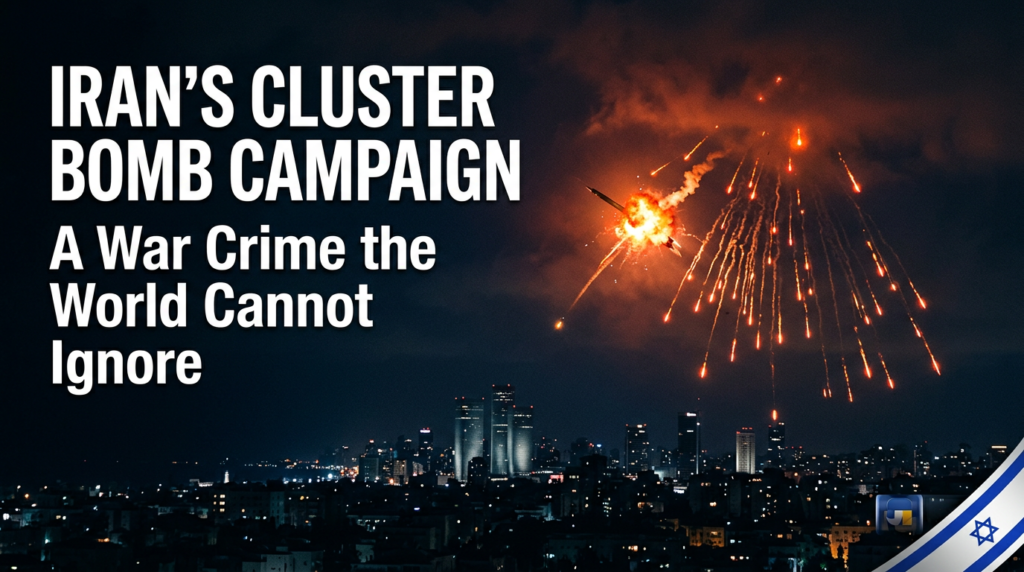
On the night of March 17–18, 2026, a ballistic missile launched from Iran broke through Israel’s formidable air defense network and detonated over Tel Aviv. What fell from the sky was not a single warhead — it was dozens of small, spinning bomblets, scattering across rooftops, roads, and residential courtyards. A couple in their seventies were killed in their apartment by a single submunition no larger than a soda can. Tel Aviv’s main train station was damaged. Children’s playgrounds, basketball courts, and commercial centers across central Israel have been struck.
This is not a random byproduct of warfare. This is deliberate. Iran’s Islamic Revolutionary Guard Corps has been firing ballistic missiles fitted with cluster munition warheads at Israeli civilians nearly every single day since the conflict began on February 28, 2026. The Israeli Defense Forces confirm that approximately 50 percent of all Iranian missiles fired at Israel in this conflict have been cluster warheads — weapons specifically designed to scatter explosive submunitions across the widest possible area.
The question before civilized nations is not complicated: when a regime systematically and knowingly targets civilian populations with internationally condemned weapons, what does the free world do?
Support Independent Local Journalism
TheTownHall.News is a non-profit reader-supported journalism. Just $5 helps us hire local reporters, investigate important issues, and hold public officials accountable across Alameda County. If you believe our community deserves strong, independent journalism, please consider donating $5 today to support our work.What Are Cluster Munitions — and Why Are They Different?
Understanding the gravity of what Iran is deploying requires understanding what cluster munitions actually are.
A cluster warhead is a parent munition that, rather than detonating on impact, opens in mid-air — typically between 7 and 10 kilometers above the ground — and releases dozens of smaller bomblets across a radius that can span several miles. Iran’s variant, fitted to its Khorramshahr and Zolfaghar ballistic missiles, is reported to carry between 24 and 80 submunitions, each carrying up to 5 kilograms of explosives.
The danger is compounded by physics. Once submunitions are released, no defense system on earth — not Iron Dome, not Arrow-3 — can intercept dozens of individual bomblets simultaneously scattered across that kind of area. Arrow-3 must destroy the parent missile above the atmosphere before it releases its payload. If it misses, the bomblets fall freely.
Then there is the secondary horror: unexploded ordnance. Cluster submunitions have a notoriously high failure-to-detonate rate. Bomblets that don’t explode on impact sit dormant — on roadsides, in backyards, under bushes — waiting for a child to pick one up, sometimes years later. Israel’s Home Front Command has already issued public advisories warning civilians not to approach unidentified objects on the ground.

N.R. Jenzen-Jones, director of Armament Research Services and one of the world’s leading munitions analysts, described Iran’s warhead design as indicative of a “weapon of terror” — built not for precision, but for maximum indiscriminate dispersal. This is not a weapon aimed at military infrastructure. It is a weapon aimed at people.
A Regime With a Clear Strategy: Maximize Civilian Casualties
The Iranian regime’s intent is not ambiguous. As its ballistic missile launcher fleet has been progressively degraded by U.S. and Israeli military campaigns, Iran has pivoted to cluster munitions as a force multiplier — getting more casualties per missile. The Foundation for Defense of Democracies put it plainly in its March 2026 analysis: the broad dispersal radius of these weapons makes them “impractical for targeting specific or hardened military objectives, but highly effective at inflicting damage on large populations.”
Strike by strike, the pattern is unmistakable. A February 28 submunition hit a basketball court in central Israel. Days later, bomblets struck a children’s playground in Rishon LeZion. In the first week of March alone, cluster munitions caused damage to cars, commercial centers, and residential buildings across metropolitan Tel Aviv. By March 9, multiple people had been killed and many more injured across at least six separate impact sites — from a single missile.
IDF spokesman Lieutenant Colonel Nadav Shoshani has called Iran’s use of these weapons a “war crime.” Amnesty International — hardly a body known for its pro-Israel leanings — declared as early as July 2025 that Iran’s “deliberate use of such inherently indiscriminate weapons is a blatant violation of international humanitarian law.”
The evidence is overwhelming. The intent is deliberate. The victims are civilians.
Support Independent Local Journalism
TheTownHall.News is a non-profit reader-supported journalism. Just $5 helps us hire local reporters, investigate important issues, and hold public officials accountable across Alameda County. If you believe our community deserves strong, independent journalism, please consider donating $5 today to support our work.International Law and the Responsibility to Be Clear
Over 120 nations have signed the 2008 Convention on Cluster Munitions, a global treaty banning the development, production, stockpiling, and use of these weapons. Iran has not signed it. Neither has Israel, the United States, Russia, or China. That legal gap, however, does not create a moral vacuum — and it does not override the Geneva Conventions.
Under international humanitarian law, the use of inherently indiscriminate weapons against civilian populations is prohibited regardless of treaty status. The core principle is distinction — the obligation of any party to a conflict to distinguish between civilian and military targets. Cluster munitions, by design, cannot make that distinction. Their deployment against densely populated urban centers is not a gray area. It is a violation.
And yet the international response has been measured to the point of incoherence. The same global institutions that moved swiftly to condemn weapons use in other theaters have been conspicuously slow to speak with unified moral clarity about what Iran is doing to Israeli cities. This selective outrage is not justice — it is politics. And it has consequences: when the world’s response to banned weapons being fired at civilians is procedural hand-wringing, regimes learn that the cost of escalation is manageable.
The Cost of Inaction: A Broader Threat
The Iran-Israel conflict that began on February 28, 2026 is not a regional skirmish — it is a confrontation with global implications. NATO has already withdrawn troops from Iraq to Europe due to spillover effects. Oil markets have been rocked by Iranian strikes on Israel’s Haifa refinery. Qatar’s energy minister has warned of consequences to Gulf natural gas supplies. The Strait of Hormuz — through which roughly 20 percent of the world’s oil passes — remains under threat.
Beyond the energy economics lies a strategic reality that conservatives have long understood: weakness invites aggression. The Iranian regime does not respond to diplomatic entreaties or carefully worded UN resolutions. It responds to deterrence, to strength, and to the credible threat of consequences. When the West hesitates and equivocates, Iran interprets that as permission to push further.
Prime Minister Netanyahu stated plainly on March 19, 2026, that despite significant military progress in 20 days of war, “there has to be a ground component” — affirming what military history teaches again and again: air campaigns alone rarely deliver durable outcomes against determined adversaries. The free world must be prepared to support Israel not just rhetorically, but with material aid, intelligence sharing, and unified diplomatic resolve.
What Ordinary Iranians Know That Their Rulers Ignore
It would be incomplete — and unfair — to conflate the Iranian regime with the Iranian people. While the IRGC fires cluster bombs at apartment buildings in Tel Aviv, millions of ordinary Iranians have spent years risking imprisonment and death to protest a regime that denies them basic freedoms. The Iran Human Rights Activist News Agency (HRANA) estimates that more than 3,000 people have been killed inside Iran since the start of this conflict — victims of their own government’s strategic choices.
The regime’s rulers have made their priorities transparent: pour national resources into ballistic missiles and proxy warfare while their citizens suffer poverty, repression, and violence. Supporting Israel’s right to self-defense is not anti-Iranian. It is, in fact, consistent with the aspirations of millions of Iranians who have marched and died for the very freedoms their rulers deny them.
The Conservative Principle at Stake: Evil Must Be Named and Confronted
At its core, this is a question of moral clarity — one of the founding commitments of conservative thought. Edmund Burke’s warning, that evil triumphs when good men do nothing, has never been more applicable. A regime that deliberately arms its missiles to kill civilians — not soldiers, not military targets, but grandparents in apartments and children near playgrounds — must be called what it is: barbaric, criminal, and contemptible.
This is also a question of law and order on the world stage. The same principles that conservatives apply domestically — that rules must mean something, that accountability is not optional, that those who break the law must face consequences — apply internationally. A world in which cluster munitions can be rained on civilian populations without serious consequence is not a safer world. It is an invitation to more of the same.
Israel is not asking the world to fight its battles. It is asking the world to be honest about what is happening. That is not too much to ask.
Conclusion: Stand Firm, Stay Clear
Iran’s cluster munition campaign against Israeli civilians is documented, deliberate, and deadly. It has killed civilians in their homes, scattered explosive traps in playgrounds, and challenged the most advanced defense systems ever built. It violates international humanitarian law and represents one of the most cynical military strategies deployed in modern warfare.
The free world has a choice: respond with clarity, resolve, and unified purpose — or allow ambiguity and inaction to serve as quiet permission. History does not remember kindly those who chose silence in the face of atrocity.
Israel stands. The question is whether its allies will stand with it — not just in words, but in will.
📢 Call to Action
Stay informed. Make your voice heard. Share this article.
The mainstream conversation around this conflict too often buries the most important facts — banned weapons, deliberate civilian targeting, a regime that glorifies violence. You can change that by sharing this piece with your network, writing to your elected representatives, and demanding that your government take a clear, public stance against Iran’s use of cluster munitions.
The price of silence is always paid by the innocent. Don’t let the world look away.
Sources: Reuters · AP News · CNN · Foundation for Defense of Democracies · New York Times · Jerusalem Post · Amnesty International · IDF Spokesperson Statements · HRANA · Al Jazeera · Euronews