Iran’s War on Dubai: Why the Drone Attacks on the World’s Safest City Demand Western Resolve — Not Retreat
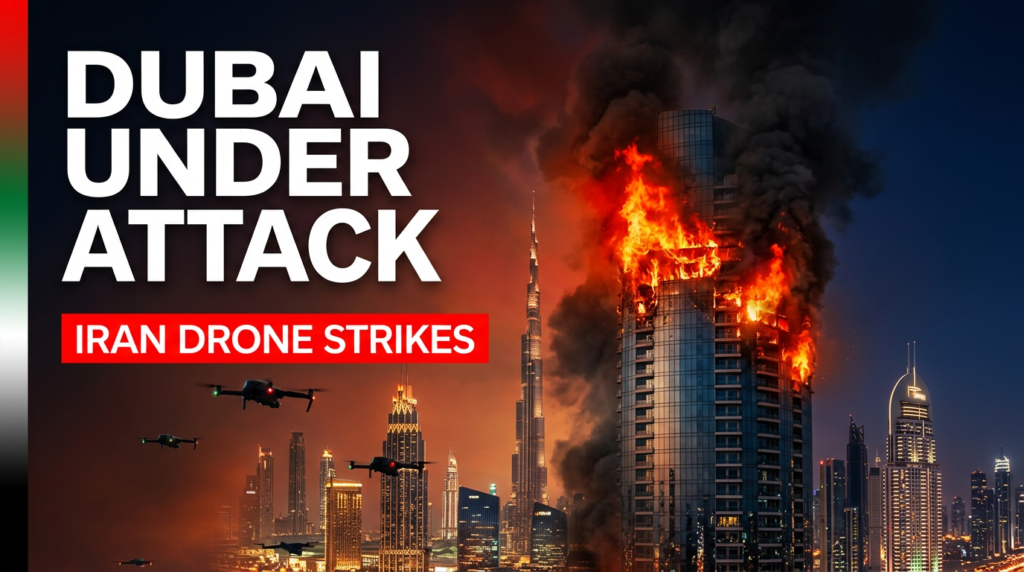
The skyline is burning. The Strait of Hormuz is closed. Oil is past $100 a barrel. And Washington is already hearing calls to stop fighting. Don’t be fooled — this is exactly the moment to hold the line.
A Luxury Tower in Flames — and a Warning to the World
For decades, Dubai has been the world’s ultimate symbol of what ambition, order, and economic freedom can build. Gleaming skyscrapers rising from the desert. A city where the rule of law attracts talent and capital from every corner of the globe. A beacon of stability in one of the most turbulent regions on Earth.
On the night of March 11, 2026, that skyline caught fire.
Support Independent Local Journalism
TheTownHall.News is a non-profit reader-supported journalism. Just $5 helps us hire local reporters, investigate important issues, and hold public officials accountable across Alameda County. If you believe our community deserves strong, independent journalism, please consider donating $5 today to support our work.An Iranian drone struck the Address Creek Harbour 2 Tower — a luxury residential high-rise in the heart of Dubai Creek Harbour — sparking flames visible from miles away and triggering a full evacuation. It was not an isolated incident. It was the latest chapter in a 14-day campaign of relentless Iranian aggression that has now struck Dubai International Airport, Palm Jumeirah, an AWS data center, the U.S. Consulate, Jebel Ali Port, and critical oil infrastructure across the UAE and wider Gulf region.
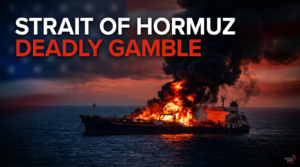
Since February 28, 2026, Iran has launched 285 ballistic missiles, 15 cruise missiles, and over 1,567 drone attacks against the UAE alone, according to the UAE Ministry of Defense. Six people have been killed and 141 injured on UAE soil. The Strait of Hormuz — through which 20 percent of the world’s traded oil passes — is effectively closed. Oil prices have surged past $100 per barrel.
This is not a localized conflict. This is a direct assault on the global order — and on the values of law, security, and economic freedom that underpin it.
What Actually Triggered This War
Context matters, and responsible analysis demands honesty about it. The current conflict was ignited when the United States and Israel launched coordinated military strikes against Iran’s nuclear and missile infrastructure — strikes that reportedly killed Iranian Supreme Leader Ayatollah Ali Khamenei. Iran’s retaliation has been swift, broad, and deliberately aimed at civilian and economic targets across the Gulf.
Iran’s newly installed Supreme Leader, Mojtaba Khamenei, has issued an unambiguous ultimatum: attacks on U.S. military assets and infrastructure will continue unless all American military bases in the region are closed. He has also vowed to keep the Strait of Hormuz sealed and has threatened to “set the region’s oil and gas on fire” if Iran’s own energy infrastructure is further targeted.
This is not the language of a government seeking negotiation. It is the posture of a regime that respects one thing above all else: strength.
The Cost of Weakness: A Lesson Decades in the Making
Conservatives have long argued that appeasement doesn’t end aggression — it invites more of it. The history of Iran’s behavior toward the West bears this out with painful precision.
For years, Iran was offered diplomatic off-ramps, financial incentives, and international legitimacy. Sanctions were eased. Billions of dollars in frozen assets were released. Each time, the regime used those resources not to improve the lives of its people, but to fund proxy warfare, ballistic missile development, and terrorism. The nuclear deal did not stop Iran’s ambitions — it subsidized them.
What changed the calculus was not diplomacy. It was deterrence — credible, applied force backed by a resolute U.S. administration willing to say that civilizational threats will be met with civilizational resolve.
Support Independent Local Journalism
TheTownHall.News is a non-profit reader-supported journalism. Just $5 helps us hire local reporters, investigate important issues, and hold public officials accountable across Alameda County. If you believe our community deserves strong, independent journalism, please consider donating $5 today to support our work.Today, President Trump has stated plainly: “We’re going to be hitting them very hard.” U.S. Senator Lindsey Graham has confirmed the conflict could continue for some time, but made clear that no ground troops in Iran are contemplated. Australia has deployed surveillance aircraft. France has scrambled Rafale jets to protect its bases. The United Kingdom is flying defensive air sorties over UAE territory.
This is what real alliances look like. This is what law, order, and collective defense demand.
Why Dubai Matters — and Why You Should Care
Some may ask: why should Americans or Europeans care about a burning tower in Dubai?
The answer is simple: because what happens in Dubai doesn’t stay in Dubai.
The UAE is home to over 200,000 American citizens and nearly one million expatriates from Western nations. It hosts major U.S. military installations, including Al Dhafra Air Base — a critical hub for operations across the Middle East. Dubai International Airport is one of the busiest in the world; it has now been struck, briefly closed, and forced to redirect passengers to bomb shelters multiple times in two weeks.
More fundamentally, the Strait of Hormuz closure is already being felt at the gas pump, in shipping costs, and in financial markets worldwide. A prolonged disruption to Gulf energy flows would accelerate inflation, constrain global growth, and punish the working families conservatives rightly champion.
This is fiscal reality. This is national security. This is personal responsibility at the macro scale — because a world where Iran can blockade one-fifth of the global oil supply without consequence is a world where no free economy is truly secure.
The $11.3 Billion Question: Accountability and Resolve
Critics on the left — and some libertarians on the right — have raised legitimate questions about cost. The Trump administration has estimated the war’s first six days cost $11.3 billion. More than 250 organizations have signed letters demanding Congress defund the operation, arguing that money is needed domestically.
These are not frivolous concerns. Fiscal accountability is a conservative cornerstone. Every dollar spent abroad is a dollar that must be justified to the American taxpayer. Congress has both the right and the obligation to scrutinize war spending.
But here is the counterargument that must be made clearly: the cost of inaction is always higher than the cost of action — when the threat is real.
The cost of allowing a nuclear-capable Iran to operate freely, to close international waterways, to bomb allied cities with drone swarms, and to threaten regime-friendly nuclear proliferation across the Middle East? That cost would dwarf $11.3 billion. It would be measured not just in dollars, but in the lives of American service members, the security of American allies, and the credibility of American power for generations.
Fiscal responsibility does not mean refusing to fund national defense. It means ensuring that every dollar spent serves a clear strategic objective — and defeating Iran’s capacity to threaten the civilized world is precisely such an objective.
The Civilian Cost — and Iran’s Accountability
It would be morally incomplete to write this article without acknowledging the human toll on Iranian civilians. Iran’s UN ambassador reports at least 1,348 civilians killed in U.S.-Israeli strikes. Children have died. Families have been torn apart.
These deaths are tragic. Every civilian casualty is a moral weight that must be carried.
But accountability requires honesty: these civilians are being killed because the Iranian regime chose to build nuclear weapons and ballistic missiles in populated areas, to use civilian infrastructure as shields, and to launch a war that has now killed innocents across six nations. The responsibility for those deaths lies, in the first instance, with a regime that has held its own people hostage for decades — executing dissidents, suppressing women, funding terrorism, and now dragging the region into open war.
The answer is not Western retreat. The answer is the defeat of the regime’s military capacity and, ultimately, the conditions for the Iranian people themselves — many of whom have taken to the streets repeatedly — to reclaim their own country. Israeli Prime Minister Netanyahu has said explicitly that the goal is to create conditions for regime change from within. That is a legitimate and historically grounded objective.
A Call to Clarity — and Action
The burning towers of Dubai are a vivid image. But they are also a reminder of something deeper: that the order, security, and prosperity the free world has built are not self-sustaining. They require defense. They require resolve. They require leaders willing to act — and citizens willing to hold those leaders accountable for acting wisely.
This is the conservative case, plainly stated: strength deters aggression, weakness invites it. Free economies require secure trade routes. Alliances must be honored. And when a regime that executes its citizens, funds global terrorism, and pursues nuclear weapons attacks your allies’ cities with drone swarms — you do not negotiate. You respond.
Stay informed. The mainstream media narrative will shift daily — some days amplifying the costs of conflict, others the costs of inaction. Read widely, read critically, and follow primary sources from the UAE Ministry of Defense, U.S. Central Command, and credible outlets covering the full picture.
Get involved. Contact your Congressional representatives and demand clear war authorization, transparent cost accounting, and a coherent strategic end goal. Support is not a blank check — it is an informed, principled commitment.
Share this article. The people in your community deserve to understand what is actually at stake — not just a burning tower in a distant city, but the future of the international order that keeps every free nation safe and prosperous.
The fire in Dubai is a warning. Whether it becomes a turning point — or a surrender — depends on us.
All facts in this article are sourced from the UAE Ministry of Defense, AP News, Al Jazeera, Gulf News, BNO News, and the Institute for the Study of War (ISW), as of March 13, 2026.