Israel’s Lebanon Strikes Shatter Iran Ceasefire: What Washington Isn’t Telling You
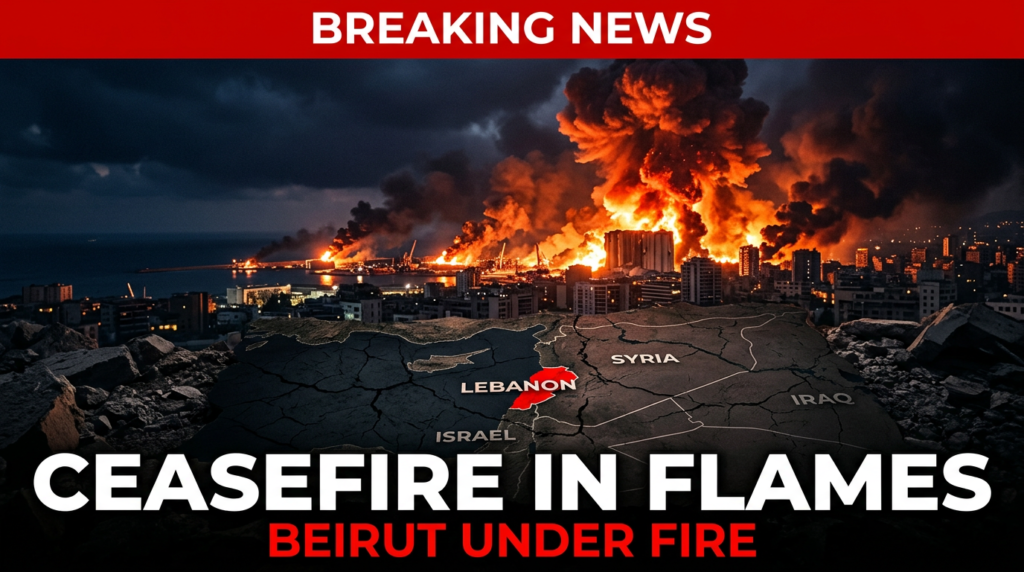
As Israel bombs Beirut and Iran threatens to shut down the Strait of Hormuz, a fragile U.S.-brokered truce is unraveling in real time — and the American public deserves a straight account of what’s at stake.
The bombs fell without warning.
On April 8, 2026, Israel launched what military analysts are calling its largest single coordinated assault of the Lebanon war — striking more than 100 targets in under ten minutes. The blasts ripped through central Beirut’s Corniche al Mazraa district, a densely populated commercial and residential corridor. At least 182 people were killed and 890 wounded in a single day. The five-week running toll now stands at 1,739 dead and 5,873 wounded, according to figures reported by the Associated Press.
Support Independent Local Journalism
TheTownHall.News is a non-profit reader-supported journalism. Just $5 helps us hire local reporters, investigate important issues, and hold public officials accountable across Alameda County. If you believe our community deserves strong, independent journalism, please consider donating $5 today to support our work.This is not a distant geopolitical abstraction. It is a rapidly escalating crisis with direct consequences for American foreign policy, global energy markets, and the credibility of every diplomatic commitment the United States makes. And at its center is a critical question that Washington has yet to answer honestly: did the Trump administration broker a ceasefire deal that Israel had no intention of honoring?
A Ceasefire Built on Sand
The ink was barely dry on the U.S.-Iran tentative two-week ceasefire agreement when the strikes began. The Trump administration announced the truce as a diplomatic win — a pause in direct hostilities between Washington-aligned forces and Tehran, brokered in part by Pakistan. Global markets responded immediately: stocks rallied, oil slid toward $90 a barrel, and headlines declared a moment of cautious relief.
Then Israel moved.
According to reporting from The Guardian, Israel was informed of the ceasefire deal only at the last minute — and officials were reportedly “not happy.” Within hours, the strikes on Beirut commenced. The central dispute now fracturing the agreement is stark: Iran and Pakistan insist the ceasefire explicitly covers Lebanon and Hezbollah. The United States and Israel insist it does not.

President Trump has publicly sided with Israel, contradicting mediator Pakistan’s framing of the deal — a contradiction that analysts at both the Soufan Center and Chatham House have characterized as a deliberate attempt to exploit a diplomatic window. In plain terms: Israel may have used the ceasefire announcement as cover to accelerate operations before any binding constraints took hold.
That is not a conspiracy theory. That is what the timeline shows.
Why This Moment Demands Fiscal and Strategic Accountability
Americans who believe in government accountability — who are tired of blank checks sent overseas without clear objectives — have every right to demand answers here.
The United States has expended enormous diplomatic capital, military resources, and taxpayer-funded foreign aid navigating the volatile Middle East for decades. Each new escalation carries a price tag. The Strait of Hormuz closure, announced by Iran in response to the Beirut strikes, is not a symbolic gesture. Approximately 20% of the world’s oil supply transits that waterway. Any sustained closure drives up energy prices globally — and American families and small businesses feel that directly at the pump and in supply chains.
When foreign policy commitments are made without clarity and then immediately undermined, the cost is borne not by the diplomats who made them — but by ordinary citizens.
Support Independent Local Journalism
TheTownHall.News is a non-profit reader-supported journalism. Just $5 helps us hire local reporters, investigate important issues, and hold public officials accountable across Alameda County. If you believe our community deserves strong, independent journalism, please consider donating $5 today to support our work.This is precisely why transparent, accountable governance in foreign affairs matters. It is not isolationism to demand a clear explanation of what the U.S. committed to, who knew what and when, and what the exit strategy looks like. It is civic responsibility.
Iran’s Response: Threats, Pressure, and a Fragile Red Line
Iran is not staying quiet. President Masoud Pezeshkian called the Beirut strikes a “blatant violation” that renders negotiations “meaningless.” Iran’s Islamic Revolutionary Guard Corps (IRGC) has issued what it described as a “regret-inducing” warning — vowing decisive retaliation if Israeli attacks on Lebanon do not stop immediately.
Iran’s parliament speaker, Mohammad Bagher Qalibaf, escalated further on Thursday, warning of “explicit costs and strong responses” if the assault continues. Iran has already moved to restrict oil tanker movement through the Strait of Hormuz — a pressure tactic that stops short of full closure but signals Tehran’s willingness to use energy leverage.
Meanwhile, Hezbollah — which had publicly committed to ceasefire adherence prior to the Israeli strikes — resumed rocket fire into northern Israel, calling it a direct response to what it termed ceasefire violations by Israel.
The situation on the ground is a feedback loop of escalation, and the window for de-escalation is narrowing fast.
The Human Reality Behind the Headlines
It is essential not to reduce this crisis to geopolitical chess.
The strikes on Beirut’s Corniche al Mazraa were not surgical. They hit a district where civilians live, shop, and work. Lebanon’s President Joseph Aoun called the bombardment “barbaric.” The country’s Social Affairs Minister indicated the government is ready for negotiations — a signal of political exhaustion from a nation still rebuilding from years of compounding crises.
Among the confirmed military targets: Ali Yusuf Harshi, described as a senior aide and relative of Hezbollah Secretary-General Naim Qassem. Israeli Defense Minister Katz warned publicly that Qassem himself is next. Whether these are proportionate military operations or collective punishment is a question that serious journalists, legal scholars, and policymakers must ask openly — and freely. Suppressing that debate does not serve truth or stability.
The families living under those strikes deserve to be counted. So do the families in northern Israel absorbing Hezbollah rockets. The honest position is holding both truths at once.
What Critics Get Wrong About “Staying Out of It”
Some voices on both the left and the libertarian right argue the United States should simply disengage — that this is not America’s fight. That position deserves a fair hearing, but it also needs a reality check.
The U.S. is already inside this conflict by virtue of the ceasefire it brokered. Disengagement now does not mean neutrality — it means abandoning an agreement the U.S. helped design, signaling to both allies and adversaries that American commitments are conditional and time-limited. That is not restraint. That is a credibility collapse with long-term strategic consequences.
The responsible position is not endless military entanglement — it is holding all parties, including close allies, accountable to the terms that American diplomats negotiated and American taxpayers funded. Personal responsibility applies to nation-states too.
Key Takeaway
The U.S.-Iran ceasefire is not dead yet — but it is on life support. Israel’s Lebanon strikes, the Hormuz closure, and the open contradiction between American and Pakistani accounts of what the ceasefire actually covers have created a three-way crisis of credibility. How the Trump administration responds in the coming 48 to 72 hours will determine whether this moment becomes a turning point toward diplomacy or a descent into a broader regional war.
“When governments make commitments in the name of peace and then look away as those commitments are broken, the people who pay the price are never the people who made the deal.”
Conclusion: Accountability Cannot Wait
This is the kind of story that gets buried under partisan noise. It should not be. Regardless of where you stand on U.S. foreign policy, on Israel, on Iran, or on the proper use of American military and diplomatic power — the core obligation is the same: demand clarity, demand accountability, and refuse to accept a version of events designed to manage your reaction rather than inform your judgment.
The Beirut strikes are not background noise. The Strait of Hormuz is not a technicality. The ceasefire contradiction is not a diplomatic footnote. These are live wires. And the American public — the people ultimately footing the bill for foreign policy decisions made in their name — deserve straight answers.
Stay Informed. Stay Engaged.
This story is developing by the hour. Share this article to ensure your network has the full picture — not just the version the headlines are giving them. Subscribe to The Town Hall for independent, fact-based reporting that holds power accountable. Civic life depends on an informed public, and an informed public starts with you.