New Laws 2026: How States Are Balancing Public Safety with Individual Liberty
A Mixed Bag for Constitutional Conservatives
As Americans rang in 2026, hundreds of new state laws took effect across the nation—some representing genuine conservative victories in public safety and law and order, others raising serious concerns about government overreach into personal freedoms. From Tennessee’s groundbreaking domestic violence offender registry to Virginia’s controversial social media restrictions on minors, the new legislative landscape reveals an ongoing tension between protecting citizens and preserving individual liberty.
The most notable changes include Florida’s animal cruelty database under “Dexter’s Law,” Tennessee’s first-in-the-nation domestic violence offender registry, Virginia’s unprecedented one-hour daily social media limits for children, and Texas’s new artificial intelligence regulations. While some laws strengthen law enforcement tools and protect vulnerable populations, others represent the kind of government expansion that should concern anyone who values limited government and personal responsibility.
This isn’t a simple story of conservative versus liberal policies. It’s a complex picture of states responding to real problems—sometimes with measured, effective solutions that respect constitutional principles, and sometimes with heavy-handed interventions that substitute government mandates for parental authority and individual choice.
Support Independent Local Journalism
TheTownHall.News is a non-profit reader-supported journalism. Just $5 helps us hire local reporters, investigate important issues, and hold public officials accountable across Alameda County. If you believe our community deserves strong, independent journalism, please consider donating $5 today to support our work.Let’s examine what’s working, what’s concerning, and what these laws reveal about the state of American federalism in 2026.
The Conservative Wins: Law and Order Policies That Work
Tennessee’s Domestic Violence Offender Registry
Tennessee deserves recognition for implementing the nation’s first public domestic violence offender registry. Beginning January 1, 2026, repeat domestic violence offenders convicted on or after this date will have their names, photos, dates of birth, conviction dates, and counties of conviction publicly accessible.
This represents sound conservative policy for several reasons. First, it enhances public safety without creating new crimes or expanding police powers—it simply makes existing conviction information more accessible. Second, it empowers individuals and families to make informed decisions about their safety. Third, it applies only to repeat offenders, recognizing that patterns of violent behavior deserve heightened scrutiny.
Critics might argue this creates a scarlet letter effect, but conservatives understand that consequences for criminal behavior aren’t punishment—they’re accountability. If you’ve been convicted multiple times of domestic violence, the public has a legitimate interest in that information. This isn’t about rehabilitation versus punishment; it’s about protecting potential future victims.
The registry respects federalism by allowing Tennessee to address a serious problem with a state-level solution tailored to local needs. It doesn’t require federal mandates or funding. It’s exactly the kind of innovative policy that states should be testing in our constitutional laboratory of democracy.
Florida’s Animal Cruelty Database
Florida’s implementation of an animal cruelty database under “Dexter’s Law” similarly represents effective conservative governance. The publicly searchable database tracks individuals convicted of aggravated animal cruelty, allowing pet sellers, rescue organizations, and residents to verify whether potential adopters have abuse convictions.
Animal cruelty isn’t just about protecting animals—research consistently shows strong correlations between animal abuse and violence against humans, particularly domestic violence and child abuse. The FBI recognizes animal cruelty as a predictor of violent criminal behavior. By tracking these offenders, Florida enables private organizations and individuals to make informed decisions without expanding government power.
Notably, several other states including Delaware and Tennessee already maintain similar registries, demonstrating that this isn’t radical policy—it’s proven, effective, and respectful of both public safety and private decision-making. The database doesn’t prohibit anyone from owning animals; it simply provides information that empowers citizens to protect themselves and their communities.
Indiana’s Charity Gaming Restrictions
Indiana’s new law limiting charity bingo and casino nights to three times weekly might seem minor, but it addresses a real problem: charitable organizations morphing into de facto casinos. After the state gaming commission accused an Elks lodge of racketeering and seized over $100,000, lawmakers recognized that charitable gambling had strayed from its original purpose.
Support Independent Local Journalism
TheTownHall.News is a non-profit reader-supported journalism. Just $5 helps us hire local reporters, investigate important issues, and hold public officials accountable across Alameda County. If you believe our community deserves strong, independent journalism, please consider donating $5 today to support our work.This represents conservative governance at its best—targeted regulation addressing specific abuse without banning the underlying activity. Churches, veterans’ organizations, and legitimate charities can still host fundraising events. But organizations that essentially operate as unlicensed casinos under the guise of charity face appropriate restrictions.
Conservatives understand that limited government doesn’t mean no government. It means government action proportionate to legitimate problems, respecting the principle that freedom requires responsibility.
The Troubling Trends: When Good Intentions Meet Government Overreach
Virginia’s Social Media Time Limits
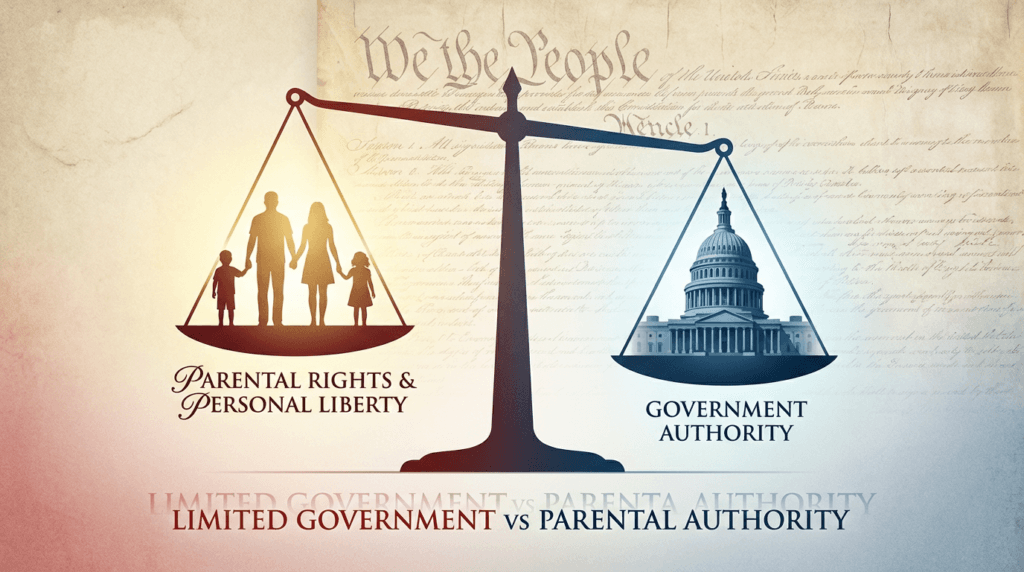
Virginia’s law limiting children under 16 to one hour daily on each social media platform—unless parents grant additional access—represents the kind of government overreach that should concern every conservative, regardless of their views on social media’s impact on children.
Make no mistake: social media poses real challenges for young people. Studies document mental health impacts, addiction patterns, and developmental concerns. But the solution isn’t government mandates that usurp parental authority—it’s empowering parents to make decisions for their own families.
This law places enforcement responsibility on social media companies, essentially deputizing private corporations to police family decisions. It assumes that bureaucrats in Richmond know better than parents how much screen time is appropriate for every child in every circumstance. It’s the nanny state in digital form.
Conservative principles demand that we trust parents—not government—to raise their children. If parents determine that their teenager needs two hours on Instagram to maintain social connections, or that their child with special needs benefits from extended YouTube educational content, that’s their decision to make. Government has no business micromanaging family screen time policies.
The law is also practically unenforceable and will likely drive tech-savvy teenagers to VPNs, foreign platforms, and workarounds—teaching them to evade rules rather than developing genuine self-discipline.
Texas’s Age Verification Requirements
Texas’s requirement that users verify their age before downloading mobile apps, with minors under 18 needing parental permission, raises similar concerns. While protecting children from inappropriate content is a legitimate goal, this law creates a massive data collection apparatus that threatens privacy for all users.
Age verification systems require providing sensitive personal information—driver’s licenses, credit cards, biometric data—to third parties. This creates honeypots of personal data vulnerable to breaches, government surveillance, and commercial exploitation. The conservative position should prioritize privacy and limited government over expansive verification schemes.
Moreover, this approach treats symptoms rather than causes. Instead of building government infrastructure to monitor app downloads, we should be strengthening families, teaching digital literacy, and empowering parents with better tools to monitor their own children’s device usage.
California’s Enhanced Plastic Bag Ban
California’s expansion of its plastic bag ban—now prohibiting even the thicker reusable plastic bags allowed since 2014—exemplifies how environmental regulation often fails to achieve stated goals while restricting consumer choice.
The original 2014 ban allowed thicker plastic bags on the theory that consumers would reuse them. When that didn’t happen as predicted, rather than questioning whether bans work, California doubled down with more restrictions. This is classic progressive policy: when government intervention fails, the solution is always more government intervention.
Research on plastic bag bans shows mixed results at best. Consumers often switch to paper bags with higher carbon footprints, or buy plastic trash bags separately—negating environmental benefits. Meanwhile, businesses face compliance costs, and consumers lose convenient options.
Conservatives should support genuine environmental stewardship, but through market incentives and technological innovation—not top-down bans that restrict freedom while delivering questionable benefits.
The Federalism Factor: States as Laboratories
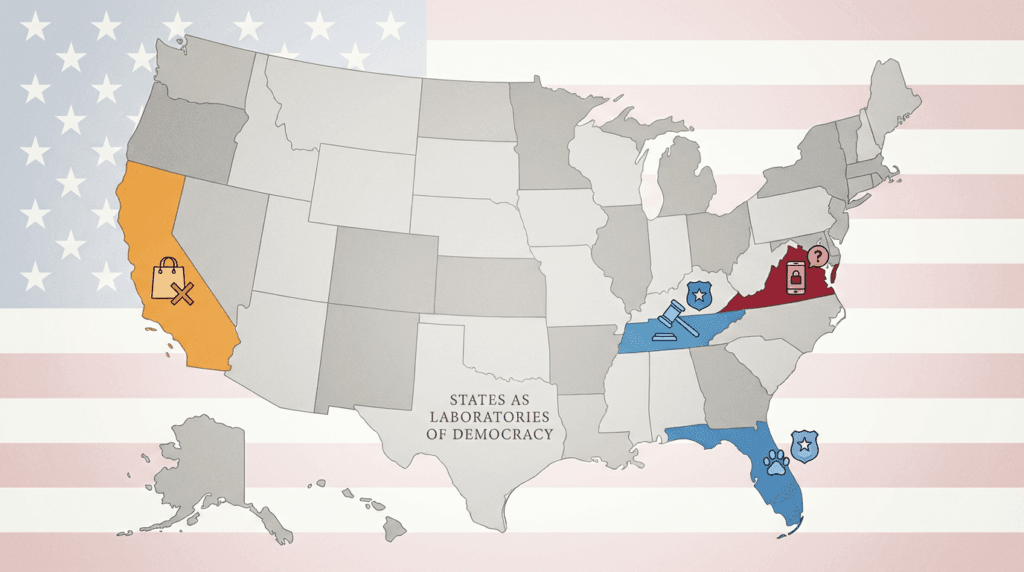
One genuinely positive aspect of these diverse new laws is what they reveal about American federalism. Tennessee can try a domestic violence registry while other states watch the results. Virginia can experiment with social media limits while parents in Texas maintain different approaches. Florida can track animal abusers while other states assess effectiveness.
This is how the Constitution intended our system to work. States serve as laboratories of democracy, testing different solutions to common problems. Successful policies spread; failures get abandoned. Citizens can “vote with their feet” by moving to states whose policies align with their values.
The alternative—uniform federal mandates—eliminates this experimentation and learning. When Washington imposes one-size-fits-all solutions, bad policies affect everyone, and we lose the ability to compare different approaches.
Conservatives should celebrate this diversity even when we disagree with specific state choices. The answer to Virginia’s social media overreach isn’t federal legislation—it’s allowing other states to demonstrate better approaches that respect parental authority.
What’s Missing: Policies Conservatives Should Demand
While analyzing what states enacted, it’s worth noting what’s largely absent from the 2026 legislative agenda:
Election Integrity Measures – Despite ongoing concerns about election security, few states implemented meaningful reforms to voter ID requirements, ballot harvesting restrictions, or voter roll maintenance.
Parental Rights Protections – Beyond Virginia’s misguided social media law, most states failed to advance genuine parental rights legislation addressing school curriculum transparency, parental consent for medical procedures, or protection from ideological indoctrination.
Tax Relief – With inflation still impacting family budgets, most states missed opportunities for meaningful tax cuts that would let families keep more of their hard-earned money.
School Choice Expansion – Few states advanced education savings accounts or expanded school choice options that would empower parents to select the best educational environment for their children.
These omissions reveal that even in conservative states, legislatures often focus on reactive policies addressing immediate problems rather than proactive reforms advancing core conservative principles.
The Path Forward: Principles Over Politics
As we evaluate these new laws, conservatives should apply consistent principles rather than reflexively supporting or opposing based on partisan labels:
Does it enhance public safety without unnecessarily restricting liberty? Tennessee’s domestic violence registry and Florida’s animal cruelty database pass this test. Virginia’s social media limits fail it.
Does it respect parental authority and family autonomy? Most of these laws ignore this principle entirely, substituting government mandates for family decisions.
Is it the least restrictive means of addressing a legitimate problem? Indiana’s charity gaming restrictions meet this standard. California’s plastic bag ban doesn’t.
Does it respect federalism and state sovereignty? All these laws, by virtue of being state rather than federal, respect federalism—even when we disagree with specific provisions.
Does it promote personal responsibility rather than government dependency? The registries empower citizens to make informed decisions. The bans and mandates substitute government judgment for individual choice.
Conclusion: Vigilance in Victory and Defeat
The new laws taking effect in 2026 present a mixed picture for conservatives. We should celebrate genuine victories in public safety and law enforcement while remaining vigilant against government overreach—even when it comes wrapped in concern for children’s welfare or environmental protection.
Tennessee’s domestic violence registry and Florida’s animal cruelty database demonstrate that effective law enforcement tools can enhance public safety while respecting constitutional principles. These innovations deserve support and replication in other states.
But Virginia’s social media restrictions and similar nanny-state interventions remind us that threats to liberty don’t always come from the left. Sometimes well-meaning conservatives embrace government solutions that undermine the very principles we claim to defend—parental authority, personal responsibility, and limited government.
The challenge for the conservative movement is maintaining intellectual consistency. We can’t champion limited government and parental rights when it suits our policy preferences, then abandon those principles when we’re worried about social media or other modern challenges.
As these laws take effect, conservatives should watch the results carefully, support what works, criticize what doesn’t, and always—always—prioritize constitutional principles over political expediency.
Call to Action: Your Role in State Governance
Know Your State’s Laws – Don’t rely on national media to tell you what’s happening in your state. Follow your state legislature, read proposed bills, and understand how new laws affect your family and community.
Contact Your State Legislators – State representatives are far more accessible than federal officials. Call, email, or visit your state senator and representative. Tell them which principles matter to you and hold them accountable for their votes.
Engage Locally – State laws matter, but local implementation matters more. Attend school board meetings, city council sessions, and county commissioner hearings. This is where policy becomes reality.
Support Conservative State Organizations – Groups like the Goldwater Institute, Americans for Prosperity state chapters, and state-level policy institutes do the hard work of drafting model legislation and holding officials accountable.
Vote in State Elections – Midterm and off-year state elections have abysmal turnout, yet they determine who writes these laws. Make state elections a priority, not an afterthought.
Share This Analysis – The mainstream media won’t provide conservative perspective on state legislation. Share this article with friends, family, and social networks so more Americans understand what’s really at stake in state policy debates.
The fight for conservative principles doesn’t happen primarily in Washington—it happens in state capitals across America. Your engagement matters more than you think.