No Free Pass for Fraud: Why the Deporting Fraudsters Act Is a Victory for American Taxpayers
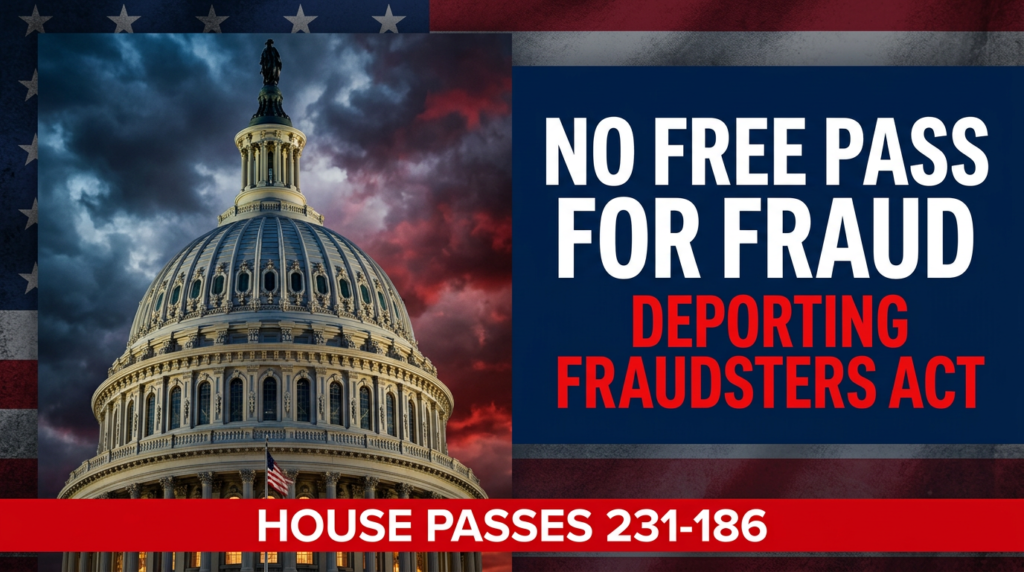
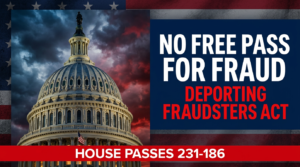
There is a principle that most Americans across the political spectrum once agreed on: if you come to this country, you play by the rules. You do not game the system. You do not steal from your neighbors. And if you do, there are consequences. On Wednesday, March 18, 2026, the U.S. House of Representatives took a firm stand for that principle — passing H.R. 1958, the Deporting Fraudsters Act of 2026, by a vote of 231 to 186. Not a single Democrat crossed the aisle to vote yes.
The message from House Republicans was clear: the American safety net exists to serve those who need it most — not to be exploited by people who have entered the country illegally and have no legal right to its benefits in the first place. This is not a radical idea. It is a foundational one.
What the Bill Actually Does
The Deporting Fraudsters Act, introduced by Representative Dave Taylor (R-Ohio), amends the Immigration and Nationality Act to make public benefits fraud an explicit, codified ground for deportation and permanent inadmissibility. Under the bill, any non-citizen — documented or undocumented — who is convicted of, or admits to, defrauding federal, state, or local benefit programs would be deportable and barred from re-entry.
Support Independent Local Journalism
TheTownHall.News is a non-profit reader-supported journalism. Just $5 helps us hire local reporters, investigate important issues, and hold public officials accountable across Alameda County. If you believe our community deserves strong, independent journalism, please consider donating $5 today to support our work.Offenses covered under H.R. 1958 include:
- Social Security fraud
- SNAP (food assistance) fraud
- Mail fraud
- Conspiracy to defraud the United States
- Theft or bribery involving federal funds
- Identification document fraud
- Any similar crime involving government funds or public benefits
The bill also strips eligibility for virtually all forms of immigration relief for those found guilty of benefit fraud — closing the door on appeals, asylum claims, and other legal mechanisms that have historically allowed bad actors to delay or avoid removal.
The Scale of the Problem This Bill Addresses
Critics of this legislation rushed to label it “redundant.” But redundant legislation does not inspire near-unanimous opposition from an entire political party. The word “redundant” is a convenient shield for those who prefer the status quo — a status quo that has cost American taxpayers enormously.
Consider the numbers:

- 61% — the rate of welfare program use among illegal immigrant households, according to the Center for Immigration Studies’ 2024 report.
- $956 — the estimated net annual cost to every U.S. taxpayer attributed to illegal immigration.
- ~1 million — the number of illegal aliens estimated to hold fraudulent or stolen Social Security Numbers, according to the Federation for American Immigration Reform and cited in a White House fact sheet on Social Security enforcement (April 2025).
These numbers represent real money leaving the wallets of working Americans — teachers, tradespeople, farmers, and small business owners who pay taxes faithfully and receive no such safety net themselves if they fall on hard times. The argument that existing law already handles this issue is undercut by those same statistics. Clearly, it does not.
A House Oversight Committee probe into welfare fraud in Minnesota’s social services programs — including alleged large-scale daycare fraud — further illustrates how vulnerable these systems are to exploitation. When fraud thrives at scale, it does not just drain public coffers. It redirects resources away from the most vulnerable Americans these programs were built to protect: the elderly, the disabled, and those temporarily in genuine need.
Personal Responsibility and the Integrity of the Safety Net
At its core, the Deporting Fraudsters Act is a bill about consequences — the same concept of personal responsibility that built this country. Conservatives have long argued that a functioning society depends on the rule of law being applied equally and without exception. If a citizen commits benefit fraud, they face criminal prosecution. If a non-citizen does the same, it is entirely reasonable — indeed, it is logical — that their immigration status also be reconsidered.
“If an illegal alien defrauds the United States or steals benefits from our nation’s most vulnerable, they should be permanently removed from our country. Ohioans work too hard to have their tax dollars stolen by people who shouldn’t be here in the first place.” — Rep. Dave Taylor (R-Ohio), Sponsor of H.R. 1958
This is not cruelty. This is clarity. Privilege of residency — and certainly the privilege of public benefits — must come with a basic obligation: honesty. The notion that breaking that obligation should carry no meaningful consequence is not compassion. It is the dismantling of accountability.
The Democrat Opposition: What It Reveals
The Democratic response to this bill deserves careful scrutiny. Their primary arguments fell into two buckets: procedural (“this is redundant”) and humanitarian (“it could harm vulnerable families”). Both arguments are worth examining honestly.
Support Independent Local Journalism
TheTownHall.News is a non-profit reader-supported journalism. Just $5 helps us hire local reporters, investigate important issues, and hold public officials accountable across Alameda County. If you believe our community deserves strong, independent journalism, please consider donating $5 today to support our work.On the “redundant” claim: Representative Jamie Raskin (D-MD) argued that fraud is already a deportable offense under existing immigration law. The Congressional Budget Office’s own analysis partially supports this framing — noting that under current law, crimes involving fraud can be considered crimes of moral turpitude, making a non-citizen potentially deportable. However, the CBO also confirmed that only some fraud cases rise to that threshold under current interpretations — leaving meaningful gaps that this bill explicitly closes. Calling a bill “redundant” because it clarifies and strengthens existing law is not an argument against the bill. It is an argument for the status quo in the face of documented failures.
On the humanitarian concern: Democrats worried that the bill could cause legal immigrants and mixed-status families to avoid seeking emergency aid out of fear. This argument conflates entirely separate categories of people. Legal immigrants with a legitimate need for emergency assistance are not fraudsters. The bill targets those who deliberately deceive the system — not those who lawfully access benefits they qualify for. Treating these groups as interchangeable does a disservice to both.
There is also the question of the provision allowing deportation based on “admitted acts” without a formal criminal conviction. Republicans clarified that the bill does not prevent criminal prosecution before removal — and that the standard of “admitting to essential elements” of fraud is a legal concept already present in immigration law for other offenses. The due process concern, while worth monitoring in implementation, is not a sufficient reason to leave gaping loopholes in place.
The Senate: The Fight Is Not Over
The Deporting Fraudsters Act now heads to a Senate where Senate Minority Leader Chuck Schumer (D-NY) has already declared it “dead on arrival.” Under current Senate rules, most legislation requires 60 votes to overcome a filibuster — meaning Republicans would need at least seven Democratic senators to cross party lines. Given the House vote, that appears unlikely.
Republican leadership is reportedly exploring procedural options to force movement on the bill. Whether this legislation makes it into law in its current form — or finds its way into a broader reconciliation package that requires only a simple majority — remains to be seen. What is already clear is that the political calculus here favors those who push forward. Poll after poll shows that the American public, including significant portions of Hispanic and independent voters, overwhelmingly supports enforcing immigration law and holding fraudsters accountable regardless of status.
The Senate’s inaction, if it materializes, will be a defining choice — and voters will remember it.
Why This Matters Beyond the Bill Itself
Legislation like the Deporting Fraudsters Act matters for reasons that go beyond the narrow policy question of deportation thresholds. It speaks to a broader principle: the integrity of government institutions depends on enforcement with teeth. Laws that cannot be consistently enforced are not laws — they are suggestions. And when those laws govern the distribution of limited public resources, the failure to enforce them is a betrayal of every American who plays by the rules.
There is also a message being sent to those considering illegal entry. A country that imposes real consequences for fraud is a country that takes its laws seriously. That message — credible, consistent, and enforced — is itself a deterrent. It is a more humane long-term policy than one that implicitly signals that the rules are optional.
The American safety net was built by the American people, funded by the American people, and it must be protected for the American people — including the most vulnerable legal residents and citizens who depend on it. Allowing that system to be defrauded without consequence is not generosity. It is negligence.
Stay Informed. Stay Engaged. Make Your Voice Heard.
The Deporting Fraudsters Act passed the House — but the Senate battle is just beginning. Your voice matters. Know where your senators stand, contact them directly at senate.gov/senators/senators-contact.htm, and track the bill’s progress at congress.gov/bill/119th-congress/house-bill/1958. Share this article with fellow Americans who believe in accountability, fiscal responsibility, and the rule of law — because the fight for an honest, sustainable immigration system is far from over.
Sources: U.S. House of Representatives Office of the Clerk (March 18, 2026); Congress.gov — H.R. 1958 bill text; Congressional Budget Office cost estimate (February 9, 2026); Center for Immigration Studies Welfare Use Report (2024); White House Fact Sheet on Social Security enforcement (April 2025); Federation for American Immigration Reform; OAN Newsroom (March 18, 2026). This article represents the opinion and analysis of The Town Hall News editorial team.